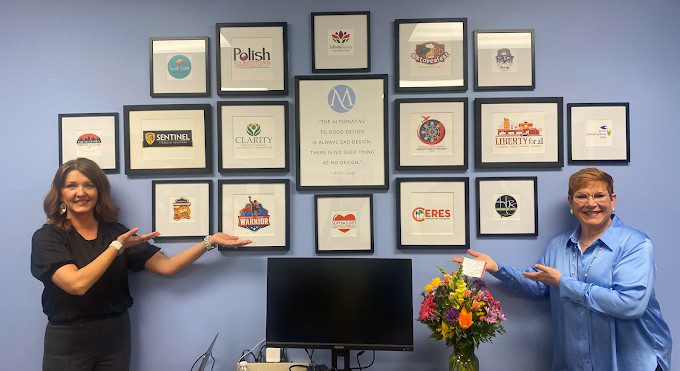
There are two ways to understand MARQUEE Creatives. The first is to read its list of services, a parade that moves from public relations to pop-up activations, from database management to event design, and may leave you wondering if a boutique agency has accidentally swallowed a marketing department. The second is to look at the wall in its Youngstown office. It is covered in framed logos - a brewery, an autism organization, a heritage festival, local businesses and causes. Suddenly the list makes sense. MARQUEE is not organized around a medium. It is organized around the problem that small, mission-heavy organizations tend to have: the story, the fundraiser, the website and the room full of guests all have to agree.
Aundréa Cika Heschmeyer founded the business in 2005 after returning home to the Youngstown area to raise her family and care for her mother. She had worked as a journalist in television, newspapers and magazines in South Dakota and Washington, D.C. Back home, freelance writing from her basement became consulting. Consulting became an agency. MARQUEE incorporated as an LLC in 2019.
That sequence matters. Journalism trained Heschmeyer to find the consequential detail. Youngstown taught her that a good idea still has to survive a tight budget. Nonprofit work taught the firm that the audience may be donor, volunteer, board member and beneficiary all at once. Event work made every promise physical. If the registration table jams or the room goes quiet, no brand guideline can save the evening.
The useful inconvenience of being hard to categorize
MARQUEE calls itself an experiential marketing agency. The phrase is broad enough to hold the work: branding, graphics, content, social media, advertising, SEO, websites, public relations, nonprofit development, fundraising, database systems, community engagement and full event production. Commercial clients hire it to become clearer and more visible. Nonprofits use it to connect communications with the machinery of development. Government buyers can procure design, outreach, exhibits, media production and event support.
The alternative is usually a collection of specialists - a PR shop here, an event planner there, a freelancer for the website - or an internal marketing hire expected to perform several occupations at once. MARQUEE's wager is that coordination is itself a product. It uses a network of affiliated professionals, which Heschmeyer described in 2025 as 13 people with more than 20 years of experience on average. The firm can assemble the disciplines a job needs without behaving like a high-volume agency.
This structure is not automatically better. A global product launch may require scale, round-the-clock capacity and offices MARQUEE does not claim to have. A company that wants anonymous production at commodity speed will probably dislike the required collaboration. The model works when the assignment is consequential, the audience is complicated and the client actually wants senior people close to the work. MARQUEE says it intentionally keeps a modest client roster. That is partly a cultural preference and partly capacity math.
“We don't want to be the biggest agency - just the one clients trust to tell their story with clarity, strategy, and soul.”Aundréa Cika Heschmeyer, founder and CEO
The first thing to fail was the easy pipeline
Small agencies rarely fail in cinematic fashion. A server does not explode. A designer does not flee with the Pantone book. More often, the pipeline simply gets quiet. Heschmeyer has written candidly about seasonal revenue, slow quarters and the pressure of building a creative business in an economically fragile city. In 2025 she said fresh business had tightened even while MARQUEE continued serving existing clients and pursuing state and federal opportunities.
Her response was striking for how unnovel it was. She called financial advisers. She reconnected with peers and former clients. She asked for help. She looked into bridge funding before it became urgent. In her telling, sometimes the sentence that reopened a door was simply, “I'd love to work together again.”
The changed mind here was about growth. MARQUEE did not need to become the largest agency in northeast Ohio. It needed a broader client mix, sharper pricing, sturdier infrastructure and access to buyers whose budgets did not rise and fall with one local season. That meant learning procurement.
Ohio Women Business Enterprise certification.
A $5,000 pitch grant for SEO and Google Ads.
A federal Junior Ranger book, won in a 20-offer competition.
SBA WOSB and EDWOSB approvals after a long application.
A small contract can be a large signal
In August 2024, the National Park Service awarded MARQUEE a $16,621 purchase order to design a digital Junior Ranger activity book for Nicodemus National Historic Site in Kansas. Nicodemus is the only remaining western town established by African Americans during Reconstruction. The assignment required children and teenagers to encounter that history through activities, not a lecture.
Twenty offers competed. The park superintendent said MARQUEE was selected for its educational-design expertise. The dollar value was modest by federal standards, but that is the wrong scale for reading the event. It was the firm's first federally funded creative project: proof that a Youngstown agency could translate community storytelling into the vocabulary, compliance and delivery demands of a national institution.
The cost of reaching that point was not just money. MARQUEE says its later federal WOSB and EDWOSB approvals took 556 days from application to acceptance. The Ohio APEX Accelerator at Youngstown State University helped the firm navigate the process. Certifications do not create skill, and they do not guarantee contracts. They make a qualified firm legible to a buying system. For an agency that had long been explaining why it did not fit neat boxes, legibility was valuable.
What the reader can borrow
MARQUEE's play is unusually copyable because none of it depends on a viral trick. Choose clients by the problem they share, not by the format you happen to sell. Turn adjacent skills into one coordinated offer. Treat certifications, vendor registrations and capability statements as market development, not clerical afterthoughts. Keep enough flexibility in the team to match specialists to the assignment. When demand softens, speak to people who already know the quality of your work.
The five moves hiding in plain sight
- Name the buyer you serve before listing everything you can make.
- Package coordination as part of the value, not invisible overhead.
- Build procurement credentials before a perfect bid appears.
- Use a first small contract as evidence for the next, larger one.
- Keep former clients close enough that an honest call is not awkward.
There are conditions attached. The breadth only works if someone can direct it; otherwise a full-service offer becomes a messy menu. Selectivity only works if pricing supports the attention promised. A contractor network only works with clear workflows. Public-sector work rewards patience, documentation and cash-flow planning - poor fits for a firm seeking fast, predictable sales. MARQUEE's method is not a shortcut. It is a decision to make patience operational.
The market is the mission, made purchasable
MARQUEE sits between several familiar categories: regional creative agency, event producer, nonprofit development consultant and government communications vendor. The overlap is the point. Its customers are often doing something meaningful but difficult to explain, fund or stage. The agency turns that mission into a brand people can recognize, a campaign they can answer, an event they can attend or a public deliverable they can use.
The company is now building more internal structure, mentoring its affiliated talent and formalizing a startup branding package for Mahoning Valley entrepreneurs. That package - logo, messaging, digital presence and story - sounds smaller than a government contract. It may be just as revealing. MARQUEE's instinct remains local even as its market grows national: make a good organization easier to understand, then give people a reason to join it.