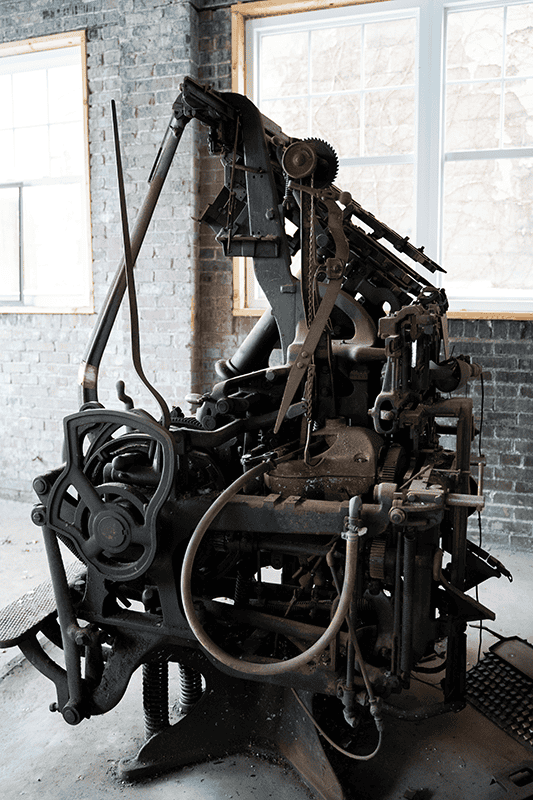
In downtown Erie, inside a brick building that has survived a flood, a fire and a long spell of vacancy, there is an old Linotype machine. It once helped a printing company turn hot metal into words. Kate & Co. plans to keep it in the lobby when the building becomes the agency's headquarters. This is almost too tidy a metaphor. A communications firm that began with data is moving into a place built for distribution. The machinery has changed. The problem has not: how do you make an idea travel?
Kate Philips knows the problem from the government side. Before she became an agency founder, she was a television reporter, worked on outreach for the 2000 Census in Maryland and served as a spokesperson for public officials including Pennsylvania Governor Ed Rendell. Her work involved budgets, legislation and the sort of policy detail that can vanish on contact with ordinary language. The experience became an operating insight: evidence is necessary, but evidence does not introduce itself.
The spreadsheet learns to speak
Philips and Nichole Parker founded Parker Philips in 2016 after seeing a gap in economic-impact analysis. Universities, nonprofits, companies and public bodies needed to know what they meant to a place in jobs, spending and tax activity. The firm could model those effects. More importantly, it could make the model intelligible in a report, at a podium or across a campaign.
That second part kept expanding. Research led to messaging. Messaging needed graphics. Graphics needed a website. A website needed social content, media outreach and somebody to keep a coalition moving in the same direction. After eight years, the company changed its name to Kate Philips & Co. and made strategic communications the headline. Economic-impact work remained in the toolkit, but no longer had to carry the whole identity.
This is what the company actually sells: not a logo in isolation, or a press release by the pound, but a sequence. Its staff spans public affairs, writing, research, brand strategy, graphic and web design, social media, video and project management. Clients can buy a focused project or a longer relationship. The fit is strongest when the assignment crosses disciplines and the audience must understand something before it will act.
The customer with a difficult sentence
Kate & Co.'s public portfolio looks eclectic until you notice the recurring customer: an organization with a complicated sentence to say. Children First needed a 40-year-old advocacy brand renamed and rebuilt without losing its accumulated trust. Infinite Erie needed a civic investment plan to feel like a shared project rather than a binder. An energy-choice campaign needed policy explained without making the reader feel trapped in a utility hearing. The Erie Community Foundation needed financials, donor paths and community stories to live inside one visual system.
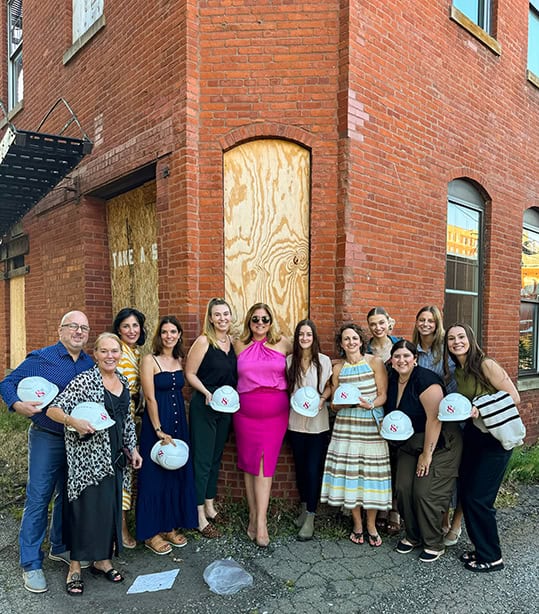
Education and public policy are especially revealing. Kristianna Del Grande, now a vice president at the firm, worked with Philips to launch Pre-K for PA in 2014. The campaign went on to help secure several hundred million dollars in state-budget funding for pre-kindergarten access. Kate & Co. also cites work supporting a new community college and campaigns around school funding, child care and lead exposure. These are not quick consumer conversions. They require repetition, coalition discipline and the patience to keep an argument recognizable for years.
That history is also the firm's competitive advantage. A conventional design shop can make a clean campaign. A research consultancy can defend a methodology. A public-relations firm can pitch a reporter. Kate & Co. tries to put those functions on the same table. The model works when each discipline sharpens the others. It becomes less distinctive when a client needs only cheap production, a giant paid-media buying operation or a highly specialized technical study with no public-facing component.
A headquarters as argument
In March 2025, the firm began renovating 111 West 11th Street with a pink wrecking ball. The 7,513-square-foot building dates to 1870 and once housed A-K-D Printing Company. Plans preserve the curved windows, exposed brick, iron fire escape and the Linotype, while adding offices, an in-house print shop, green space, a rooftop deck and a first-floor event venue. Avon Design Group and Spaulding Banks Project Management are partners on the work.

Pennsylvania announced an Enterprise Zone grant in December 2025 to support the headquarters renovation, job creation and public-space improvements. It is support for the building project, not venture funding for the agency.
The move is practical - more room, more production capability, more places to meet - but it also says what the rebrand said. Kate & Co. does not want to be a remote supplier of anonymous deliverables. It wants to be an institution with a visible address, a room for gathering and a stake in Erie's next chapter. The building is content, workplace and civic claim at once.
The part worth copying
The useful lesson is not to rename an agency after its chief executive or to buy a picturesque ruin. It is to watch the work for clues. Parker Philips learned that clients did not merely want a calculation. They wanted the calculation interpreted, designed, distributed and defended. The company reorganized its identity around that demand.
A portable version of the Kate & Co. method
- Define the decision, not merely the deliverable. A website is rarely the final problem.
- Put research before language, then make one person accountable for keeping the language plain.
- Build a small cross-functional team around the assignment instead of handing it down a production line.
- Design the evidence for the place it will be used: a budget hearing, phone screen, donor meeting or newsroom.
- Stay close enough to implementation to learn what the strategy missed.
There are conditions. This approach depends on access to decision-makers, a client willing to share real information and enough time for research to affect the answer. It struggles when leadership wants decoration after every important choice has already been made. It also asks a boutique team to protect focus while serving many kinds of organizations. Breadth is useful only if somebody keeps the argument coherent.
The Linotype in the lobby offers the neat closing thought. Its genius was not that it created language. People did that. The machine made language reproducible at speed. Kate & Co.'s modern version is a mix of research models, designers, policy veterans, social calendars and media judgment. The equipment is different. The job is still to take a complicated thought, give it form and send it into the world before the moment passes.