The first thing Kimberly Kane learned about public relations came from the news business: people rarely call a reporter when everything is simple. They call when a hospital has a new treatment, a government has a frightened public, a company has a confused workforce, or a leader has managed to acquire both a microphone and a problem. Kane spent 15 years in television news, much of it at Milwaukee's TMJ4. Then, in 2013, she started a communications firm in her basement. She carried over the reporter's least glamorous tool - the habit of asking one more question.
That habit became the central bet of Kane Communications Group. The Milwaukee agency does the familiar things: public relations, branding, marketing, paid media, video, social, crisis response. But its pitch is arranged in a less familiar order. First, identify the business problem. Then listen to employees, customers and stakeholders. Then define what should change. Only after that does anyone reach for the campaign concept.
The quiet product is not publicity. It is agreement about what the organization is doing, why it matters and whether anyone can prove it.

The slogan arrives last
Consider Indigenous Pact, a Native-owned healthcare organization with a growing remote-first workforce. Kane and HR consultancy Humani did not begin with swag or a chirpy employee newsletter. They integrated human-resources and internal-communications strategy, sharpened how decisions were explained, and created a recognition program with monthly peer nominations. A meeting series was improved. A framework was built to show how teams depended on one another.
points of employee net promoter score improvement. Recognition reached 84% of staff, and 98% said they planned to stay at least another year.
The numbers are client-reported results, not a laboratory experiment. They still reveal Kane's preferred unit of work. An advertisement is a deliverable. A clearer organization is an outcome. If employees do not understand how decisions are made, a prettier intranet is simply confusion with better typography.
The first failure was targeting everyone
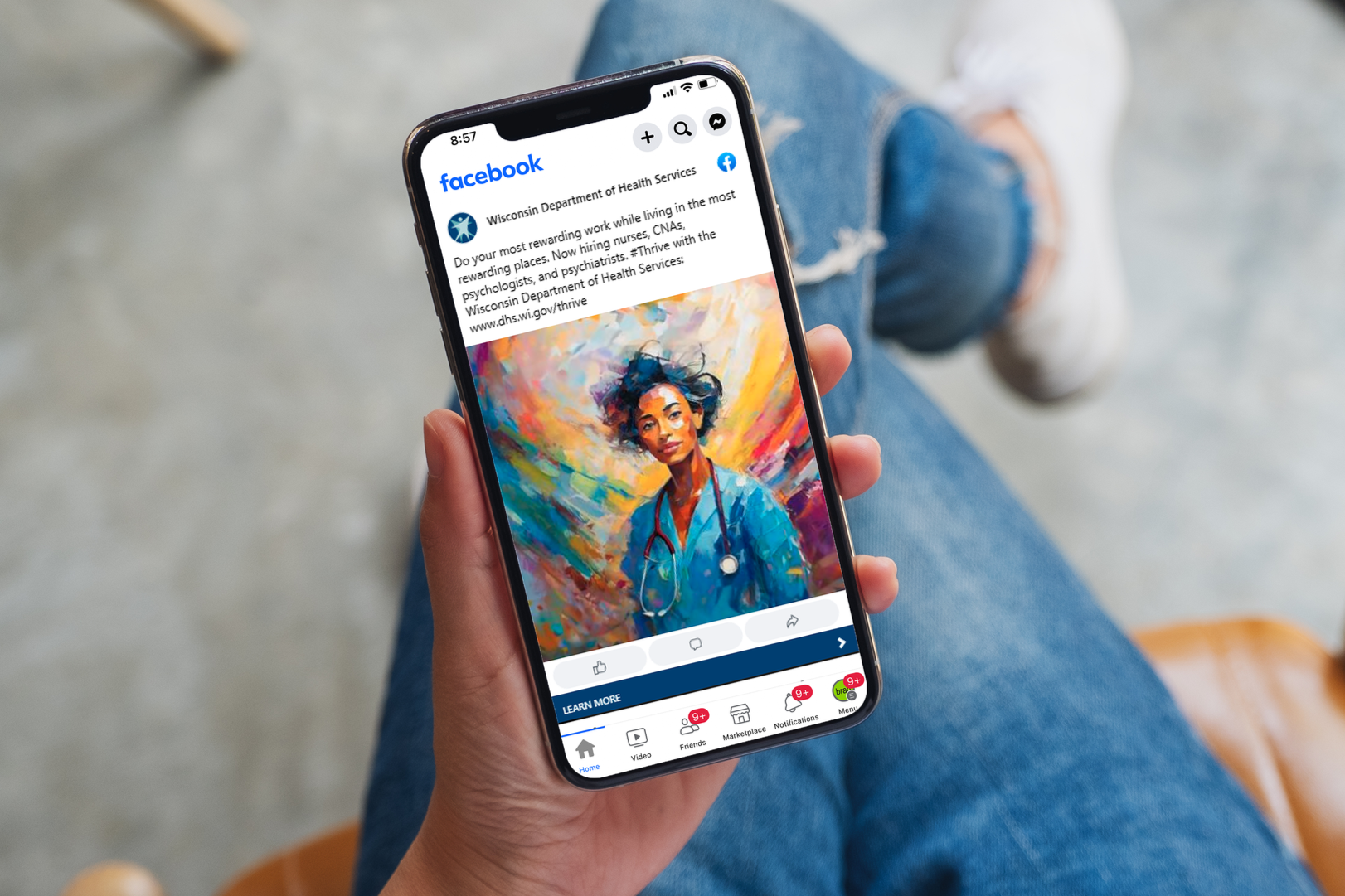
In 2024, Wisconsin's Division of Care and Treatment Services had more than 400 open clinical jobs across seven facilities. Earlier recruiting lacked defined candidate profiles and useful campaign tracking. This is the kind of sentence agency case studies often hurry past. It is also the entire plot. If you do not know whom you need or what they respond to, buying more attention merely makes the uncertainty expensive.
Kane researched the audience and ran a three-month campaign aimed at nurses, social workers and psychologists in Wisconsin and five neighboring states. The media mix included LinkedIn, story-style social ads and display advertising. It generated 2,832,422 impressions, 38,045 clicks and 197 applications, including 57 from registered nurses. The reported click-through rate was 1.34%, about 19 times the benchmark used in the case study.
Find the friction
Audit the current state. Interview the people living with the problem. Define the business objective in plain language.
Change the conditions
Bring leadership, operations and culture into the same frame. Decide what the organization can honestly promise.
Earn the audience
Choose media, creative and messengers only after the story has evidence and a way to measure movement.
This is the part another organization can copy without hiring Kane: write the outcome before the content. Name the audience narrowly enough to exclude somebody. Set a baseline. Interview the people closest to the issue. Decide what operational change must accompany the message. Then choose channels. The method sounds obvious because good methods often do after somebody has done the difficult thinking.
A purpose claim with an audit trail
Kane calls itself purpose-driven, a phrase stretched nearly transparent by corporate use. Its more persuasive choice was to submit the phrase to outside checks. The company became a certified B Corporation in 2022 with a published impact score of 97.2, above the 80-point certification threshold. It is certified as a Women's Business Enterprise and Disadvantaged Business Enterprise, and it participates in the United Nations Global Compact.
The agency also created its own research product. In 2021, Kane surveyed a random sample of 980 working women in Wisconsin, then held listening sessions with more than two dozen women before forming employer recommendations. Half of respondents were considering leaving their jobs; the leading reason was feeling undervalued. The finding gave Kane a useful piece of thought leadership. More importantly, it made the firm's advice to employers harder to reduce to taste.
None of these credentials makes every campaign wise. They do make the firm's positioning unusually testable. Kane's alternative is the agency that sells a creative idea, the crisis specialist called after the smoke appears, or the internal team that knows the institution but cannot challenge its habits. Kane tries to combine all three roles: outsider, operator and translator.
What the invoice can and cannot tell you
Kane does not publish a rate card, and the price of a logo cannot be sensibly compared with a multiyear public campaign that includes research, creative and media. Public records offer scale, not a menu. A Milwaukee Public Schools integrated-communications contract was capped at $450,000 across three years. A Milwaukee County behavioral-health engagement was listed at $100,000, followed by a request for an additional $30,000. Those totals describe particular scopes and may include far more than agency labor.
- Business model
- Project fees and retainers for research, counsel, creative, public relations, marketing, media and embedded support.
- Typical buyer
- Executives, boards, communications leaders, public agencies, nonprofits and HR teams with a reputation or alignment problem.
- Where it fits
- Between a strategic consultancy and an integrated agency, with special depth in public affairs, internal communications and corporate citizenship.
There is a boundary to the model. Research only helps when leaders will hear unwelcome findings. Internal alignment requires access to employees and decision-makers. Measurement requires a baseline and enough time for results to appear. If an organization wants a burst of attention without operational change, Kane's premise becomes an inconvenience. The message cannot outrun the truth forever.
The Green Bay move
In 2023, Kane acquired Leonard & Finco, a Green Bay public-relations firm with more than three decades of regional experience. The price was not disclosed. The logic was. Leonard & Finco brought relationships and public-affairs depth; Kane brought broader creative, marketing, video, sustainability and corporate-citizenship capabilities. Susan Finco stayed on the leadership team. Two former broadcast journalists had chosen combination over competition.
By 2025, Kane said the agency had roughly 30 employees and ambitions to expand through acquisitions, operate in multiple states and serve global clients. It had already been named to the 2021 Inc. 5000 and, in 2025, was selected by the U.S. Chamber of Commerce as a CO-100 Champion of Adaptability. The footprint now runs through Milwaukee, Green Bay and Geneva.
The growth matters less than the constraint it creates. A small founder-led firm can insist on asking the extra question because the founder is nearby. A larger firm must turn curiosity into process. Kane's future will depend on whether “research first” remains a working discipline after it becomes a selling line. Every agency eventually faces this little irony: it must live the brand strategy it recommends to everybody else.