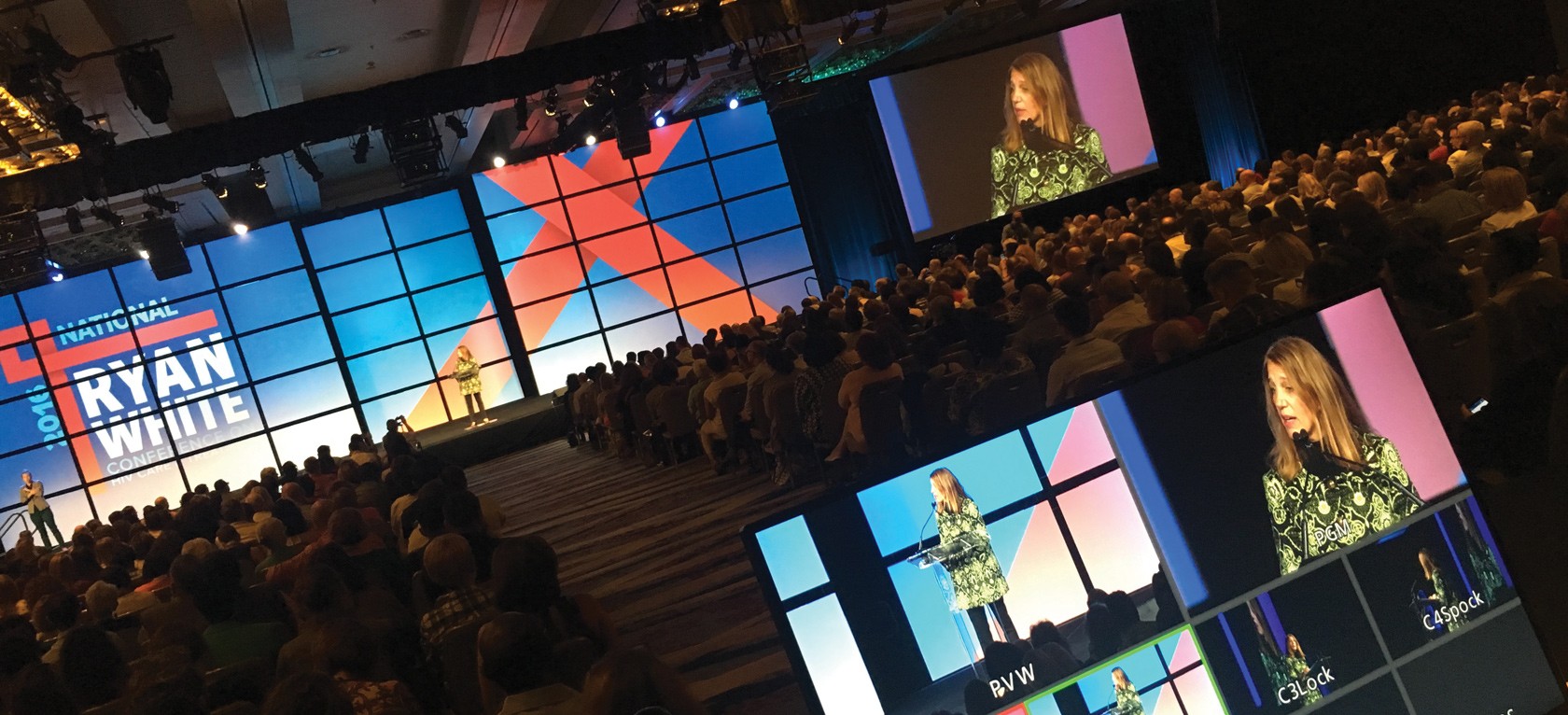
The first thing to fail was the room. In 2020, the National Ryan White Conference on HIV Care and Treatment was meant to gather thousands of people in the familiar way: plenaries, corridors, breakout rooms, seven hotels' worth of sleeping arrangements, and the useful collisions that happen near bad coffee. Then the pandemic made proximity a hazard. The venue did not merely close. The organizing assumption beneath the event vanished.
For Leonard Resource Group, the Washington communications and events firm known as LRG, this was a peculiar test. Its job was not to invent a catchy substitute for a conference. Its job was to preserve what the conference did: move technical knowledge among doctors, administrators, advocates, and people living with HIV; manage hundreds of sessions; make the material accessible; and allow a federal program to keep talking to the people it served.
LRG rebuilt the gathering online in about three months. More than 300 educational breakouts were prerecorded. A live studio handled plenary speakers. Registration, a conference website, branding, social channels, a mobile app, continuing education, and speaker coordination all had to become parts of one digital machine. More than 5,000 people attended. At peak periods, nearly 8,000 users were logged in. A conference accustomed to roughly 4,000 attendees lost its physical room and found a larger one.
The product hiding inside the service
A communications firm that behaves like an operating system
The ordinary description of LRG is accurate and not very revealing. It is a strategic communications, outreach, event-management, design, and organizational-development company. It serves federal agencies, nonprofits, associations, and a smaller group of private organizations. It makes websites and videos. It plans conferences. It designs reports. It runs campaigns. It helps manage associations.
The more useful description is that LRG handles handoffs. A policy expert has knowledge. A federal program has rules. A designer has a visual system. A speaker has twelve minutes. An attendee needs captions, a hotel, a registration confirmation, or a functioning link. Most public engagement fails in the space between those facts. LRG sells coordination across that space.
That is why its service list appears unusually broad. Outreach informs the message. The message informs the program. The program shapes the website and registration flow. The audience determines accessibility, travel, and production choices. The event generates publications, video, follow-up, and another cycle of outreach. A client can hire a separate agency for each step. LRG's proposition is that one team, close to the mission, will lose less meaning between them.
The engagement loop
Small firm, large rooms
The scale is in the coordination
LRG began in 1996 with one contract and three employees. Today LinkedIn places it in the 11-to-50-person range, and company data lists 27 people. The firm says it has supported more than 150 organizations from offices in Washington, Seattle, and Canton, Ohio. This is not the staffing profile one imagines behind a national conference with hundreds of sessions. It works because the core team is less a standing army than a practiced command post, combining its own producers, writers, designers, and strategists with venues, audiovisual crews, platform vendors, and subject experts.
Its client list makes the pattern visible: HHS and its Health Resources and Services Administration, USDA, EPA, USAID, the Federal Housing Finance Agency, Ginnie Mae, AmeriCorps, and the Association of Defense Communities. These institutions do not suffer from a shortage of important material. They suffer from important material arriving in difficult forms - a 100-page accountability report, a national advisory meeting, a public-health curriculum, a room full of military and civic leaders.
Consider the first SNAP Employment and Training National Forum. It was planned as an in-person event, then pushed online by COVID-19. LRG developed the site, managed proposals and logistics, created the event identity, prerecorded 20 breakouts, and ran 15 live discussions. The anticipated audience was 400. More than 1,000 attended. The technology mattered, but the consequential choice was to treat the virtual format as a new program rather than a livestream of the old one.
The same integration shows up in quieter work. For four consecutive years, LRG designed the Federal Housing Finance Agency's Performance and Accountability Report. The assignment involved turning annual data into intelligible graphics, laying out more than 100 pages on tight deadlines, and ensuring Section 508 accessibility. There is no applause when a screen reader navigates a table correctly. That is precisely the point.
The business underneath
Federal patience, creative speed
LRG is a privately held professional-services business. It earns fees through projects, contracts, task orders, and long purchasing vehicles such as the GSA Multiple Award Schedule. It is certified as a small and HUBZone business, credentials that matter in federal procurement. Public award records show the range: a 2024 HRSA meeting-support order worth roughly $1.48 million; a 2025 Ryan White conference-services award reported at $2.82 million; and a 2026 USDA blanket purchase agreement with a $20 million ceiling for conference support through 2031.
A ceiling is permission to order, not a promise to spend. That distinction explains why procurement numbers should not be mistaken for revenue. It also illuminates the economics. Buyers are paying not just for artifacts but for capacity held ready: people who can negotiate a venue, rebuild a schedule, brief a speaker, fix a registration flow, and deliver compliant materials without relearning the institution each time.
Long relationships are therefore more valuable than isolated projects. LRG has managed as many as 15 events a year for the Association of Defense Communities while also providing organizational management, daily news, publications, design, video, and communications. It says the association's reach more than doubled under its management. The Installation Innovation Forum, another part of that relationship, grew more than 65 percent and reached 800 attendees across more than 75 sessions in 2022.
This is where LRG differs from a conventional PR shop. A PR agency may stop at attention. An event producer may stop when the lights come up. A design studio may stop at delivery. LRG's advantage is continuity across all three. Its disadvantage is the mirror image: breadth can become expensive or unnecessary when a client needs only a logo, a press release, or a simple local gathering.
A method worth borrowing
Design the failure before you design the spectacle
The pandemic changed LRG's mind about what counted as a venue. Before 2020, virtual capability could sit beside event production. After the first cancellations, it had to move inside the production model. The lesson was not that every gathering belongs online. It was that format is a variable, while audience, purpose, accessibility, and content are constants.
Five moves a smaller team can copy
- Map every handoff, not merely every deliverable.
- Give one owner responsibility for the audience journey from invitation through follow-up.
- Build accessibility into production, instead of inspecting for it at the end.
- Separate the mission of the gathering from its format, so the room can change.
- Measure participation and usefulness, not just polish.
These moves work when the organization has a clear purpose, decision-makers who can act quickly, and enough trust to let one team coordinate across departments. They work especially well for repeat programs, where each event teaches the next. They work poorly when approvals are fragmented, the audience is undefined, or a buyer splits every responsibility among vendors that cannot share information. They are also excessive for a modest gathering whose risks are genuinely modest.
The charming thing about LRG is that its portfolio contains glamour - cabinet-level speakers, huge stages, documentary shoots - but its real expertise is administrative empathy. Someone has to imagine the person who cannot open the PDF, the presenter who has never faced a camera, the attendee who missed the email, and the public servant who must defend every line of the budget. Then someone has to fix those problems before they become visible.
A room, after all, is only a technology for gathering attention. LRG's 2020 test was to lose that technology without losing the gathering. The audience grew. The sessions happened. The public work continued. Behind it sat hundreds of small, owned handoffs - the kind of details almost nobody remembers when they work.