Brian Butler once had less than a minute to explain a complicated matter to the president of the United States. The president was boarding Marine One. The rotors, the schedule and the office itself were all making the same demand: get to the point. Butler gave the update. Years later, when he described the encounter, the lesson was less about proximity to power than the discipline of being useful around it. At the White House, he learned to be succinct and accurate because a long memo does not become more persuasive merely by arriving in a thicker folder.
It is tempting to make that minute the grand key to his career. Butler has had a career that invites brass plaques: 22 years as an Army officer, work for an Army secretary and the chairman of the Joint Chiefs of Staff, strategic counsel at U.S. Central Command, a policy role on the Homeland Security Council. Yet his second act began without ceremony. When military life ended, civilian employment did not politely salute and open the door. He had to start again.
In 2007, he founded Vistra Communications as a one-person operation from home. The business now approaches 100 employees, works from the Tampa Bay area and Northern Virginia, and serves government, corporate and nonprofit clients. Its assignments span marketing, public relations, research, consulting and the complicated middle ground where those disciplines collide. Butler built it in Lutz, north of Tampa, far from the polished shorthand of Washington. The work was still communication. The stakes had changed, and so had the room.
The resetThe résumé was impressive. The transition was not easy.
Military careers are full of visible structure: rank, mission, chain of command, the next post. Entrepreneurship supplies none of those things unless the founder makes them. Butler had been trained to enter uncertain situations, gather information and move a team toward an objective. Starting Vistra asked him to use the same muscles without the uniform or the institution behind him. There was no communications staff waiting for direction. At first, the staff was Brian.
The determination had older roots. Butler grew up in Riviera Beach, Florida, in a middle-class family that paired ambition with obligation. His mother had joined the March on Washington in 1963 and regarded education as an equalizer. His parents pushed their children to dream big and act at the same scale. Years later, when Butler told his mother he had prayed about starting a business, she recommended that he pray again, “and this time listen.” It is excellent maternal advice and a fairly brutal second round of due diligence.
The change also required a fresh measure of humility. A decorated career and senior assignments could establish credibility, but they could not substitute for winning the next client, paying the next invoice or figuring out what a civilian customer actually needed. Butler learned the grammar of business one relationship at a time. He assembled the name Vistra from three working words: vision, strategy and action. Its enduring motto is plain enough to fit on an index card: “We succeed when our clients succeed.” It contains no fireworks. It does contain a useful constraint. The agency is not the hero of a client's story. It has work to do.
One discipline, three rooms
Listening became the bridge. In a 2025 conversation about leadership, Butler described active listening as central to the business. This sounds almost comically obvious for a communications company, in the way that fresh ingredients sound obvious for a restaurant. Obvious things become distinctive when someone practices them reliably. Clients often know more about the contours of their problem than an outsider does. The consultant's first job is to hear the knowledge hidden beneath the request.
“We succeed when our clients succeed.”Brian Butler's operating line at Vistra
The long tableRelationships are part of the operating system
Butler talks about relationships with the seriousness other executives reserve for quarterly forecasts. His public life supports the point. He has served on business, public-media, veteran and regional boards. He chaired the Tampa Bay Chamber in 2023. He helped create a fellowship intended to prepare more diverse professionals for nonprofit board service. More than 30 percent of Vistra's staff have served in the military. None of these connections looks accidental. Together, they form a working theory: communities become more capable when people who normally occupy separate rooms are given a reason to meet.
That theory matters in a communications company. Vistra works across federal agencies, companies and nonprofits, institutions that often use the same words while meaning very different things. Butler's value is partly translation. He understands the tempo of a command staff, the scrutiny around public work and the commercial reality that a good idea still needs a buyer. His Army career took him to more than 60 countries. The travel adds range, but his instinct remains local: understand the people in front of you before reaching for the microphone.
There is a dry wit under the careful phrasing. During a 2019 interview, after being reminded that Vistra had finished the previous year around $12 million in revenue, Butler was asked where he expected the next year to land. “In the Black!” he replied. Three words, one exclamation point, no hostage situation involving a spreadsheet. A person can spend decades mastering concise communication and still enjoy the joke.
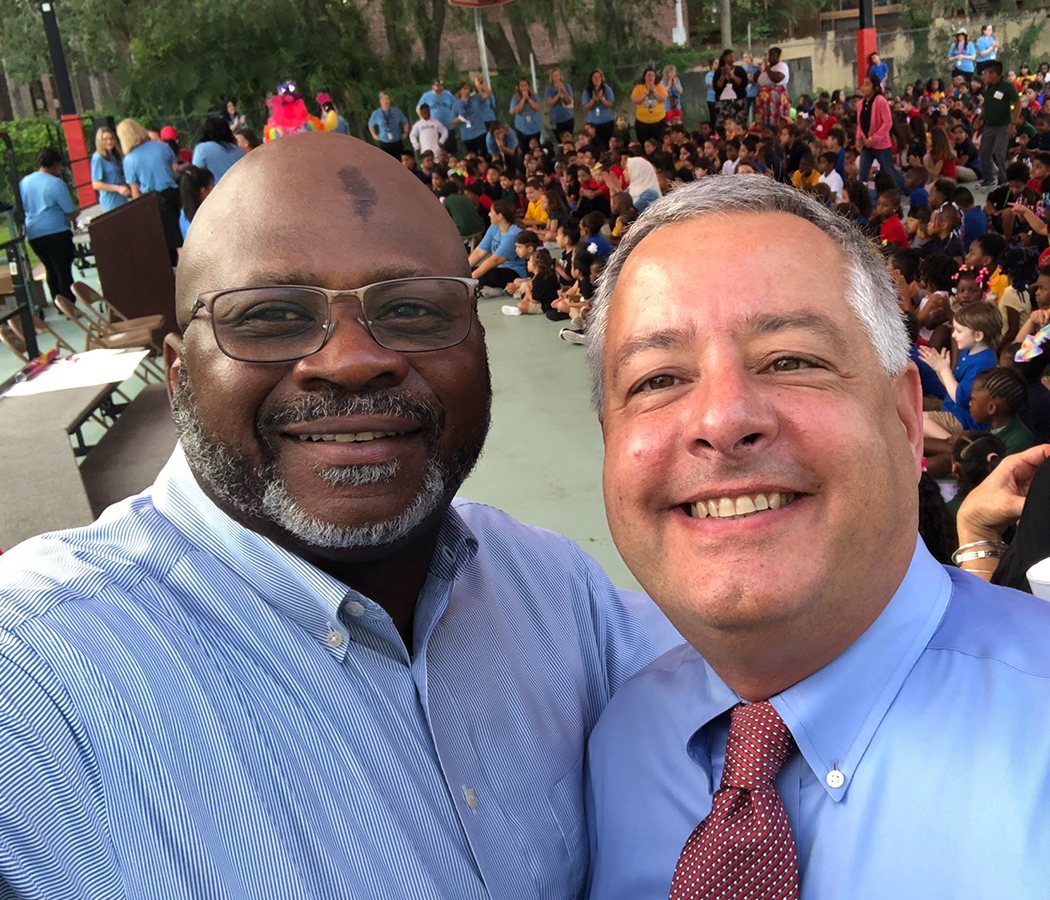
One day of changeA school lunch line became a leadership laboratory
The clearest example of Butler's relationship theory did not begin in a boardroom. It began at Mort Elementary School. His commitment to supporting the school led him to spend a full day alongside its principal, Woodland Johnson. He taught. He planned. He served lunch. The duties were ordinary, which was precisely their value. A school looks different from inside the timetable than it does from the stage at a fundraiser.
Butler left with a challenge for his peers: give a public elementary school an entire day. In 2019, the idea became CEOs in Schools. The following year, Vistra joined with the Hillsborough Education Foundation to carry it forward in partnership with Hillsborough County Public Schools. Nearly 150 Tampa Bay executives now enter elementary schools each year, shadowing principals, meeting students and seeing both the small triumphs and stubborn constraints of public education.
The duration is clever. An hour allows a visitor to be charming. A day makes charm compete with the lunch schedule. Leaders encounter the rhythm of the place, not merely its prepared presentation. They can ask better questions because they have seen where a question lands. The schools gain relationships with people who control budgets, networks and attention. The executives gain something rarer: a firsthand view of the system preparing their future workforce.
This is Butler's communications philosophy made physical. Before proposing the message, enter the situation. Before announcing concern, learn the names. Before suggesting what a principal ought to do, follow the principal for a day. Proximity is not a policy, but it is a better beginning than abstraction.
Army leadership, public affairs and senior communications assignments.
A one-person operation starts the long civilian build.
One immersive day becomes an annual regional initiative.
Butler leads the Tampa Bay Chamber board for the year.
Regional influence follows years of business and civic work.
The second actService, translated rather than retired
Butler's career can look like a sequence of impressive settings: Pentagon, White House, CENTCOM, agency, chamber. The more revealing continuity is service. The noun stayed put while the job titles changed around it. In uniform, service meant the mission and the people responsible for it. At Vistra, it means helping a client reach a goal and creating a workplace where veterans can translate hard-won abilities into civilian value. In the schools program, it means asking executives to lend their attention before lending their advice.
Recognition has followed. Butler has been included in the Tampa Bay Business Journal's Power 100 for six consecutive years through 2026. He was named the Tampa Bay Chamber's Outstanding Leader of the Year in 2018 and has received honors tied to both business and veteran service. The awards describe reach. They do not explain method.
Method is quieter. It is the pause that lets another person finish. It is the edit that takes a briefing from five minutes to one. It is the decision to turn a useful day at one school into an invitation for 149 other leaders. It is a company motto that gives the success away to the client. These habits are not glamorous, but glamour is a poor substitute for repeat business.
In March 2026, Butler returned to Hampton University, his alma mater, to moderate a forum for young men about leadership, networks, ethics and professional readiness. The scene completed a neat circle. A student who had entered the Army through ROTC came back as a veteran, founder and civic leader to ask questions of the next generation. Moderators know an important secret: the conversation improves when the person with the microphone does not use all the oxygen.
The short briefing and the long relationship ask for the same thing: respect for another person's time.The Butler method
Brian Butler built his second career in an industry famous for messages. His sharper contribution may be attention. He listened to clients closely enough to build a broad firm around their real problems. He listened to a principal closely enough to redesign how local executives encounter schools. He listened to his own difficult transition closely enough to make room for other veterans at Vistra.
A minute beside Marine One taught him what must be removed. A day at Mort Elementary taught him what must not be rushed. Between those two clocks sits the work: clear words, durable institutions and the modest confidence to hear the answer before offering one.