Give someone a useful report and an awkward thing happens. They ask for another. Then a different breakdown. Then the same figures for a different region, please, and could someone make them available before the meeting? Mark LaRow understood this appetite long before AI conversation windows became a familiar software feature. Information, once tasted, tends to spoil the appetite for waiting.
In a piece about enterprise reporting, LaRow proposed a small mathematical ambush. Take a data mart with five dimensions, ten attributes in each, ten metric areas and twenty metrics per area. Even restricting the user to a simple report with two attributes and two metrics produces 1.9 million possible reports. A modest request has become a staffing problem with excellent arithmetic.
His answer was to change how people obtained information. Across a career in technical consulting, business intelligence, mobile applications and identity software, he has returned to that practical question. How much machinery should a person have to understand before getting an answer? The products have changed. The argument has proved rather durable.
A long apprenticeship in other people’s problems
LaRow studied electrical engineering and computer science at MIT, earning bachelor’s and master’s degrees. His subsequent career included seventeen years at Ernst & Young, where he became a partner responsible for technical consulting across the eastern United States. That is a long stretch spent working inside the gap between what an organization wants and what its systems can actually deliver.
He then spent fourteen years at MicroStrategy. His responsibilities eventually included product strategy, product marketing and competitive intelligence as executive vice president of products. These are jobs with different demands: decide what the software should do, explain why someone should buy it, and understand what the other vendors are promising. A product executive has to keep all three conversations recognizably about the same product.
There is a useful continuity here. Consulting puts the customer’s particular predicament in front of you. Product work asks whether enough customers share that predicament to justify building something repeatable. LaRow’s public explanations often begin at the point where an ordinary task becomes unnecessarily difficult. The report backlog was one example. The crowded dashboard would become another.
Possible report combinations in LaRow’s deliberately modest data-mart example. A thought experiment, not a customer usage figure.
Twelve reports walk into a dashboard
In 2007, LaRow described a dashboard that could stand in for twelve to fifteen separate reports. The important feature was movement: users could change views within the dashboard rather than leave it to open another document. His concern was the reader’s attention as much as the quantity of data. A useful interface should let someone follow a question while it is still in mind.
It is easy to forget how much office software once depended on accepting the document you were given. A report arrived with its columns already chosen. A new question often meant another request. LaRow was arguing for an interface that let the user continue the investigation. The software would handle more of the preparation; the reader could spend more time considering the result.
He was equally plain about what could go wrong underneath. Discussing a Texas transportation data system in 2010, he emphasized the central role of the data itself. The observation sounds almost too obvious to print. Yet the expensive interface still depends on the less photogenic work of making the underlying records clean and consistent.
“With all BI systems, the core component is data.”
Mark LaRow, 2010
That insistence gives his later work a longer history. Before he became associated with Verato, he was already describing the quality of the inputs as the obstacle. A chart can make a disagreement attractive. Resolving the disagreement requires attention elsewhere. For someone selling analytical software, this is a refreshingly inconvenient thing to admit.
The phone refuses to be a tiny desktop
Then the screen shrank. In March 2010, speaking during a Canadian product road show, LaRow challenged the habit of delivering conventional business intelligence reports on smartphones. The familiar grids and graphs had been designed around a different device. Moving them into a smaller rectangle did little to address how someone would actually use a phone.
“What people really want on these devices is not a Web browser experience,” he said. He argued for applications built around the iPhone’s own way of working. MicroStrategy was developing technology to help customers create those applications. His product argument began with a person holding a device, rather than a report looking for somewhere else to appear.
The distinction was practical. A person checking a figure between appointments has a different amount of attention available from someone seated at a desk. The interface has to acknowledge that. LaRow’s earlier writing about mobile business intelligence had made the case for taking useful information beyond the office. Now he was arguing about the shape it should take when it arrived.
Seen together, the dashboard and the phone reveal a recurring design interest: remove the work that interrupts the question. Let the user change a view without starting again. Let the application fit the device already in the user’s hand. These are modest sounding improvements. Anyone who has tried to read a desktop report on a phone can appreciate their ambition.
An editorial map of LaRow’s work, rather than a product architecture.
Before the answer, identify the person
Identity was already part of LaRow’s product vocabulary at MicroStrategy. In 2014, he discussed Usher, the company’s identity technology, and how a phone could help confirm who was making a transaction. That work placed the individual, rather than only the business report, at the center of the software conversation.
His writing about MicroStrategy Gateway for Facebook explored a related translation problem. Facebook organized information through a social graph. Enterprises commonly worked with relational databases and established internal controls. Gateway was presented as a way to bring those worlds together, allowing organizations to work with social information through familiar database tools. Different systems had different assumptions; someone had to make the connection usable.
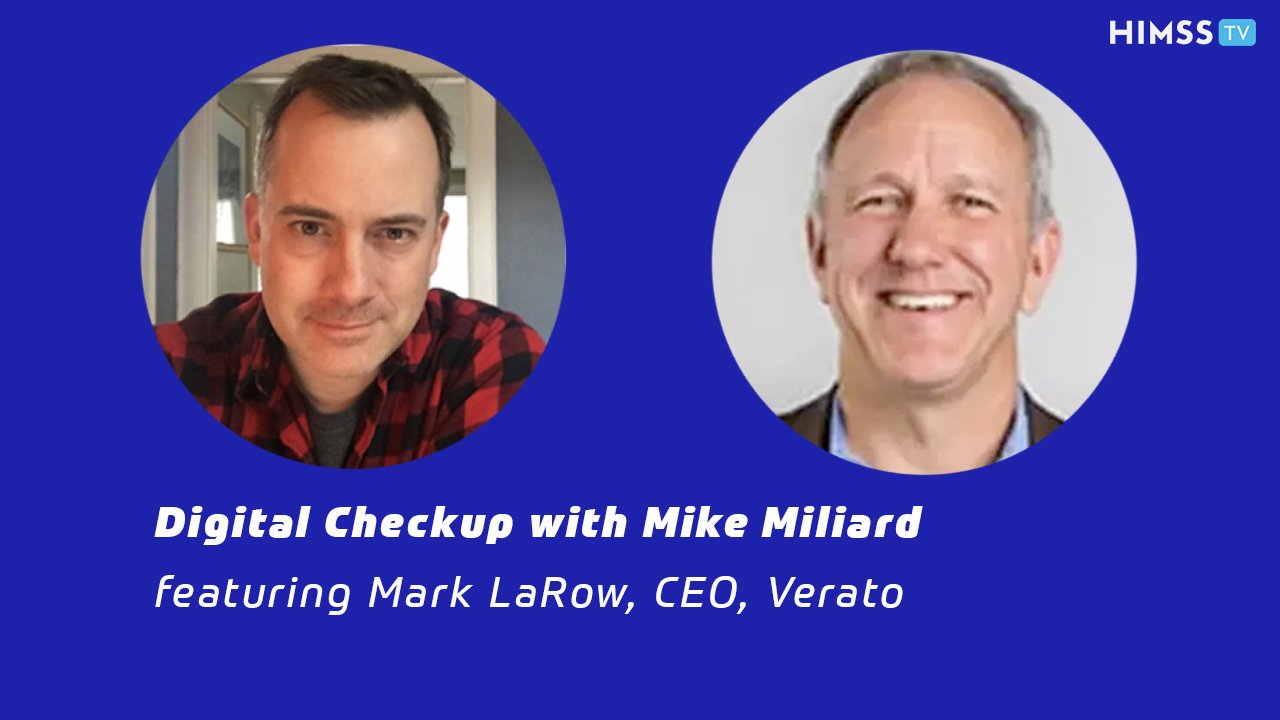
In January 2015, LaRow became CEO of the company that would be known as Verato. It was then called Araxid. He arrived with substantial experience of enterprise software and the work of explaining it. The company had an identity-matching technology to bring to market. LaRow’s role was to help turn that technical proposition into an operating business.
The scale was considerably smaller than his previous employer’s. After a $12.5 million financing round, he described plans to grow Araxid from twenty employees to about thirty-five during 2015, chiefly by adding technical staff. There is something clarifying about those numbers. At that size, adding fifteen people changes the organization. A hiring plan is also a plan for what the company will be capable of doing.
The business gets bigger; the question stays small
Verato’s business centered on determining when records in different systems belonged to the same individual. Names change. Addresses become old addresses. Different databases can describe the same person differently. Referential matching uses a separate reference resource to help connect those descriptions. The promise depends on resolving the ordinary untidiness that people introduce simply by living their lives.
Under LaRow’s first period as CEO, the company raised another $12.5 million in 2017 and $10 million in 2019. Bessemer Venture Partners and Columbia Capital led those rounds. By 2019, the investor group also included Blue Heron Capital and the California Health Care Foundation. These were company financings, not measures of LaRow’s personal wealth.
In 2021, the company announced a planned change of leadership. Clay Ritchey would become CEO effective April 30; LaRow would move to the board. The retirement plan had been in place since autumn 2019. At the handover, investor Kent Bennett credited LaRow’s leadership while reporting annualized company growth above fifty percent over the preceding three years.
LaRow described himself as proud of the company’s growth and confident about the team’s future. The statement’s emphasis was on an organization able to continue. Today, Verato’s leadership page again lists him as CEO, alongside his board position. His career at the company now includes both the earlier handover and the current executive role.
Wood, football, and the unfinished question
Away from software, LaRow’s stated interests include woodworking and FC Barcelona. Neither needs to be turned into a secret explanation for his career. A hobby is allowed to remain a hobby. Still, after so much talk about databases and product strategy, it is agreeable to encounter someone who also likes making things that do not require a password.
His working life offers its own sufficient through line. Reports multiplied. Dashboards needed to respond. Phones demanded applications that respected their size. Identity systems had to reconcile the several versions of a person stored in different places. Each chapter brought a technical problem close enough to recognize as a human inconvenience.
LaRow has spent decades working on that distance between information existing and information being useful. There is always another system, another screen, another record to reconcile. The simple answer remains a demanding product to build.
Keep following the question
Writing, conversations and the career record.
Mark LaRow on LinkedIn ↗Verato leadership ↗LaRow’s writing on mobile business intelligence ↗His essay on Facebook data and enterprise tools ↗The 2010 mobile software conversation ↗The 2021 leadership handover ↗