David Schmaier arrived at Dreamforce in 2013 with an acquisition in mind. He had been following Veeva, which built software for a particular industry on Salesforce’s platform. Somewhere among the exhibitors, he thought, there ought to be another company worth buying. A conference floor is an expensive place to discover that your shopping list is imaginary.
He found plenty of applications. What he could not find was the industry software business he had come looking for. After roughly an hour, he left San Francisco’s Moscone Center and called Craig Ramsey, a former colleague and Veeva co-founder. The opportunity, he had decided, would have to be built.
Ramsey was interested. Discussions with Mark Armenante, Young Sohn and James Ramsey followed. In March 2014, Vlocity was founded. The idea was to develop applications for industries such as communications, insurance and government, using Salesforce as the foundation. Schmaier had gone shopping for a business and returned with the obligation to start one.
That beginning explains something about the career that followed. Schmaier’s attention goes to the distance between what a general software platform can do and what a particular customer actually needs. A platform can be capable, widely used and full of applications while still leaving an awkward gap. He had spent enough time in enterprise software to recognize the shape of it.
An engineer learns the customer’s vocabulary
His training began in mechanical engineering at Rensselaer Polytechnic Institute, followed by an MBA at Harvard Business School. The combination gave him two professional languages: how things work, and why somebody might pay for them. Enterprise software would provide a long opportunity to practice both.
At Oracle in the late 1980s, he met Marc Benioff and Tom Siebel. Those working relationships would recur across his career. He later described himself as having spent most of his professional life on products. The people around those products changed companies; the conversations about customers continued.
He joined the founding executive team at Siebel Systems. Over a twelve-year tenure, his responsibilities included products, marketing and alliances. That is a useful combination for someone building business applications: deciding what a product does, explaining it to buyers and arranging the relationships that help it reach them.
By 2007, he was on Genstar Capital’s Strategic Advisory Board. His work there extended the interest in specialized software beyond a single operating company. He also served on TravelClick’s board. When Genstar announced the hotel software company’s sale for $930 million in 2014, it specifically thanked Schmaier and fellow advisory board member Bob Dowdell for their contribution.
The hotel business offers a plain explanation of why specialization matters. Selling a room involves reservations, availability and distribution. Those details shape the work. A useful application must accommodate them. The appeal of industry software is that the buyer does not have to begin by translating the business into terms the software understands.
“who is the customer?”
David Schmaier, recalling Harvard Business School
Let somebody else build the foundation
Vlocity brought that logic into Salesforce’s ecosystem. It could concentrate on the applications while using a platform already in place. For a founder, the choice concerned both engineering effort and access to customers. A foundation has to be maintained long after the ribbon cutting.
Schmaier described the early ambition with the phrase “Veeva times ten.” The company began with four industry product suites and expanded to six. His explanation was commercial as well as technical: several industries offered a larger combined opportunity than concentrating on one. Vlocity aimed to serve them without financing the construction of an entire underlying platform.
There is a trade here that any platform business makes. Working inside an established ecosystem creates access and imposes dependence. The host’s technology, priorities and customer relationships become part of the operating environment. Vlocity accepted that relationship as a central part of its plan. Its name would eventually travel onto Salesforce’s acquisition paperwork.
In a 2019 interview, Schmaier recalled telling Benioff, “You made enterprise software fun again.” It is an unexpectedly cheerful endorsement of a business full of procurement processes and integration work. It also suggests what he enjoyed: an environment in which a team could assemble a business around applications rather than first building every layer beneath them.
For the customer, the distinction is more practical. A communications provider must make service changes work. An insurer must support its particular transactions. A government agency has its own procedures. The sale of software begins with broad promises; living with it involves thousands of specifics. Vlocity chose those specifics as its field of work.
Six years to the Salesforce deal
By March 2019, Vlocity’s financing provided a public measure of investor confidence: a $60 million Series C at a $1 billion valuation. Those figures describe a funding round, rather than revenue or the personal wealth of a founder. Keeping the labels attached matters. In technology, numbers have a habit of acquiring more glamorous job titles.
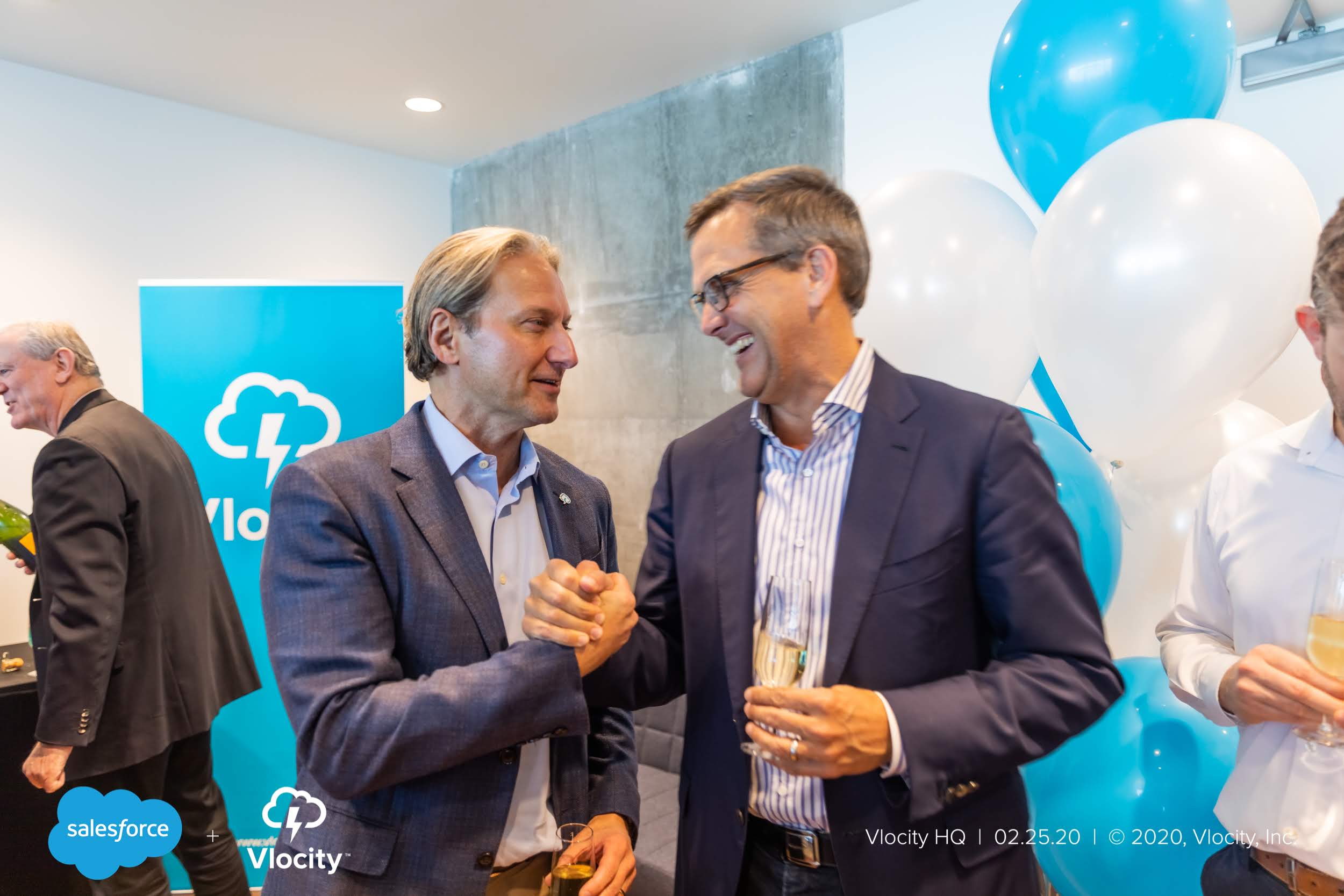
On February 25, 2020, Salesforce announced an agreement to acquire Vlocity. The stated consideration was approximately $1.33 billion, net of the value of shares Salesforce already owned, and subject to customary adjustments. Payment would involve cash and the assumption of outstanding unvested employee equity awards. The familiar headline number had some accounting attached.
The strategic explanation was straightforward. Vlocity’s applications were built natively on Salesforce and complemented its industry capabilities. Bringing the business inside Salesforce would make that relationship an internal one. Work that had been done across a partnership could become part of the same company’s product decisions.
The acquisition closed in June 2020, and Schmaier became CEO of Salesforce Industries. For someone who had used Salesforce as a customer and then as a partner, employment added a third perspective. A founder can leave after a sale. Schmaier took on responsibility for the work inside the buyer.
Net of shares already held by Salesforce; subject to adjustments. Cash and assumed unvested employee equity awards.
A bigger product brief
On February 1, 2021, Salesforce named him President and Chief Product Officer, with responsibility for the global product team, strategy and vision. The remit extended beyond the company he had brought in. He was now helping set product direction across Salesforce.
At the time, he emphasized the company’s entrepreneurial culture and the need to help customers through changing technology. His own path made the appointment intelligible: he understood the product organization, the partner’s position and the customer’s purchasing decision. Each sees the same application from a different seat.
The larger job also put a familiar problem on a larger desk. A company can add products faster than a customer can make sense of them. The work of product leadership includes giving those additions a coherent purpose. For Schmaier, the persistent subject was the customer’s experience across the business, rather than any single department’s view of the transaction.
Even his account of waiting at the DMV became a software question. Why should the experience demand standing in line when digital tools could make it easier? Bureaucracy supplies an unusually reliable product demonstration: everybody understands the inconvenience before the presentation begins. His interest was in how the process could change for the person using it.
- 2014Co-founds Vlocity
- 2020Joins Salesforce; leads Industries
- 2021Becomes Chief Product Officer
- TodayPresident & Chief Strategy Officer
The conversation moves to AI
As artificial intelligence moved into enterprise products, Schmaier’s public conversations moved with it. In December 2023, he joined Anthropic co-founder Tom Brown for a Salesforce Ventures fireside chat in San Francisco. They discussed model accuracy, better outputs, possible uses and the responsibilities involved in developing AI.
The setting connected an established applications company with a model developer and an audience of founders and corporate executives. That mix brings different questions into the same room. What can the technology produce? What can a business trust? How does an interesting demonstration become something an employee can use repeatedly?
In an October 2024 discussion alongside Airtable CEO Howie Liu and Salesforce’s Adam Evans, Schmaier used a canoe race to explain technological upheaval. On flat water, competitors must work harder to gain ground. Rougher conditions give prepared, nimble participants opportunities to get ahead. His comparison treated uncertainty as part of the competition, rather than an interruption to it.
There is continuity with the Vlocity years in that outlook. A change in technology creates room for a different application business. Recognizing that room requires knowing where existing arrangements frustrate customers. Whether the new ingredient is a cloud platform or an AI model, the commercial question still concerns the work somebody needs done.
Back to the person at the other end
Salesforce now lists Schmaier as President and Chief Strategy Officer. His responsibilities span acquisitions, venture capital, market strategy and monetization, alongside corporate philanthropy and the Office of Ethical and Humane Use. The founder who once built on the platform now helps consider where the wider company goes next.
His advisory work also continues. He serves on Genstar’s Strategic Advisory Board and on advisory bodies at Harvard Business School and Harvard’s engineering school. Engineering, business education and software investing remain present in his working life, rather than appearing only as earlier entries on a résumé.
The most economical statement of his outlook remains a question from business school: “who is the customer?” It is short enough to survive a long meeting and awkward enough to improve one. A discussion can contain plenty of information about a product while saying very little about the person expected to use it.
Schmaier’s career gives that question a concrete setting: an Oracle office, a Siebel product team, a hotel software board, an exhibition aisle, a Salesforce strategy discussion. The settings change. The useful detail is often waiting in the same place, where a person tries to get something done and the software asks for a little too much patience.