Before Thomas M. Siebel put his name on software, he found a place for himself among the books. At the University of Illinois, he liked the stacks in the Main Library. Years later, asked about that campus, he remembered the physical proximity of so much knowledge: five million volumes, with an answer sometimes only a few flights of stairs away.
“That’s where I studied,” he said. For someone associated with databases, it is a pleasingly substantial origin story. The information occupied shelves. Finding it involved walking. Nobody had yet offered to summarize it in a chat window.
Siebel would help make customer information into a software industry, sell his company to his former employer, and begin again with a business that became C3 AI. Yet the library remains a useful place to start. His career has repeatedly concerned the distance between information that exists and information that people can put to work.
Five million volumes, three degrees
Born in Chicago in 1952, Siebel arrived at computing by an indirect route. He completed a history degree at Illinois in 1975. After graduation, he headed west and worked as a ranch hand in Idaho. He also worked in book publishing before returning to the university. The eventual collection of credentials included an MBA in 1983 and a master’s in computer science in 1985.
It is tempting to arrange those subjects as a progression toward something more useful. His later career suggests a better reading: they could work together. History concerned large changes over time. Business concerned the organization of people and money. Computing supplied a means of changing how those organizations operated. A customer relationship, for example, could become something a company remembered systematically.
Siebel’s public account of his ambitions is less predetermined than a founder biography usually permits. He wanted to work in computer science. Becoming an entrepreneur emerged from that work. The distinction gives his early career some room to breathe. He had skills to acquire before he had an industry to address.
Oracle provided a consequential education of its own. Between 1984 and 1990, he held leadership positions at the database company. Larry Ellison became a colleague, then a competitor, and eventually the buyer of the company bearing Siebel’s name. Their professional relationship would require more than one description.
Selling the sales department a computer
Siebel became interested in applying information technology to sales, marketing, and customer service. Manufacturing and accounting already had substantial software systems. The people responsible for finding and keeping customers offered another opening. He had worked on an internal sales automation system at Oracle, known as Oasis, and believed the opportunity extended beyond one employer.
There was an intervening chapter at Gain Technology, a multimedia software business where he served as CEO. Gain merged with Sybase in 1992. In 1993, he and Patricia House founded Siebel Systems. The new company concentrated on the work that would become widely known as customer relationship management, or CRM.
The proposition was practical. A large business needed to know who its customers were, what salespeople had promised them, and what had happened when they called for help. Those facts might exist somewhere already. Getting them into a useful relationship with one another was the business.
In a later interview, Siebel recalled an unusual arrangement for the early employees: compensation could come in cash or shares, and most chose shares. He described a company with little payroll expense that shipped its production product after about a year. That recollection puts a human decision underneath the subsequent growth. People had to choose a claim on the future over money available in the present.
The customer was in the room
By the turn of the century, Siebel Systems had become a large international business, with thousands of employees and annual revenue exceeding $2 billion. Its operating manner attracted attention alongside its growth. Siebel emphasized customer satisfaction, financial discipline, and professional conduct. He expected the company selling software to take the customer’s circumstances seriously.
A 2001 interview captured his impatience with casual dress when receiving a senior customer arriving from overseas. The wardrobe was part of a larger argument about respect and preparation. A software company could be technically inventive and still behave like an established business. The customer had travelled a long way; the host could locate a suitable shirt.
The same approach extended to partnerships. Enterprise software rarely arrives in an empty room. Other vendors’ systems are already there, along with years of decisions, dependencies, and habits. Making the new product work with that inheritance is part of the sale. The installation matters after the demonstration has ended.
Oracle announced its agreement to buy Siebel Systems in September 2005, in a transaction valued at approximately $5.8 billion. The acquisition closed on January 31, 2006. The former employer and the company founded outside it were now under one corporate roof. Ellison and Siebel had competed for business; their customers would have to live with the combined result.
For Siebel, that might have supplied a respectable ending. Instead, the next chapter returned to the same broad territory: helping large organizations use information, with another generation of technology available to do it.
Starting again, with a different kind of data
He founded C3 in 2009. Its early focus was energy and carbon management. The company’s names would change as its scope developed, passing through C3 Energy and C3 IoT before C3 AI. The sequence records a business following a widening field of applications.
Cloud computing, large data sets, connected devices, and machine learning offered a different collection of tools from the one available in 1993. The work remained recognizable. A manufacturer might want to anticipate equipment failure. A utility might need to understand demand. A business might want a clearer view of its inventory. Each application would have to connect technical capability with a decision somebody actually needed to make.
C3 AI went public in December 2020 on the New York Stock Exchange under the ticker AI. By then, Siebel had also published Digital Transformation: Survive and Thrive in an Era of Mass Extinction. The 2019 book joined three earlier titles on selling and electronic business. Its subtitle made his view of technological change fairly difficult to miss.
He has also resisted assuming that today’s prominent technology companies must own the next era. Speaking publicly in 2023, he pointed to earlier transitions that reshuffled the industry. It is an argument with obvious appeal to a challenger. It is also consistent with a career spent entering markets while their eventual shape was still unsettled.
His interest in AI extends to what it does to work and institutions. In public conversations, including a July 2026 interview with Condoleezza Rice, education and the practical uses of new technology sit alongside the commercial opportunity. The history student is still interested in what follows the invention.
A university is a long bet
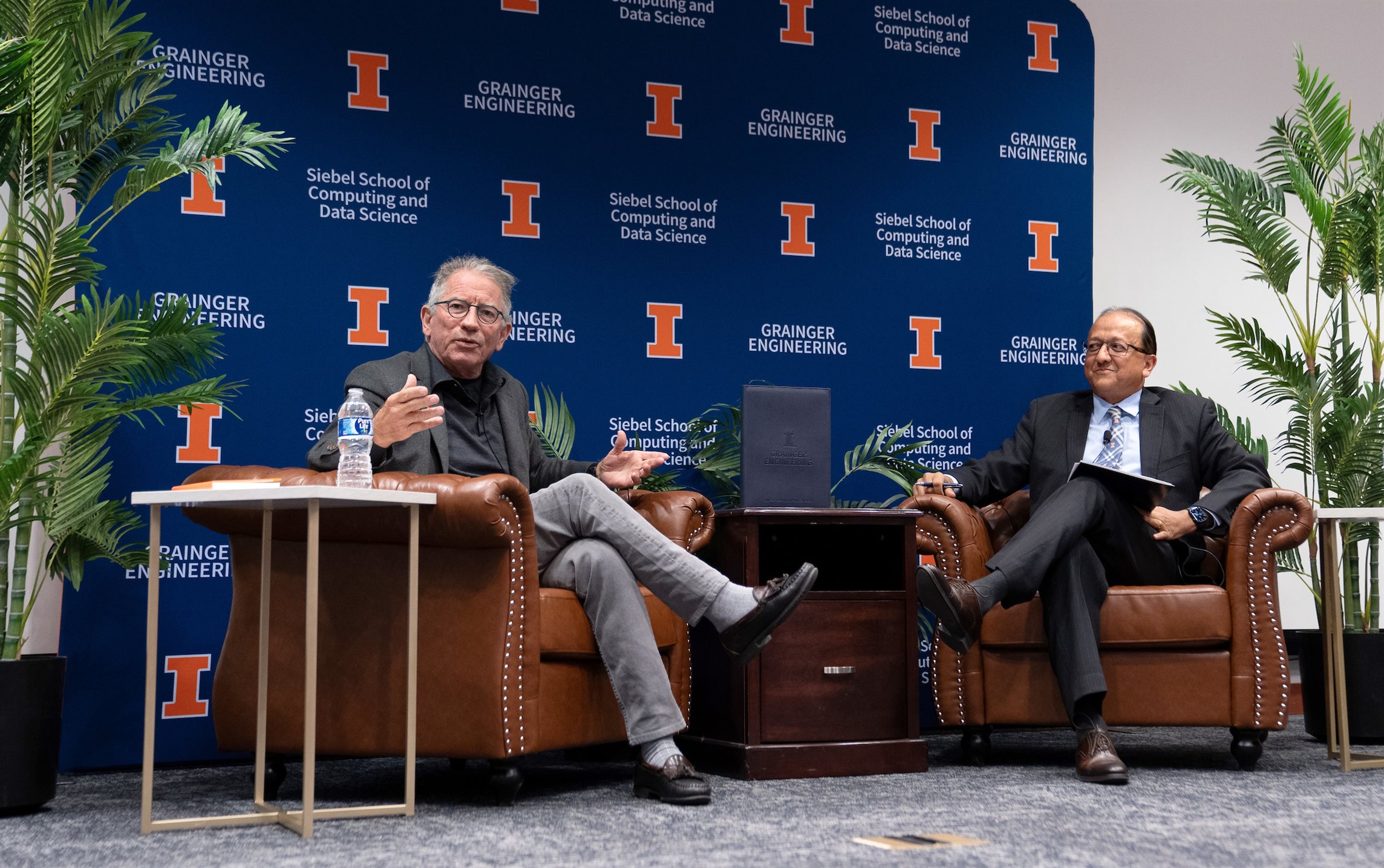
In 2024, a $50 million gift helped establish the Siebel School of Computing and Data Science at Illinois. The university’s plans allocated half the gift toward naming the school and half toward a new building. It joined earlier support for computer science and design. A former student was putting money back into the place where his own disciplines had come together.
The Siebel Scholars program, founded in 2000 by the Thomas and Stacey Siebel Foundation, takes another approach: support graduate students and build a continuing community among them. Its reach has included institutions in the United States, China, France, Italy, and Japan. The recipients carry the work into careers the donor does not control.
There is a related practice inside C3 AI. The company pays for employees to earn an online master’s degree in computer science. Completion brings a $25,000 bonus, a guaranteed 15 percent raise, and a stock grant. Continuing education has a line in the compensation package. The encouragement comes with arithmetic.
Completion bonus, plus a 15% raise and a stock grant for the funded online computer science master’s degree.
These commitments give his educational interests a durable form. A book can argue for preparing for change. A scholarship can pay someone to prepare. A company can make learning part of an employee’s working life, with consequences beyond a certificate on the wall.
“Fiscal 2026 was a failure of execution.”
Thomas M. Siebel · FY2026 shareholder letter
Back to the weekly review
The current chapter comes with a less ceremonial assignment. Siebel became executive chairman when Stephen Ehikian took over as CEO in September 2025. Effective May 8, 2026, Siebel returned as chief executive, with Ehikian continuing as president.
His fiscal 2026 shareholder letter was blunt: “Fiscal 2026 was a failure of execution.” He described a turnaround involving reorganized products, services, and sales, tighter costs, clearer ownership, deadlines, and weekly reviews. The language was familiar from his earlier emphasis on discipline. The circumstances made it a test of whether those practices could produce another recovery.
September’s results supplied an early set of measurements. C3 AI reported $52.4 million in quarterly revenue and positive free cash flow of $2.1 million. It also reported a non-GAAP operating loss of $36.2 million. Those numbers describe progress and remaining work at the same time. A quarter can offer evidence without settling the story.
That unfinished quality makes Siebel more interesting than a sequence of company names and transaction prices. He has repeatedly argued that a technical change creates room for a new kind of business. He is now responsible again for the daily work behind that argument: product quality, delivery, support, spending, and sales.
The library stacks offered knowledge within walking distance. A company asks for something harder: people who can turn what they know into a result another person values. After databases, CRM, and the arrival of enterprise AI, Siebel is still working on that part.