Leaving university was going to cost Korawad Chearavanont five million dollars. His parents had set a condition: raise that much for his startup, and he could leave Columbia. In 2015, Eko’s Series A came in at $5.7 million, led by Gobi Partners. The arithmetic was unusually agreeable. He had cleared the bar with $700,000 to spare.
There is a temptation to stop the story there. A young founder, a famous family, an Ivy League departure: the ingredients practically arrange themselves. But the useful part comes afterward. Permission to work on a company does little to settle whom it should serve, what it should sell, or how long it will take to become the business its founder imagines.
Chearavanont has spent the intervening years revising those answers. Eko’s beginnings lay in messaging for students. Its customers became employers. The business expanded into software that other companies could put inside their own apps. Today, as founder and executive chairman of the wider Amity group, he is pursuing enterprise AI, acquisitions and a possible public listing. The university bargain was an early checkpoint on a road with considerably more turns.
The family name came with homework
Chearavanont’s surname deserves its place in the account. His grandfather, Dhanin Chearavanont, built the Charoen Pokphand group into an international business. His father, Suphachai, built a career across telecommunications and the family’s wider enterprises. Korawad grew up close to people for whom running a company was a daily occupation.
His introduction to technology included a visit to Alibaba in 2004, when he was ten, to meet Jack Ma. Later came time around the family’s data centre business. These were rather more substantial introductions than the average school careers day. They also help explain why technology could seem like a plausible field in which to start something of his own.
He has described a family expectation that each generation should build a business. That gives independence a particular meaning here. There were experienced people to consult and an established business world within reach. There was also an expectation to produce something new. Any fair account of his career needs room for both the access and the obligation.
The early product still struggled. At Lawrenceville, the New Jersey boarding school he attended, he worked on a social messaging idea for students. Downloads proved easier to obtain than habitual use. An accelerator programme at Tigerlabs brought him into contact with David Zhang, who became his co-founder. After school, they spent a gap year in Bangkok rebuilding the software.
By early 2013, another poor reception had left them considering whether to stop. His father’s response was brief: “Two years is nothing.” For a teenager who had already spent a substantial portion of his working life on the project, that was a challenging definition of nothing.
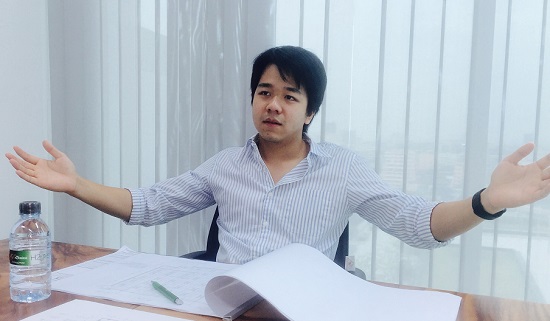
The customer was holding a phone
The workplace supplied a more promising setting. Eko developed around people who needed to communicate and organise work through their phones. A message could carry an instruction, but a business also needed a way to find the instruction later, direct it to the appropriate team and know what happened next.
That took the product into the less glamorous, more consequential territory of daily operations. By 2018, Chearavanont was describing a system that combined communication, workflows, project management and shared knowledge. The design had to accommodate different approval chains and review schedules. One department might require two reviewers; another might require four. The software was supposed to absorb that variation.
There is a revealing preference in that approach. He kept returning to the circumstances of the employee using the product. A frontline worker’s phone could be the practical centre of a working day. The product needed to make sense there, amid existing responsibilities, without demanding that an entire organisation reorganise itself around a chat window.
In a Bangkok hotel using Eko, employees coordinated staffing and the ordinary requirements of service, including whether enough napkins were ready for lunch. It is an excellent corrective to abstract talk about digital transformation. Somewhere at the end of the software is a table that needs setting.
The funding grew alongside the ambition. A $20 million Series B followed in November 2018, led by Sinar Mas Digital Ventures. By 2019, Eko had moved its headquarters to London while retaining its development base in Thailand. Chearavanont was trying to sell internationally and recruit internationally at the same time. A company could have Thai roots without asking every employee or customer to live within reach of Bangkok.
- 2012Eko is founded. Messaging supplies the starting point.
- 2015A $5.7m Series A clears the university condition.
- 2020ConvoLab joins; the Amity umbrella takes shape.
- 2024The social business becomes Social+. Amity expands in enterprise AI.
- 2026A new funding round and Singapore research hub.
A social network, sold in pieces
The next expansion kept communication at the centre while changing the buyer’s relationship to it. Instead of only supplying a workplace destination, Amity offered components that businesses could build into their own digital products: chat, social features, video and bots. A company with an existing audience could add the machinery for that audience to interact.
The 2020 acquisition of Thai chatbot company ConvoLab helped broaden the offering. The Amity name became an umbrella for the enterprise messaging and social infrastructure businesses. The founding team around the social product included Zhang, Touchapon Kraisingkorn and Francesca Gargaglia, alongside Chearavanont. This was becoming a business with several strands and several people responsible for carrying them.
For a travel app, the attraction was straightforward. Booking a ticket brings someone in for a transaction. A community gives travellers reasons to exchange information and return between purchases. Amity’s technology supported the Connect social platform inside AirAsia’s app. The software was increasingly something a user could encounter without needing to recognise the company that supplied it.
Chearavanont put the engineering obligation plainly: “We sell technology to software engineers, so product quality is the top priority for us.” Selling the components meant accepting that another team’s product depended on them. The promise had to survive integration, traffic and repeated use.
In October 2024, the social infrastructure business announced its rebrand to Social+ and named Gargaglia CEO. The wider Amity group continued under the Amity identity. Keeping those branches distinct matters when following Chearavanont’s career: the former CEO’s current title is founder and executive chairman of the group.
“Eko Communications is not built for sale.”
Korawad Chearavanont · 2015
An acquisition buys a place in the room
Enterprise AI brought a further change in method. Amity’s group strategy now combines research with purchases of established software businesses. In September 2024, it announced the acquisition of a majority stake in Tollring, the UK call analytics company. That brought a communications business with customers across several international markets into the group.
The practical attraction extends beyond a product catalogue. An established software company already has relationships, a sales route and experience of the work its customers need done. Adding AI to that setting gives researchers a specific problem and an existing way to deliver the result. It also leaves the demanding job of making the acquired business and the new technology work together.
Chearavanont’s current argument favours models shaped for particular industries and tasks. In his August 2026 Techsauce discussion, he described proprietary business data and existing customer distribution as central to Amity’s approach. He also described using debt and private credit for early acquisitions before the strategy attracted larger equity rounds. The financing had its own sequence of tests.
Amity calls its approach Build, Buy, Bridge. The words are compact; the responsibilities are extensive. Researchers must develop useful capabilities. Acquisition teams must choose suitable businesses. Operating teams must connect the two. For Chearavanont, the work has moved far beyond persuading classmates to try a messaging app.
- 01 / Build
- Develop AI capabilities through the research team.
- 02 / Buy
- Acquire software businesses with established customers.
- 03 / Bridge
- Bring AI into the products those customers already use.
For all the talk of industry-specific models, his public enthusiasm can be considerably less earthbound. In a LinkedIn post, he linked his excitement about SpaceX to childhood memories of watching Star Destroyers and the prospect of a future Mars colony. It is a useful glimpse of the person behind the enterprise vocabulary. The founder discussing customer distribution and acquisition finance still makes room for the pleasure of watching a spacecraft take off and land. Software strategy has not entirely crowded out the boy who liked spaceships.
The next permission slip
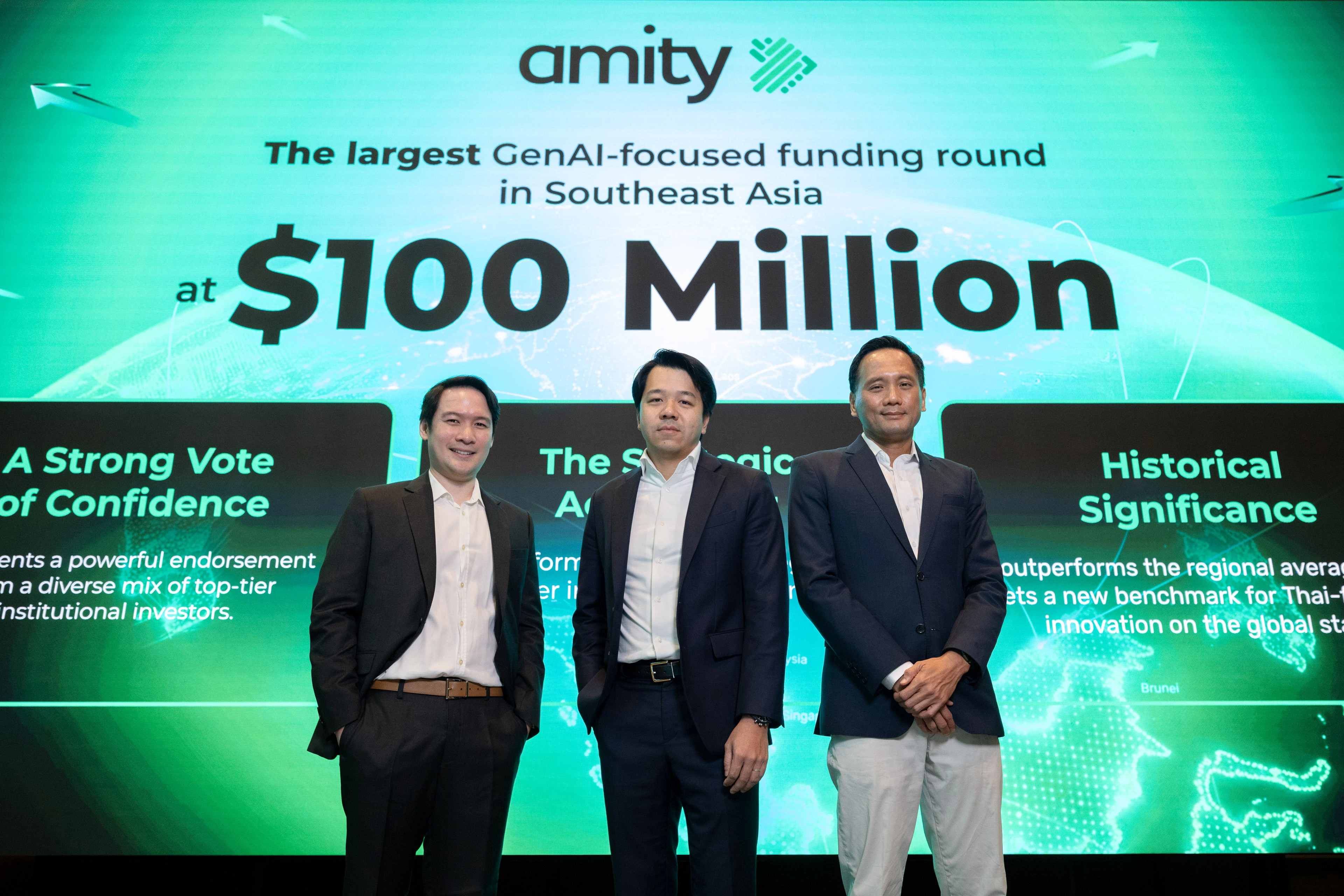
In March 2026, Amity announced a $100 million Series D led by EDBI alongside Asia Partners and SMDV. The group said it had passed $100 million in annualized revenue in 2025. Its announced aim was to exceed $200 million in annualized revenue in 2026, with preparations for a 2027 public listing. Those are different kinds of numbers: capital raised, an operating run rate and a future target.
June brought the opening of its Singapore office and AI Research & Application Center. The centre gives the group a research home and a regional headquarters for Southeast Asia, alongside its continued work in Bangkok. The geography has become more elaborate, but the original ambition remains recognisable: build from Thailand and find customers beyond it.
There is an older deadline worth remembering. In 2015, Chearavanont was already talking about a possible IPO and another ten years of building. Forbes included him in its 2016 Asia 30 Under 30 enterprise technology list. Recognition arrived early; the business kept requiring revisions.
His parents’ condition had a pleasingly definite finish. Five million dollars could be counted, and a university place could be left behind. The current undertaking has no equally tidy release clause. An acquisition must be integrated. A customer must renew. A research project must become something useful enough to buy. Chearavanont has won considerably more room to pursue his idea. Filling that room is still the job.
Follow the next chapter
Work, conversations and the longer record.
- Korawad at Amity Official biography ↗
- LinkedIn Posts and professional updates ↗
- Woody Talk Watch his interview on YouTube ↗
- The global AI argument Techsauce · October 2026 ↗
- Back in the Eko years A 2015 conversation ↗
- Social+ The social infrastructure business ↗
- Thailand GameChanger, episode 03 Listen to the founder’s early account ↗