A football match helped supply the plot twist in Francesca Gargaglia’s career. In 2018, the Thai telecom company True wanted people watching World Cup streams to talk to one another inside its entertainment app. Eko, the company she would join that September, had built workplace messaging software. Could some of that machinery be taken apart and put to a different use? The request contained the beginnings of a business: give an existing app the means to become a gathering place.
It is an appealingly practical origin. Nobody needed to persuade football supporters to have opinions. The job was to give those opinions somewhere to go while the match was still happening. Chat became part of the entertainment, and the customer wanted more: profiles, updates, photographs, feeds. What had looked like a feature request began to look like a product in its own right.
Today Gargaglia is co-founder and CEO of social.plus, the company previously known as Amity. Its pre-built software lets businesses put social experiences inside their own apps. Her route there ran through law, consulting and several continents. The recurring question in that journey was where she wanted to spend her time. The recurring question in her business is what makes anyone want to come back.
A departure from the sensible route
Gargaglia grew up in Perugia, in central Italy, and studied law at Bocconi University in Milan. She has described a childhood full of books, museum visits and curiosity. Travel became a way to follow that curiosity beyond the familiar. During university, volunteering in Salvador de Bahia brought her into a small group of international students whose backgrounds differed from her own.
In her account of the trip, arriving alone in Brazil was exhilarating. She wanted the encounter with unfamiliar people and places to become a lasting part of her life. That is a more specific ambition than collecting destinations. It asks a career to keep producing encounters that ordinary routine might otherwise screen out.
There were opportunities to do that within a conventional profession. Her early experience included the United Nations in Jakarta and Baker McKenzie in Dubai. At PwC, she worked with European businesses expanding into sub-Saharan Africa. Johannesburg offered a close view of the decisions involved in taking an established company somewhere new.
Building a European desk also gave her a smaller, protected version of starting something: a budget, targets and a team to assemble. In retrospect, she has described that experience as a discovery that she enjoyed creating. The law degree had supplied a route into professional life; working alongside business leaders suggested other jobs she might want to do.
- Perugia → MilanLaw at Bocconi
- Dubai → JohannesburgLegal work & market expansion
- BangkokEko, then Amity
- Across marketsLeading social.plus
Selected career stops, rather than a complete travel itinerary.
The customer who changed the question
Meeting Korawad Chearavanont helped bring that possibility closer. She was drawn to the energy of his startup work and moved to Thailand in September 2018. Her initial role at Eko was on the legal side. It was a substantial change of setting, though the skills involved in setting up operations and entering markets had travelled with her.
The World Cup experiment pointed toward an opening beyond enterprise chat, a field crowded with large technology companies. A conversation between colleagues and a conversation between supporters might share technical components, but they belonged to different commercial worlds. The opportunity was to make those components available to other businesses rather than keep them tied to one workplace product.
Another early customer, an airline, supplied a further test. Its app was useful for buying tickets, yet passengers had little reason to visit between journeys. Chat could connect people on the same flight and help travellers exchange information. Gargaglia recalled more than seven million messages in the first month. It suggested that the appetite for conversation extended well beyond a football audience.
That example makes her proposition unusually easy to picture. A ticket gets someone onto a plane. A conversation might bring them back to an app on a day when they have no ticket to buy. For the business, those are different kinds of relationship. For the passenger, a useful answer from another traveller is a reason to open the thing again.
“Am I adding positive value?”
Francesca Gargaglia, on the question entrepreneurs should ask themselves
An international company, with an Italian argument
Amity’s expansion gave Gargaglia another chance to argue for a place she knew. In early 2022, the company opened its European headquarters in Milan, near the Arco della Pace. She joked about the internal contest over where the office should go. Milan won, helped by connections to other offices, the attraction of living in Italy and incentives for people moving back from abroad.
There was a larger point behind the office choice: she wanted to demonstrate that Italy could host technology and innovation work. Her career had required leaving home repeatedly. Building part of the company in Milan gave that movement a return leg, with colleagues and jobs coming along for the ride.
The scale described in those years belonged to the broader Amity story. By 2024, its workforce had grown from ten to more than 250 people. Gargaglia described an organization that mixed skills and distributed responsibility, using the phrase “liquid organization.” The current social.plus company presents a different snapshot: more than 60 employees and more than 18 nationalities. Those figures describe different stages and scopes of the business, rather than a single uninterrupted headcount chart.
Her international experience also became part of her leadership work. In a conversation about building a global startup, she discussed hiring for accountability and soft skills, and measuring success through the product’s effect on users and her own development. A distributed business gives such preferences practical consequences: colleagues need ways to work together when geography offers very little help.
Speed meets the balance sheet
Gargaglia’s public ambitions have not always come wrapped in caution. In January 2022, she spoke about wanting Amity to reach a billion-dollar valuation that year. It was an aspiration, and an expression of the period’s appetite for rapid expansion. Later that year, her TEDxBolognaSalon talk asked why so many startups were failing.
Her argument challenged the prestige attached to growing as fast as possible. A company that pours its resources into expansion can become dependent on the next injection of capital. When the market turns, the vulnerability lands on employees as well as investors. She wanted the startup world to pay more attention to stability, profitability and lasting value.
In a subsequent interview, she also argued for checking whether an idea has customers before falling in love with it. Passion needed execution, and a team needed people aligned with the work. Those concerns sound rather less glamorous than unicorn status. They also describe the obligations that remain after a fundraising announcement has disappeared down everyone’s feed.
In a public post closing the first half of 2025, she supplied a concrete milestone: social.plus had become profitable in the second quarter. She also described a difficult preceding year, with slow growth and delayed projects. Profitability was her own reported milestone, and she presented it as something she had long prioritized. The critique of growth at any cost had acquired a result she could point to.
Her career offers both impulses in the same person: the urge to cross borders quickly and the desire to build something that survives the journey. That tension is more interesting than a tidy conversion story. An ambitious founder still has to decide what kind of growth the company can carry.
The relationship after the transaction
On October 15, 2024, Amity announced both its rebrand to Social+ and Gargaglia’s appointment as CEO. The company’s announcement identified the United States as its largest market and named customers including Ulta Beauty and Harley-Davidson. The new name put the social component of an app at the centre of its public identity.
Her underlying argument had been visible earlier. Writing in 2021, she questioned how much control a brand really has when its audience relationship lives on someone else’s social platform. The issue included access to customer insights and control over communication. Building inside an owned app offered a different arrangement, with the business responsible for its own environment.
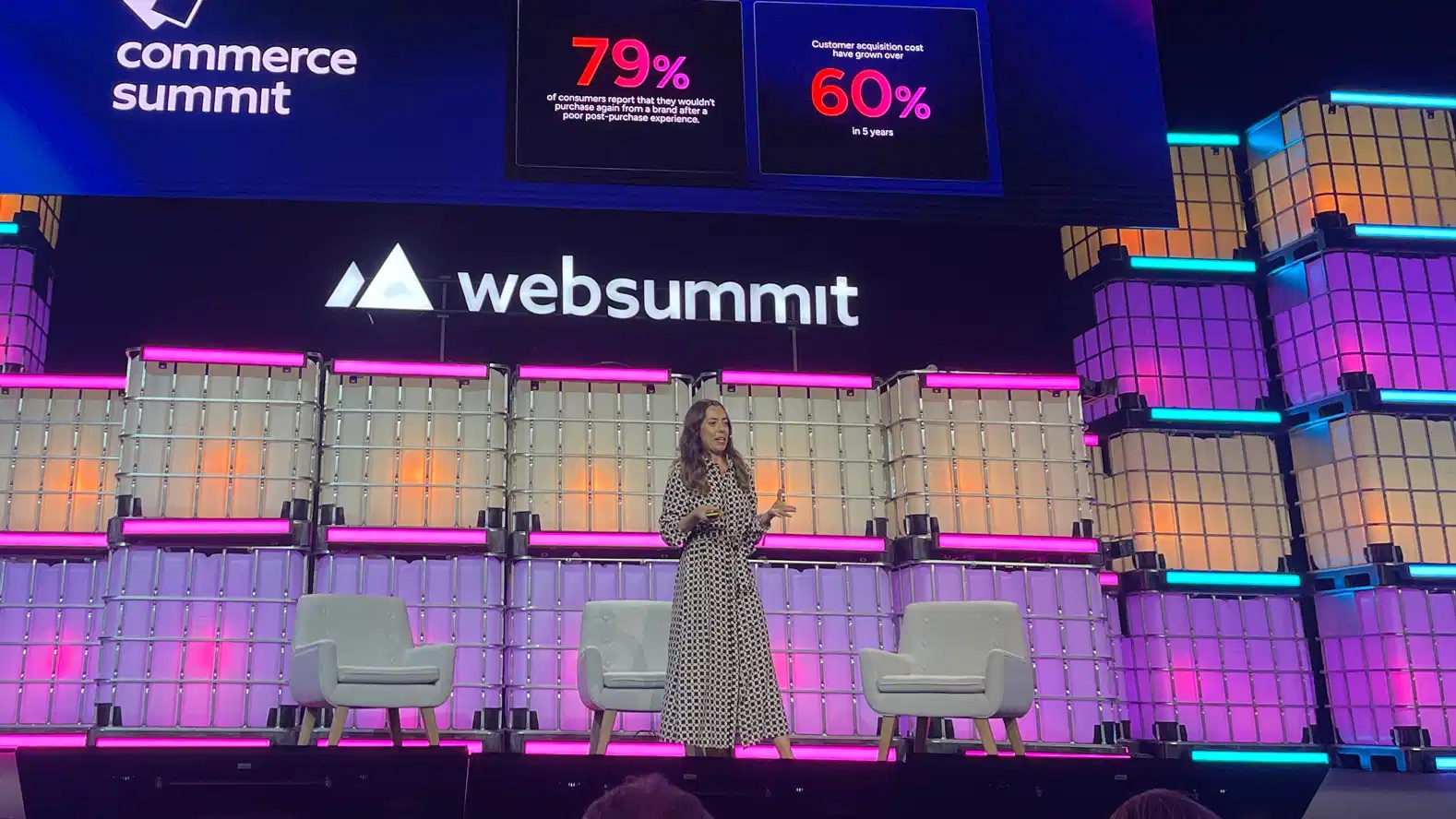
At Web Summit in 2025, she turned to retail and the effort spent winning first purchases. Her presentation emphasized retention, community and customer lifetime value. Acquiring a shopper is one event; maintaining a relationship involves what happens afterwards. A company selling community infrastructure has an obvious interest in that argument, and her work makes the commercial stake clear.
In June 2026, social.plus announced an owned fan community for the South Sydney Rabbitohs. The company reported that more than 60 percent of the club’s paying members joined within the first week. Live match chat was again part of the attraction. Eight years after the World Cup experiment, the familiar desire to watch and talk together remained a useful business problem.
of Rabbitohs paying members onboarded in the first week, according to the June 2026 company announcement.
Another set of tools, the same invitation
The work has continued into the machinery developers use. In May 2026, social.plus launched an MCP server to connect AI development tools with its platform context and documentation. In July came Vise, a tool for guiding and checking AI-assisted integrations. The company described more than 400 platform-specific checks. These launches tackle the work required to get community features into an app in the first place.
In August 2026, Gargaglia was named a finalist for Technology Entrepreneur of the Year in the Allica Bank Great British Entrepreneur Awards. The announcement credited social.plus with serving more than 100 enterprise clients. Recognition arrived for a business built around other companies’ relationships, often operating behind the apps their customers actually see.
The personal appetite for unfamiliar company has remained consistent. She has spoken about food, travel and the pleasure of meeting people through her work. At a founders’ gathering in Dubai, she valued the openness of conversations and the feeling that participants could support one another. The appeal of community was quite literal: people with something to discuss, given time together.
That brings her story back to the match. The stream supplied the event; the supporters supplied the conversation. Gargaglia’s business grew around finding room for both. For someone whose career has involved so many departures, she has chosen a very particular problem to work on: giving people a place to return.