Therese Tucker had engineers. A bank in Nebraska had money and an accounting problem. After three years of trying to sell wealth management software, this was a combination worth considering. Her company, BlackLine, had one paying customer. The original plan was running out of road.
The request came from First National Bank of Nebraska in 2004. Could BlackLine help with closing the books? Tucker had spent much of her own money getting the business going. She wanted to know whether the bank would pay for the work. It would. The customer’s problem became the company’s direction.
There is something pleasingly unceremonious about this origin. Accounting automation sounds like the sort of enterprise that should emerge from a grand strategy document. In Tucker’s telling, it emerged from a conversation between people who needed different things and could help each other. The accountant supplied the problem. The programmer was willing to change the assignment.
It also makes her a slightly awkward mascot for the cult of the infallible founder. The product that established BlackLine was someone else’s suggestion. Tucker has said so in front of an audience of entrepreneurs, where admitting that your original idea did not work is a useful way to disturb the seating. Her achievement depended on knowing when to stop defending it.
First National Bank of Nebraska supplied the problem that changed BlackLine’s direction.
Before the balance sheet, a blinking tree
Tucker grew up on a farm in rural Illinois, the youngest of four daughters. Her parents wanted her to acquire practical skills, including typing and shorthand, that could lead to secretarial work. She was the first in her family to attend college. Computer science arrived later, through a programming class on an Apple computer.
In 1981, she wrote a program that made a Christmas tree blink using asterisks. It was enough to redirect her education. She transferred to the University of Illinois to study computer science and mathematics, graduating in December 1983. The intervening work included punched cards and long waits to discover a small error. The tree had been more immediately gratifying.
Her first job took her to Southern California and Hughes Aircraft, where she worked on fault detection for surface ship sonar. She enjoyed seeing calculus applied to a physical problem. In 1985 she tried independent programming for small businesses, underpricing the jobs and acquiring an education in the distance between writing good software and running a viable business.
The career that followed took her into financial technology and eventually the chief technology officer’s job at SunGard Treasury Systems. By the time she founded BlackLine in 2001, she had experience building software for financial work. She also had two children. The founder in this story arrived with a working life already behind her, rather than a dorm room to escape.
A business hidden in the monthly close
The work BlackLine addressed was familiar to accountants and largely invisible to everyone else. Companies must reconcile accounts and close their books. The information may originate in substantial enterprise systems, yet the work of checking, explaining and signing off on it can scatter across spreadsheets, messages and files. Having a ledger does not make every surrounding task orderly.
Tucker described businesses handling thousands of spreadsheets outside their core financial systems. Each document could contain something necessary. Together they created a coordination problem: who had completed the work, which version was current, and what still needed attention? A spreadsheet is an agreeable tool until an entire organization asks it to double as a traffic controller.
BlackLine built software around that surrounding work. Reconciliation and financial close became the foundation of a business selling to accounting and finance teams. The attraction was practical. People needed a clearer view of the process and a more consistent way to perform it. Tucker’s programming background gave her a way to translate that need into something a customer could use.
The customer relationship mattered beyond the initial sale. A complaint could contain the next product decision. That is an unglamorous habit to put at the center of a technology company, but it gave BlackLine a reason to keep returning to the people doing the work. The most useful feedback was often about the part of the month everyone wanted to finish.
The cloud needed a customer, too
Another consequential decision came in 2007, when BlackLine committed to cloud delivery. Tucker helped engineer the transition. This meant asking companies to entrust financial processes to software delivered over the internet at a time when that proposition still required considerable explanation.
The commitment extended beyond the code. Subscription software required a different approach to selling, contracting and supporting the product. BlackLine would be operating a service that customers continued to use. The relationship would have to survive implementation, upgrades and the next close, rather than conclude with a box of software changing hands.
Tucker’s early financing had been intensely personal: retirement savings, borrowing and credit helped keep the business alive. In enterprise software, a promising customer and money in the bank can remain separated by an uncomfortable interval. A company may need the product, deliberate for months, buy it and then take more time to pay.
Outside backing eventually brought a different set of possibilities. Silver Lake Sumeru and ICONIQ Capital invested in 2013. BlackLine went public on Nasdaq on October 28, 2016. Fifteen years separated incorporation from the listing. That interval supplies a useful correction to the photograph of a founder ringing a bell: most of the work happens outside the frame.

Pink hair, ordinary assumptions
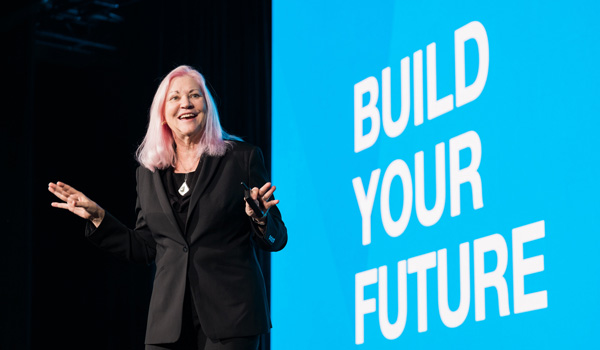
Tucker’s pink hair has become a recurring character in her business story. She has traced it to a disagreement over a marketing video she considered boring. She threatened to dye her hair pink; the marketing team did not believe she would. They had underestimated her willingness to follow through on an impractical suggestion.
The color made her recognizable. Recognition, however, did not always extend to the job she held. At a Goldman Sachs encounter after a 2017 financing transaction, an executive was introduced to BlackLine’s CEO and congratulated her male finance chief. Tucker, wearing a hoodie and floral jeans, had been standing there all along.
The episode is funny because the error is so complete. It is revealing because the introduction had already supplied the answer. A founder could build the company, take it public and help arrange a transaction, yet someone else could still receive the automatic assumption of authority. Tucker’s response to such moments has often included laughter, without pretending the assumption was harmless.
Her ambition was more expansive than being correctly identified in an elevator. “Why have a modest ambition?” she asked in 2017. The work she wanted to change was accounting itself. The hair made a memorable picture; the persistence concerned what happened on the other side of the customer’s screen.
“Why have a modest ambition?”
Therese Tucker, 2017
The founder who brought her paperwork to lunch
Tucker’s account of building BlackLine includes people who helped her think. She has described taking business documents to lunches with early board member Tom Unterman, who would identify a problem she had missed. The scene is less cinematic than a lone founder discovering the answer at midnight. It is also a better advertisement for having someone competent read your numbers.
Her recollections of hiring are similarly resistant to a polished origin story. An early engineer had yet to finish a coding course. An early marketing hire came from selling awnings. The company developed people who were willing to learn alongside it. Their previous job titles offered an incomplete description of what they might become.
That approach gives her comments about opportunity a concrete setting. Taking a chance on someone requires work after the offer: coaching, responsibility and room to grow. A company short of money may discover talent outside the familiar places because it has to. Whether those people flourish depends on what happens once they arrive.
Her commitments also extended beyond BlackLine. She served on the California Community Foundation board from 2014 to 2024. Alongside a career built around financial processes, there was a decade of service to a Los Angeles institution concerned with its communities. The two roles put her in different rooms, with different measures of useful work.
Twenty-five years, and a different seat
Tucker’s first stretch as BlackLine’s chief executive ran from 2001 to January 2021. She became executive chair, then returned to management in March 2023 as co-CEO with Owen Ryan. The return put the founder back inside a business whose products and responsibilities had expanded considerably since the Nebraska bank asked for help.
On October 1, 2025, she moved out of the co-CEO position into a Founder role, with Ryan continuing as CEO. Her responsibilities included work with major customers, European markets and product development. The assignment still involved the relationship that had changed BlackLine’s course: understanding what customers needed next.
In March 2026, BlackLine announced that she would retire from full-time executive employment effective June 2, while remaining a director and substantial shareholder. The announcement put her ownership at approximately eight percent. She expressed confidence in Ryan and the leadership team, and said she intended to continue serving on the board.
By then, BlackLine’s agenda included its Studio360 platform and further work on artificial intelligence. Those are different tools from the ones Tucker started with, but the test she learned early remains recognizable: somebody has a specific problem, and the software must be useful enough for them to pay for it.
Her story leaves room for both stubbornness and revision. She persisted with the company while allowing the original product plan to give way. That distinction took her from a struggling software venture to a public company and, eventually, a board seat after 25 years. The important turn began when an accountant described the work still waiting to be done.
- 2001Founder & CEO
- 2021Executive chair
- 2023Returns as co-CEO
- 2025Executive Founder role
- 2026Retires from full-time executive work; remains on the board