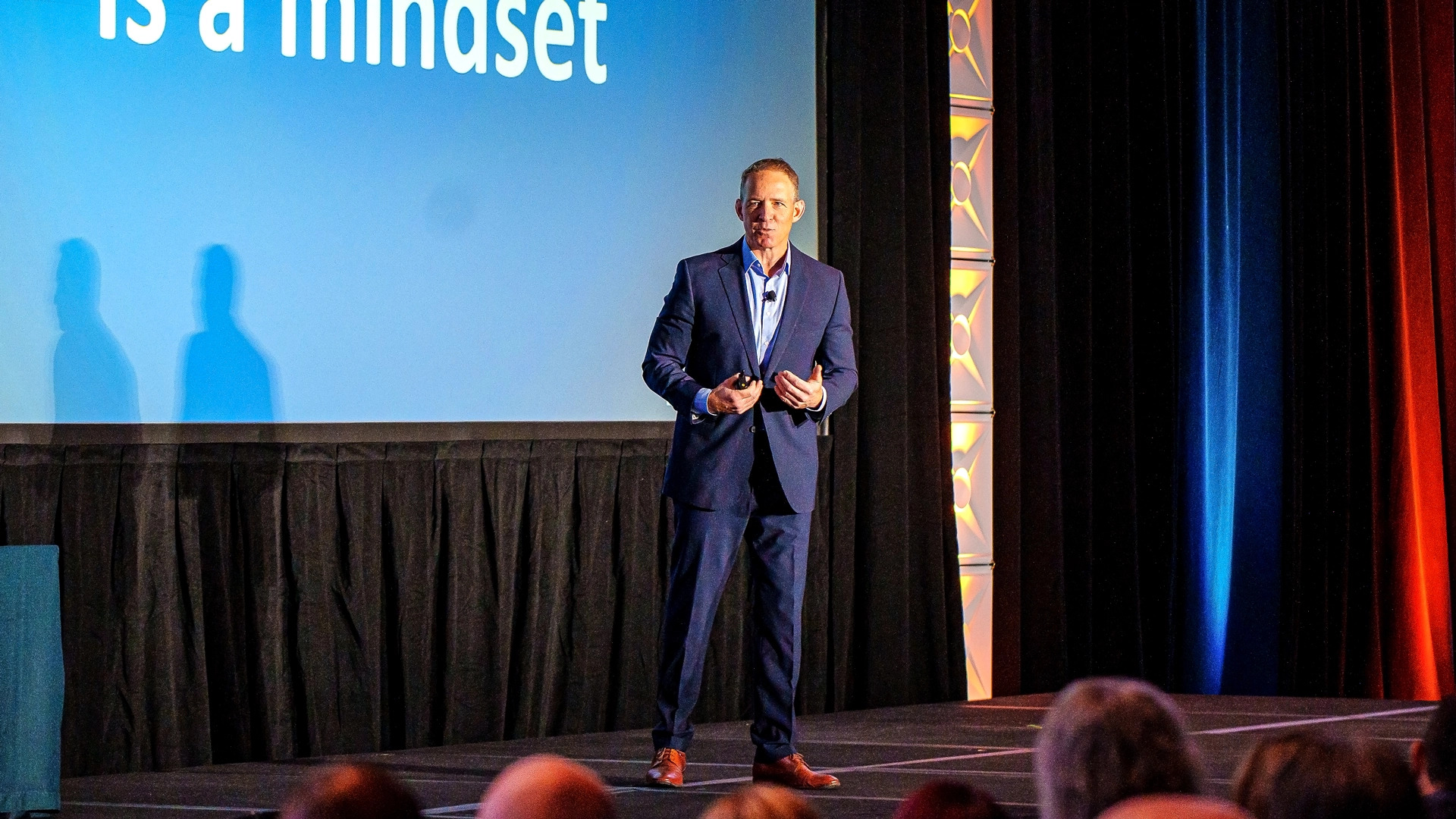
Onstage at Laserfiche’s 2025 Empower conference, John Merrill stood beneath a sentence cropped by the camera: “is a mindset.” It could have been a fragment written for his career. For nearly three decades, Merrill has occupied the awkward interval between a new technology arriving and ordinary organizations deciding what to do with it. First came early cell phones. Then Intel, wireless products and enterprise Wi-Fi. Cloud-managed networking followed. Now, as chief marketing officer of Laserfiche, he is talking about AI agents, governed data and the limits of enthusiasm without architecture.
The hardware and acronyms keep changing. The actual assignment does not. Someone has to translate engineering possibility into a customer’s Tuesday morning. Someone has to explain why the network needs rebuilding before the meeting room fills with tablets, or why an AI agent is only as dependable as the content and permissions beneath it. Merrill made that translation his trade.
His public vocabulary gives away the operating philosophy: adaptability, practicality, service, team and “why.” These are soft words in a business that likes hard metrics. Merrill treats them more like infrastructure. They determine whether strategy can carry weight when a market changes underneath it.
The useful life of a complicated product
Merrill’s early career sat close to the product. At Prime Matrix Wireless Communications, he worked in marketing and business development during the early cell phone era. At Intel, his work moved through product line engineering and management in wireless technology. That mix matters. Marketing technical products is easier when the marketer respects the machinery, understands the constraints and knows that a feature list is not yet a reason to buy.
By 2008, Merrill was director of marketing at Xirrus, a company making enterprise wireless arrays for schools, offices and convention centers. The pitch was not glamorous: access points, radios, switches, density, wiring and cost. Yet the customer problem was wonderfully concrete. More people were carrying more devices into buildings designed for a lighter digital load.
In one account from the period, Merrill said Xirrus tended to win technology evaluations and lose when politics entered the purchase. The line has the cheerful swagger of a product marketer who believes the demo. Four years later, the iPad was forcing the argument. Merrill warned that companies might need to “reshuffle” access points throughout a facility to support the new traffic. A friendly slab of glass had become an infrastructure project.
That episode contains the shape of Merrill’s work. New technology rarely stays inside the category where it begins. The iPad was a consumer object until it altered office networking. AI looked like a clever chat window until it began acting inside workflows. The marketer who can see the second-order problem becomes useful to engineers, sellers and customers at once.
A career with a why, not a straight line
Merrill studied business administration and marketing at California State University, Northridge, then completed an MBA at Pepperdine with an emphasis in marketing. His career moved from engineering-adjacent product work into communications, worldwide marketing and executive leadership. After Xirrus came global roles at Nexsan and Imation, then the vice presidency of marketing at Aerohive Networks from 2017 to 2020. He later consulted on business strategy, marketing and organizational development.
On the GENeration eXecutive podcast, he described a career shaped by embracing change and following his “why.” The episode also centered servant leadership, owning one’s career and the power of teams. That language gives the résumé some connective tissue. Merrill did not merely hop from one promising technical noun to another. He developed a repeatable response to change: learn enough to see the customer consequence, assemble people around the mission and remain willing to replace an old method.
“What matters is the system that gets you there.”John Merrill on aligning go-to-market teams
His volunteer record makes the service idea less abstract. Merrill spent 24 years as a scoutmaster and committee chair with Boy Scouts of America. He also held long leadership terms with the Newbury Park Track Club and local high school track and basketball organizations. Those commitments operate on a different clock from a product launch. A volunteer leader cannot rely on title alone. The work is repetition, trust, logistics and helping other people make progress.
Former colleagues describe a related combination at work: creative but willing to listen, professional, approachable and humble. One recommendation credits his campaigns with driving revenue but remembers his new approaches and his patience with other people’s suggestions. The pairing is the point. Creativity can become exhausting when it arrives without receptiveness. Merrill’s version appears to invite the team into the invention.
The Merrill operating system
The CMO arrives at the content problem
Laserfiche brought Merrill onto its senior leadership team in May 2022 as senior vice president of marketing. His brief covered the strategy and initiatives meant to expand global adoption, with attention to advertising, retention, events, market research and the experiences of customers and business partners. He has since become chief marketing officer.
The company was an apt destination for a marketer fascinated by transitions. Laserfiche began in document management and helped popularize the paperless office. Its modern platform spans content management, workflow, forms, automation, analytics and governance. The product lives in the unphotogenic middle of organizations: invoices, case files, contracts, records, approvals and all the bits of work that become visible mainly when they fail.
Merrill joined with experience in SaaS migration and a stated interest in high-performing, mission-focused teams. His public goal was to work with the full Laserfiche community and support its mission of accelerating how business gets done. That is a marketer’s sentence with an operator’s verb. Acceleration requires more than attention. A campaign can attract a buyer; only a functioning system can return time to the buyer’s day.
This is where Merrill’s go-to-market thinking becomes useful. Sales and marketing already agree that they want to win, he has observed. The differentiator is the system that connects their effort. At a mature level, strategy and execution share data, process and a clear measure of value. Marketing stops behaving like a calendar of activity and starts behaving like part of the growth engine.
Give the digital intern a badge, not the building keys
By 2026, Merrill’s subject had shifted from cloud migration to agentic AI. At Info-Tech Live in Las Vegas, where thousands of technology professionals gathered, he noticed that hallway conversations kept returning to one modest idea: practicality. The question was no longer whether leaders should adopt AI. It was how to deploy agents systematically enough to produce a business result.
His memorable analogy is that AI agents resemble enthusiastic interns. They bring energy and potential, but they need boundaries and guidance before receiving autonomy. The joke works because it restores management to a conversation often conducted as sorcery. An agent needs a defined task, the right access and someone accountable for its behavior. Give the eager intern a badge. Do not begin with the building keys.
“The single most important skill for 2026 is adaptability.”John Merrill on the agentic workforce
Merrill’s proposed sequence is controlled but not timid. Let IT test agents first, where technical limits and change management are understood. Prove a result in one department. Diagnose weak systems. Organize data so it can move from raw material to insight, decision and action. Redesign workflows when necessary instead of fastening an agent to a broken manual process. Inspect policies that exist on paper but are not enforced.
The lesson underneath is old enough to have survived all four of his technology waves. Adoption depends on trust, and trust is built from details. In Wi-Fi, those details were radios, walls and capacity. In agentic AI, they are permissions, data quality, governance, model behavior and cost. Marketing can create desire for the future. Operations must make the future safe to use.
Merrill expects adaptability to matter more than loyalty to any legacy programming language or familiar workflow. His own path gives the argument credibility. He has repeatedly learned a new technical landscape without abandoning the central concern: what happens to the people trying to get work done?
The translation advantage
There is no tidy ending to a profile built around change. AI agents will mature. A new interface will arrive. Today’s clever differentiator will become tomorrow’s expected feature, and then it will disappear into the plumbing. Merrill’s job will change with it.
The durable part is his position between worlds. Engineers know what a system can do. Customers know where their days become difficult. Executives know what the organization must achieve. A technology marketer earns a place in the room by translating among all three without flattening any of them.
Merrill has spent a career practicing that form of translation. He has watched personal devices strain corporate networks, cloud software alter buying models and AI move from prediction to action. His answer is neither a slogan nor a retreat. Build the team. Govern the system. Follow the why. Then adapt before the next wave makes the old map charming and useless.