At eGain’s Solve24 conference, Ashutosh Roy asked the audience who was getting positive results from artificial intelligence. Nobody raised a hand. For a chief executive selling software in the field, this was an awkwardly useful answer. The room had supplied a problem statement without requiring a slide.
Roy’s response was to describe AI as a cake with three layers: computing hardware at the bottom, models above it, applications on top. The business value, he argued, would arrive through applications connected to the systems where people actually worked. Buying the ingredients was easier than serving anything edible.
By then he had been running eGain since 1997. He had seen the internet become a place where businesses could acquire customers faster than they could answer them. Now he was watching businesses acquire conversational machines before settling what those machines should say. The family resemblance was hard to miss.
Before the inbox, the engineer
Roy’s route into this problem ran through three institutions: a bachelor’s degree in computer science at the Indian Institute of Technology in New Delhi, a master’s in computer science at Johns Hopkins, and an MBA at Stanford. His résumé puts engineering and business in the same sentence long before enterprise AI became a sales category.
From 1988 to 1992, he worked in software engineering at Digital Equipment Corporation. He went on to co-found Parsec Technologies, a call center software business in India, before serving as chairman of another company he co-founded, the internet directory service WhoWhere?, from 1995 to 1997.
At a 1999 Wharton forum, Roy described an earlier software venture in India and the difficulty of reaching world markets. He encouraged entrepreneurs to connect promising companies with customers who would push their products further. The observation adds another dimension to his path between India and the United States: building software and finding its market were different kinds of work.
The sequence matters because customer communication was already part of his working life before eGain. Parsec concerned the call center; WhoWhere? concerned finding people online. His subsequent company would occupy the messy meeting point between finding information and helping someone who needed it.
- 1988-92Software engineering
Digital Equipment - Before 1995Call center software
Parsec Technologies - 1995-97Chairman
WhoWhere? - 1997 onwardCo-founder & CEO
eGain
An inbox becomes a business
At WhoWhere?, Roy and co-founder Gunjan Sinha encountered the volume of questions that came with an internet service. eGain’s first product grew out of the challenge of handling that incoming email. The everyday inconvenience had the makings of a separate business: successful websites would need a way to manage their conversations.
eGain was founded in September 1997. In August 1998, as WhoWhere? was being sold to Lycos for $133 million in stock, eGain was introducing an email management system with customers including Looksmart and Waiter.com. Its advertised scope ran from a handful of messages to more than 10,000 a day.
The buying options sound familiar now. Customers could take a ready-to-go system or pay for a hosted service maintained by eGain. The announced prices were $50,000 for the system and about $3,000 a month to start with hosting. Even in the early internet, someone still had to pay to keep the inbox civil.
Three bets, made early
In 2000, Roy laid out three choices behind eGain: build for the web, offer a platform that could support several applications, and host software for customers who lacked the resources to manage it themselves. He said the company had looked three or four years ahead when making those decisions.
The ambition was to supply infrastructure to online businesses, whatever they sold. Roy wanted eGain to benefit from expanding electronic commerce without needing to pick the winning retailer or entertainment site. A customer with a question was an opportunity across several industries.
He also explained a consequence of hosting: eGain recognized service revenue month by month. A contract did not instantly become a quarter’s worth of reported success. That detail gives the early strategy some texture. A recurring relationship with the customer required a recurring obligation to perform. The software would stay on the premises of its maker; responsibility would stay there too.
“AI isn’t a differentiator. AI is a commodity.”
Ashutosh Roy, 2024
The distance between a document and an answer
By 2022, Roy was describing customer service in terms of trust and reassurance. The language was strikingly personal for a business selling knowledge software. A customer remembers what happens when a purchase becomes a problem; a company’s internal filing arrangements are unlikely to inspire much sympathy.
He pointed to organizations whose knowledge was spread across as many as 100 SharePoint sites. That is a remarkably elaborate way for a business to misplace its own instructions. The documents exist. The difficulty is getting the right piece of them to the person handling the conversation.
eGain’s approach put a knowledge hub behind conversational tools and connected it to existing customer systems. The ambition was practical: help an employee or a customer find an answer without making either one tour the organization chart. Roy’s focus on the machinery behind service made sense alongside his description of service as a series of moments that can create assurance.
Give the authors a better tool
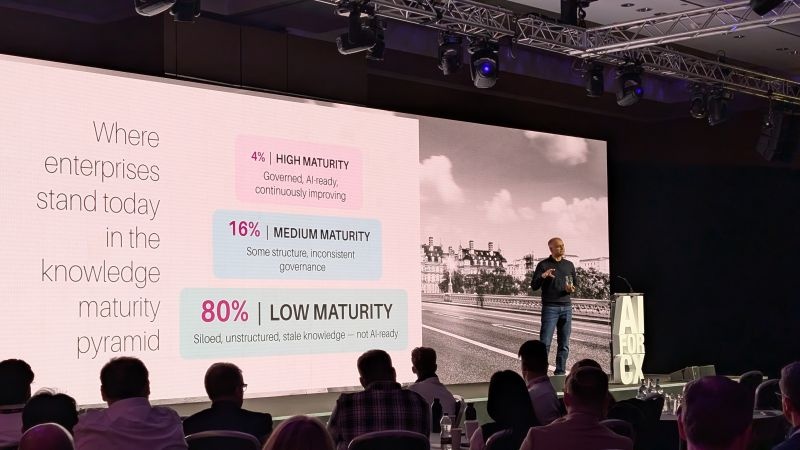
When generative AI entered the conversation, Roy paid attention to the people maintaining the answers. In 2023, he described using AssistGPT to identify gaps in customer conversations, suggest draft material and improve existing content. Knowledge authors and managers were an early focus.
That choice reveals a useful ordering of the work. Before an automated assistant can answer a question reliably, someone has to establish what the answer is. Drafting can become faster while review, control and ownership still matter. A fluent paragraph cannot approve its own refund policy.
Roy also described a gradual adoption process, with an initial trial followed by deployment and expansion. eGain’s separate Innovation in 30 Days program offered a guided production pilot, business measurements and no obligation to buy. It was a concrete way to put the technology in front of the awkward conditions that demonstrations tend to leave outside the room.
Who owns what the company knows?
In November 2025, Roy turned his attention to the executive table. His essay on knowledge stewardship asked who, inside a business, was responsible for the procedures and expertise that made work possible. Customer and financial data had recognizable owners. Business knowledge could disappear between departments.
This is where his argument becomes organizational rather than merely technical. Giving a company more storage does little to settle who must update a procedure. Connecting another application cannot decide whose account of a rule is authoritative. An AI assistant inherits these unresolved questions along with the documents.
Roy urged CEOs and boards to give knowledge explicit ownership, funding and a place in AI planning. That is also a sales argument for the category in which eGain operates. Its practical force is easy to understand: someone should be answerable for the information from which an automated answer is made.
The engineer returns to the instructions
In June 2026, he gave the idea a more technical formulation in an essay titled “Knowledge is Instruction for AI.” His claim was that company policies, procedures and accumulated expertise increasingly determine how language-model applications behave. They deserve engineering discipline comparable to the discipline applied to code.
He proposed familiar habits: tracking changes, reviewing revisions, testing outputs and measuring what happens in use. Read as a view of his own career, the argument brings the software engineer back into the picture. The object requiring care has expanded from a program to the language on which a program relies.
This remains Roy’s thesis about enterprise AI, with all the commercial interest that comes with it. But it asks a concrete question of any proposed deployment: when the business changes its instructions, how will anyone know whether the automated answers changed correctly? A launch date provides no answer to that.
The numbers have two speeds
The company’s recent results put a useful limit on any easy story of reinvention. For the fiscal year ended June 30, 2026, eGain reported $91.1 million in revenue, up 3 percent. Revenue from AI customers grew 20 percent. Roy attributed the overall pace to growth in AI Knowledge alongside a managed decline in legacy business.
Those are different measures, and they should remain different. The faster-growing activity sits inside a company with an older product base. A founder leading the same business for nearly three decades must handle both sides of that transition, including the customers whose needs predate the latest terminology.
In March 2026, the AI Knowledge Hub had reached $48 million in annual recurring revenue, up 26 percent year over year. Those earlier figures describe that product at that point in time. They offer evidence of demand, while the full-year total reminds the reader that a promising direction and rapid company growth are separate propositions.
The answer needs upkeep
On October 13, 2026, eGain introduced AI KnowledgeOps, a framework for continuously maintaining the knowledge used by AI. The accompanying capabilities included a tool called What Your Customers Ask, or WYCA, designed to group questions from customer conversations so teams could see where to concentrate their work.
The process starts with actual questions, checks the available content, closes gaps, tests answers and feeds performance back into the next revision. Roy’s stated aim is to make correct answers and actions repeatable even as products, policies and the business itself change.
The latest vocabulary is more elaborate than email management. The underlying predicament is familiar. A person asks something; a company needs to know what it means before it replies. Roy’s career has followed that exchange from a crowded internet inbox to a machine speaking on a business’s behalf. The reply can arrive almost instantly now. Keeping it worth receiving still takes work.