The founding problem was not artificial intelligence. It was email. At WhoWhere?, the internet directory Ashu Roy co-founded in the 1990s, thousands of user messages were arriving with the unruly confidence of a new medium. Every question wanted an answer. The useful answer might exist, but finding it, keeping it current and delivering it without exhausting a human team was another matter. Roy and co-founder Gunjan Sinha recognized a software problem hiding inside the inbox. In September 1997, they started eGain.
Nearly three decades later, the interfaces have changed their clothes several times. Email was joined by web self-service, chat, social channels, contact-center tools and conversational AI. Software moved from corporate servers to the cloud. The customer never stopped wanting the same thing: a correct answer, delivered before patience expires.
That continuity explains Roy better than a chronology of product names. He is an engineer who has spent his career on the border where stored information becomes an action. Generative AI has made that border fashionable. Roy's response has been to make it operational.
“AI isn't a differentiator. AI is a commodity.”Ashu Roy, 2024
The engineer before the entrepreneur
Roy's education reads like a deliberate stacking of lenses. He studied computer science at IIT Delhi, earned a master's in the subject from Johns Hopkins, then added an MBA from Stanford. From 1988 to 1992 he held software engineering roles at Digital Equipment Corporation, a company built for the era when computers were physical presences and reliability was an engineering fact, not a marketing mood.
In 1993, he co-founded Parsec Technologies, a call-center software company based in India. Two years later came WhoWhere?, the internet service that put him and Sinha close enough to the customer-email problem to feel its weight. This was not a salon conversation about the future of communication. It was a queue.
Software engineering at Digital Equipment Corporation.
Co-founds Parsec Technologies, focused on call-center software.
Co-founds and chairs internet-service company WhoWhere?.
Co-founds and leads eGain through web, cloud and AI cycles.
eGain's first product was a web-based system for responding to customer email. In 1999, the company went public on Nasdaq. A 2000 interview caught Roy explaining three strategic bets: native web architecture, a platform rather than a narrow point solution, and hosted delivery for businesses that did not want to maintain every application themselves. Today those choices can sound inevitable. They were not inevitable when offices still whirred with dial-up modems.
The bets also reveal a habit. Roy likes to place technology inside the constraints of an operating business. Who will maintain it? How will separate applications share context? What happens when the customer changes channels halfway through a problem? A trend becomes interesting when it survives those questions.
A company shaped like its question
eGain grew from email response into a suite for customer engagement and knowledge management. Its software now sits alongside customer-relationship and contact-center systems, helping enterprises organize answers for agents and self-service users. The clients tend to be large organizations, including companies in regulated industries where a plausible answer can be worse than no answer.
That qualification matters. Consumer AI trained people to marvel at fluency. Customer service imposes a sterner test. Is the refund policy current? Does it apply in this jurisdiction? Can the agent explain the answer? Will the same question receive the same treatment tomorrow?
Roy describes service as a collection of moments that creates “a sense of trust, concern, and assurance.” The language is gentler than the machinery behind it. Enterprise knowledge is usually scattered across websites, PDFs, content systems and the memories of experienced employees. Some of it conflicts. Much of it ages quietly. A model can read this disorder faster than a person, then repeat it with polished grammar.
The three-layer cake
When asked in 2024 where AI would create value, Roy offered a cake. Graphics processors form the bottom layer. Models sit in the middle. Applications occupy the top. The business value, he argued, would come from the applications. Chips and raw models are ingredients available to many buyers. The differentiated work is applying them to a business environment, its data and its content.
It is a founder's argument, naturally favorable to the layer where eGain works. It is also a useful correction to an industry that can confuse technical scarcity with customer value. A contact-center agent does not experience a model parameter. The agent experiences whether the suggestion on screen resolves the call.
Roy's advice has therefore favored small, testable deployments over magnificent transformation diagrams. In interviews he has described a crawl-walk-run path: begin with a focused use case, secure internal sponsorship, prove it and then scale. eGain formalized a version of this impulse in an “Innovation in 30 Days” program. The calendar makes the claim wonderfully falsifiable.
“The business value is going to come from apps.”Ashu Roy, explaining his AI stack
Knowledge graduates from documentation
In 2026, Roy gave his long-running idea a sharper formulation: “Knowledge is instruction for AI.” Traditional software separated instructions, written as code, from data. Engineers learned to version the code, review it, test it, monitor it and roll it back when things went wrong. Generative AI muddles that division. A system's behavior is now shaped by the policies, procedures and manuals it retrieves at the moment of an answer.
If the manual is stale, the answer may be obsolete. If two policies contradict each other, the system has inherited an argument. If nobody owns the corpus, no amount of model fluency creates accountability. Roy calls the proposed discipline AIKnowledgeOps. Its basic move is to treat knowledge with the seriousness already applied to production code.
Before changing the model, audit the instruction layer: authoritative sources, ownership, version history, conflicting policies, test questions and feedback from real use.
The framework maps familiar engineering practices onto knowledge work. Source and curate the material. Govern access by audience and risk. Publish it into retrieval and agent systems. Measure how the answers perform. Improve the corpus as failures reveal themselves. Roy also argues for a “knowledge engineer,” a role combining editorial judgment, systems thinking and domain expertise.
There is a pleasing bit of history here. A computer scientist who began work at Digital Equipment is using the discipline of software engineering to elevate the status of the company handbook. The humble document has acquired runtime consequences.
The long tenure and the new vocabulary
Twenty-nine years is a peculiar amount of time to lead one software company. It includes several periods when eGain's vocabulary changed more dramatically than its underlying concern. In 2010, Roy wrote about rebuilding after the dot-com collapse and the uneven rhythm of enterprise deals. In the following decade, the language turned to cloud customer engagement and digital transformation. Then came knowledge hubs, generative AI and agents.
The through-line is less glamorous and more durable: helping a large organization answer consistently when its information is fragmented. Roy did not predict every label. He stayed close to a problem capable of acquiring new labels.
The current business offers evidence that the latest label has commercial weight. For the quarter ended March 2026, eGain reported AI Knowledge Hub annual recurring revenue of $48 million, up 26 percent from a year earlier and equal to 64 percent of total SaaS annual recurring revenue. Roy also opened Solve26 London with a keynote connecting governed knowledge to agentic customer service. The slides had changed. The old inbox was still in the room, now multiplied across every repository an AI can search.
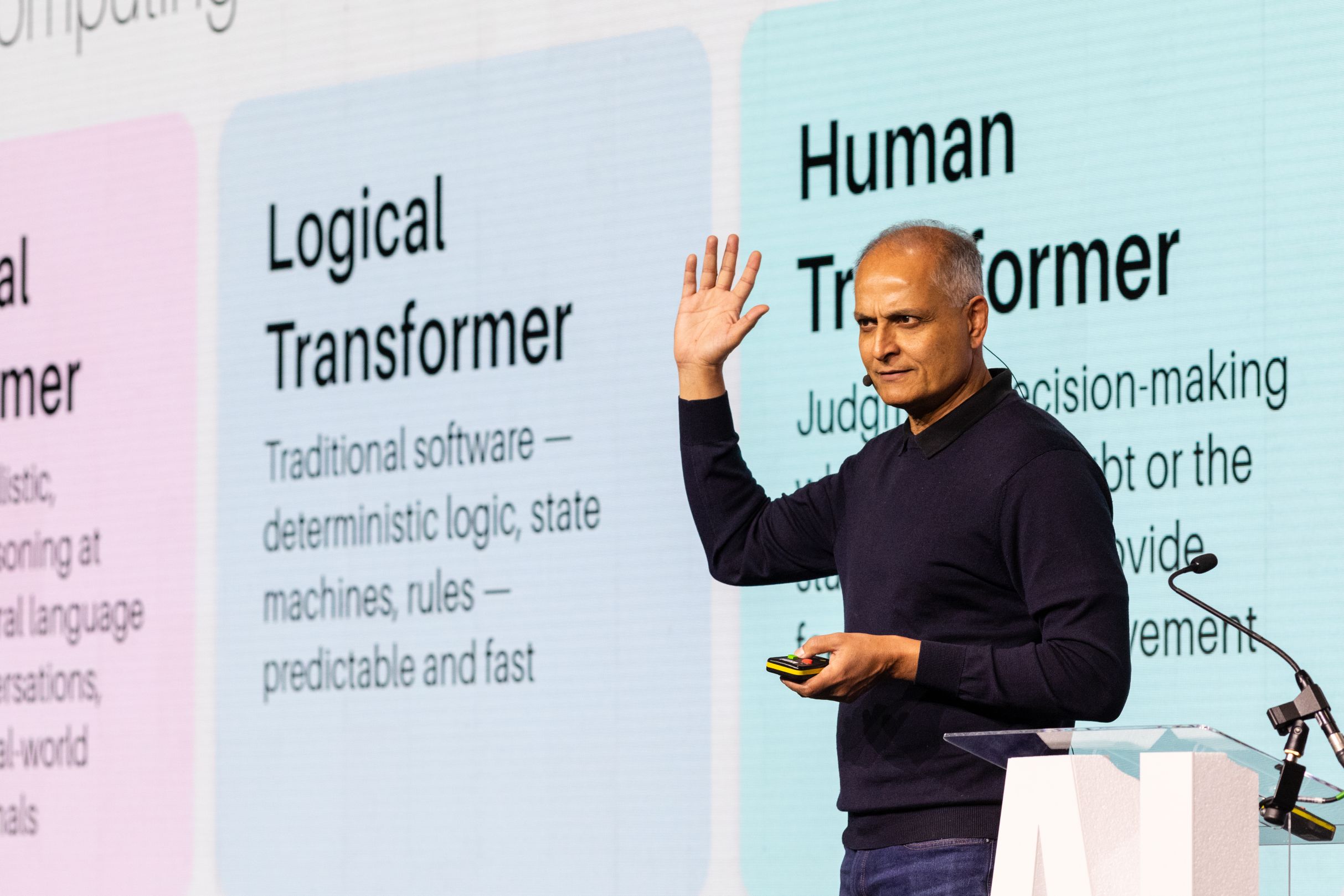
Roy's public manner is measured, fond of frameworks and suspicious of spectacle. At a 2024 conference, he asked the audience who was getting positive results from AI. No hands went up. One can imagine a more promotional executive changing the question. Roy used the silence.
The answer behind the answer
The practical appeal of Roy's thesis is that it gives leaders somewhere to look when a polished demo fails in production. The failure may not begin in the model. It may begin in the seven places where the company describes one policy differently. Fixing that problem requires editors, operators and subject experts as much as data scientists.
It also places a limit on magical thinking. Organizational knowledge is political in the ordinary sense: departments disagree, policies carry consequences and somebody must decide which version is authoritative. AI can expose this work. It cannot excuse the organization from doing it.
So the story that began with too many emails arrives at a surprisingly human conclusion. Better answers depend on clearer ownership, better writing, careful review and attention to what happens after release. The machine makes these old virtues easier to scale and harder to avoid.
Roy has spent 29 years building around the moment before an answer reaches a customer. The moment is faster now. The voice may be synthetic. The obligation remains stubbornly recognizable: know what you mean, and mean the same thing tomorrow.