At a company meeting, Mark Gazit asked a modest question. Had anyone recently sent money overseas? One employee had tried to send some to her mother in Eastern Europe. Gazit asked whether it had taken a few days. It had not arrived at all. The transaction had been rejected. Here was the problem his company wanted to solve, sitting in the same room as the people building the solution.
Gazit has returned to the question of access across several businesses. At SkyVision, it concerned places that needed an internet connection. At ThetaRay, which he co-founded and led for ten years, it concerned financial institutions trying to distinguish legitimate payments from criminal activity. Today, as founder and CEO of Marga AI, he is working on access to expertise. Looking across that career, a pattern emerges: useful things exist, but reaching them remains surprisingly difficult.
A teenage alarm, an early education
Gazit moved from Latvia to Israel at ten. As a teenager, he was already interested in computers and electronics. At seventeen, he recalled, he helped build an alarm system that would telephone the police when a burglary occurred. A company they approached told them the product would not sell. A year later, he saw such a product on shop shelves. For a young inventor, it was a brisk introduction to the distance between making a device and making a business.
His route into professional technology included service in the Israeli Air Force. He later held roles at NetMedia, NetVision and Deltathree, working through the period when internet access and voice services were becoming businesses people could buy. These were practical questions: how to connect a customer, carry a call and build something reliable enough that someone would keep paying for it. The internet was acquiring invoices as well as users.
His formal studies ranged from computer science and mathematics coursework at the Hebrew University to business education at Tel Aviv University and executive programs. The mixture fits his subsequent career. Gazit’s work has required explaining technology to people who must decide whether to trust it, fund it or put it in front of their own customers.
The overlooked side of the internet boom
During his SkyVision years, Gazit worked on a lopsided communications market. In parts of the developed world, investment had produced more infrastructure than demand could immediately absorb. Other markets still lacked dependable international connections. His company supplied connectivity to local internet providers and telecommunications businesses, using satellite links to bridge gaps in the existing network.
That distinction mattered. SkyVision did not have to become the local provider in every country. It could provide the international connection while working with businesses that understood the customers. In 2005, Gazit described learning that local knowledge was essential. Language, business practices and relationships could not simply be shipped from headquarters with the equipment. Even a satellite business eventually has to come down to earth.
One concrete project was a World Bank-funded agreement to connect a university in Maputo, Mozambique. Announced in 2005, the deal combined internet service with the equipment needed to establish the connection. It placed a familiar technology in a setting where the missing link carried a different weight. A university’s access to the wider network is an opportunity for many people, although it appears on a contract as one customer.
An editorial reading of three chapters, each with a different barrier to access.
By 2008, SkyVision was operating in fifty developing countries. Gazit was discussing potential work involving Chinese companies in Africa, a reminder that international expansion rarely follows one neat line between home and abroad. The customer, the financing, the infrastructure and the place of use may all have different addresses. His business experience was being assembled across those intersections.
Teaching a machine to notice
Before ThetaRay, Gazit led NICE Cyber & Intelligence Solutions, a division providing technology to government agencies. ThetaRay, founded in 2013, brought him together with the mathematical work of professors Amir Averbuch and Ronald Coifman. Their research concerned detecting anomalies in complicated data. Gazit’s task as founding CEO included turning that research into a company with customers, staff and a reason to renew the contract.
In 2014, he described a broad field of possible uses. A power facility might need to examine information from its turbines alongside network data to spot something unusual. Looking at one stream alone could leave out the useful clue. ThetaRay’s early ambition extended across critical infrastructure and financial institutions; the central idea involved identifying subtle departures in combinations of data.
“The real power behind the company is the people.”
Mark Gazit, discussing ThetaRay’s early team
The company raised a $10 million Series B in 2014, with backers including GE, JVP and Poalim Capital Markets. The mix brought industrial, venture and financial interests around the same table. At that stage, the business still had to demonstrate where its mathematics would become useful enough to buy. Detecting an oddity is a beginning. Helping a customer decide what to do about it is the longer job.
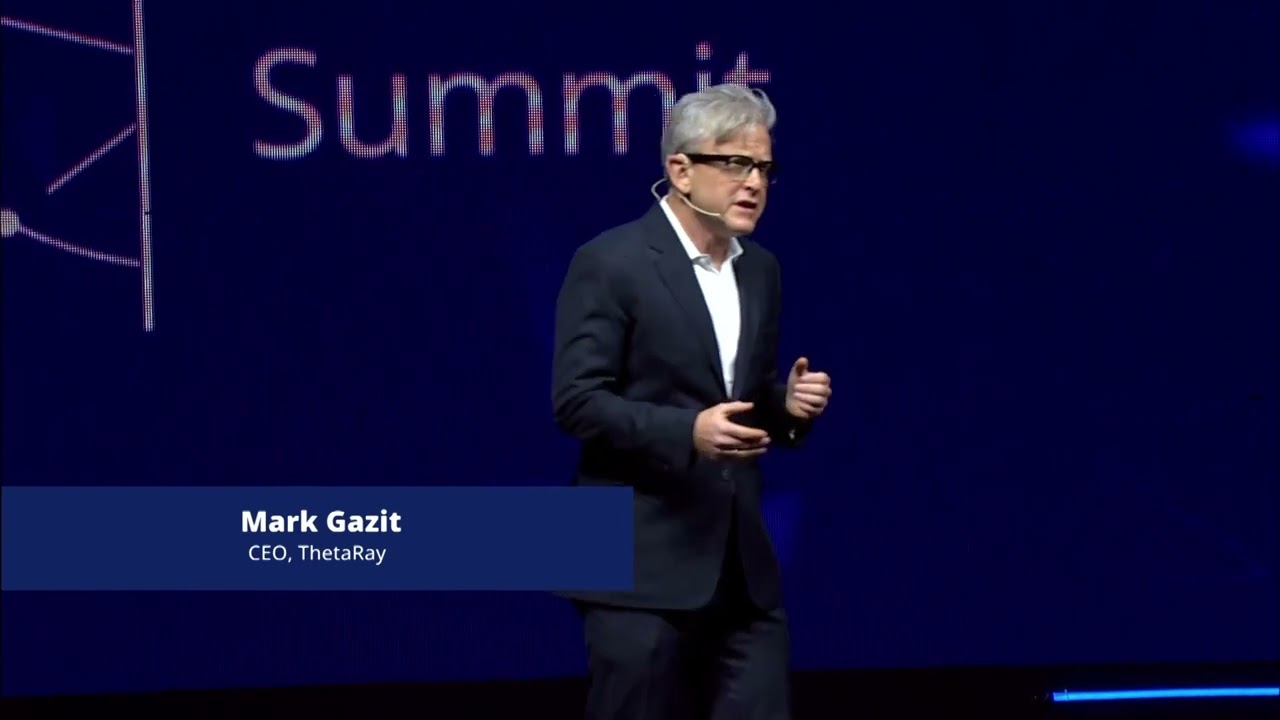
Gazit also took the argument to a public audience. At a 2018 TEDx event at Ben-Gurion University, his subject was the theft people may never notice. It was a useful way into an otherwise technical topic. A victim does not necessarily receive a courteous notification that the crime has begun. Detection has to cope with the absence of an obvious announcement.
The payment that never reached a mother
As ThetaRay focused on financial crime, Gazit argued for examining security alongside financial inclusion. A bank has reasons to scrutinize a transfer. A customer has reasons to need it completed. The rejected remittance he recalled from his own workplace put both concerns into one small story. The sender’s intention was ordinary. The outcome was a closed door.
“Money movement creates opportunities for everybody,” he said. His argument was that better detection could help institutions serve legitimate customers in places they might otherwise avoid. That was the ambition behind the business, rather than a claim that every rejected transfer could be solved by one product. The relevant question was how a financial institution could gain enough confidence to let lawful activity proceed.
He treated adoption as a management problem too. In a 2019 banking podcast, he emphasized the role of leadership in creating a culture capable of using AI. Buying software leaves an organization with further work: people need to understand it, incorporate it into their responsibilities and act on its output. The executive cannot outsource the entire change to the procurement department.
ThetaRay’s reported results over the two years before the June 2023 CEO handover, when Gazit and Peter Reynolds worked together. ARR means annual recurring revenue.
In June 2023, Gazit handed the CEO role to Reynolds, previously the company’s chief revenue officer, and moved into an advisory role. The company reported fivefold growth in annual recurring revenue and more than fifty new customers during their preceding two years together. The distinction between the founder and the current chief executive now matters to his biography. ThetaRay remains a major chapter; Gazit has continued into others.
Trust takes the slower connection
One clue to his operating style appears in his writing about doing business in the United Arab Emirates. He urged visitors to learn the culture, respect local regulations and recognize that an investment should bring value to the local economy. He stressed dependable early customers and patience. His advice allowed for ambition, while asking the ambitious visitor to understand the room.
That sensibility connects with the earlier SkyVision experience. A technology company may have something useful to sell and still need help understanding how a market works. Gazit’s UAE advice included the value of training local teams. Expertise, relationships and economic benefit all had to travel in both directions. The sales presentation could open a conversation; it could hardly stand in for one.
His later roles extended that interest in how organizations function. In May 2024, N.E.W.S. Navigation announced him as executive chairman. The Switzerland-based business works on leadership and organizational navigation through its NEWS Compass methodology. In July 2025, he joined ONAR’s board, bringing his technology and international operating experience to a marketing technology business. His work was moving beyond the particular problems of financial monitoring.
Another kind of scarce bandwidth
Marga AI brings that next phase into focus. The company develops interactive AI representations of mentors, built around their expertise, methods and way of communicating. Its public roster includes organizational thinkers Ichak Adizes and Aviad Goz. Gazit’s current leadership team includes CTO Yuri Krichevsky. The enterprise asks whether a useful conversation with an expert can become available to more people than the expert could personally meet.
The company describes safeguards including boundaries around a mentor’s knowledge, human verification and controls intended to prevent invented answers. These are its stated design choices. They matter because a representation of a named person carries a particular expectation: the response should remain faithful to what that person teaches. A fluent answer alone would leave the central promise untested.
In his December 2025 conversation with Ashutosh Garg, Gazit discussed AI as a way to extend human wisdom. By January 2026, he was promoting a session with Goz on combining human judgment with AI in leadership. The satellite connection and the AI mentor are very different products. Yet each begins with a person who could benefit from something beyond immediate reach. Gazit keeps finding businesses in the distance between the two.