An ordinary light switch has an unreasonable job description. It must summon electricity immediately, cost very little to use, and conceal everything required to make the first two things possible. Nobody pauses with a finger on the switch to consider a transmission constraint. The room is either lit or it isn’t. Maria Pope runs a business in which that tiny domestic verdict arrives all day long.
Pope has been chief executive of Portland General Electric since January 2018. Before that, she was its president, its power-supply executive, and its chief financial officer. Her preparation for the job included investment banking, software, and forest products. It is a career that has moved steadily closer to physical consequences: from financing businesses to overseeing machines to answering for an electricity system.
The result is an executive whose public conversations keep returning to the same practical subjects. How does new power reach customers? Who pays for the wires? Can a growing technology industry help support the network without leaving households with the bill? These questions give her story its tension. A cleaner grid can be an engineering achievement and still be a difficult expense for the person opening the envelope.
From the balance sheet to the control room
Pope earned her bachelor’s degree at Georgetown University in 1987 and her MBA at Stanford in 1992. She began her career with Morgan Stanley. Subsequent jobs took her through operating and finance responsibilities in several industries, including the chief financial officer’s role at Mentor Graphics, the electronic-design software company.
She had already served on PGE’s board from 2006 through 2008 when she joined the management team as CFO and treasurer in 2009. In 2013, she moved into power supply, operations, and resource strategy. Her responsibilities now included generation facilities, the energy portfolio, wholesale activity, and decisions about the resources the company would need years later.
That move matters to understanding her, because Pope has described operating experience as invaluable to her career. Running divisions helped her understand what drives a business and where its risks sit. Her advice to younger people combines depth with range: develop expertise in something that matters to you, then learn enough about the wider organization to see what comes next.
It is advice with an observable counterpart in her own working life. The former finance chief spent years overseeing power operations before becoming president in October 2017. The CEO title followed on January 1, 2018. The sequence gave her time with both the money and the machinery. In a utility, a decision about one tends eventually to become a decision about the other.
Three technologies, one address
At Wheatridge, near Lexington in eastern Oregon, the transition she oversees can be read in three numbers: 300 megawatts of wind, 50 of solar, and 30 of battery storage. The wind farm started operating in December 2020. Solar and batteries followed in spring 2022. That September, PGE and NextEra Energy Resources celebrated the combined facilities.
The distinction between generation and storage is worth keeping. A battery does not supply a new primary source of energy; it lets electricity made at one time become useful at another. Wind, sunlight, and stored power each have different schedules. The purpose of putting them together is to make those schedules more helpful to customers.
This is the practical territory Pope had been exploring before the project’s completion. Asked about electric vehicles in 2020, she discussed charging them when wind was available and using the timing of demand to help the grid. She also described a future in which vehicle batteries could send electricity back. At the time, she was clear that this latter idea was a prospect, rather than something PGE was implementing.
A bus depot therefore becomes part of the electricity conversation. So does a delivery fleet. Pope’s work with transportation partners, including TriMet and Daimler, widened the utility’s job beyond supplying a meter. The ambition depends on charging equipment, coordination, and people choosing when to plug in. Even the future has to find a parking space.
Different jobs. Shared ground.
The work before the weather
Operations impose a less photogenic discipline, too. In a 2021 interview, Pope explained that emergency preparation belongs on days when nothing appears to be wrong. Her phrase was “we prepare for them on blue-sky days.” A clear forecast is an opportunity to do the work that a bad forecast will expose.
The September 2020 Oregon wildfires had made the stakes immediate for her workforce. Pope said roughly one-fifth of PGE’s employees had either evacuated or been ready to leave their homes. The company also shut off power proactively to reduce risk. The people responsible for operating the system were themselves living inside the emergency.
Her account places the employee alongside the infrastructure. An evacuation warning does not politely wait until a shift is over. A utility must prepare equipment, coordinate with public agencies, and sustain a workforce through the same conditions it is asking that workforce to manage. For Pope, reliability has this human dimension as well as an electrical one.
“Every part of our operations must deliver customer value.”Maria Pope / 2025
A line across the Cascades
On December 1, 2023, Pope joined Jonathan Smith, chairman of the Confederated Tribes of Warm Springs, in Madras to mark a transmission partnership. The setting was the Pelton Round Butte hydropower project. The undertaking was an upgrade to the 230-kilovolt Bethel-Round Butte line, supported by a $250 million federal grant awarded to the Tribes.
The project was intended to improve a route connecting resources east of the Cascades with customers in the Willamette Valley. It also aimed to open opportunities for renewable development on the reservation. Transmission access had been an obstacle to Tribal renewable-energy goals. More capacity could have an economic purpose as well as an electrical one.
The celebration began with a Tribal Council blessing. Studies, design, permitting, and construction still lay ahead. The photograph records a beginning, with all the slower work a beginning entails. It is a useful corrective to the way infrastructure announcements can sound complete the moment the microphone is switched off.
Here, Pope’s dependence on other institutions is visible. A utility chief can authorize work within her company; a project crossing communities and jurisdictions requires agreements beyond it. The relationship with Warm Springs gives that abstract word, partnership, a location and two people standing beside one another.

The cloud needs a power connection
By 2026, the demand side of Pope’s assignment was becoming harder to ignore. PGE reported that industrial electricity demand grew about 11 percent year over year in the second quarter, driven by high-tech and data-center customers. For the full year 2025, the company had reported industrial growth of 14 percent.
These are consequential customers for an executive with a technology-sector past. A data center’s digital services depend on physical generation and a dependable connection. The cloud has a surprisingly extensive ground floor.
Pope also has worked on the policy side of that connection. Her industry roles have included chairing the Edison Electric Institute and the Electric Power Research Institute, and co-chairing a high-tech and data-center working group for the U.S. Secretary of Energy’s advisory board. They put her in discussions where utility planning meets the ambitions of other industries.
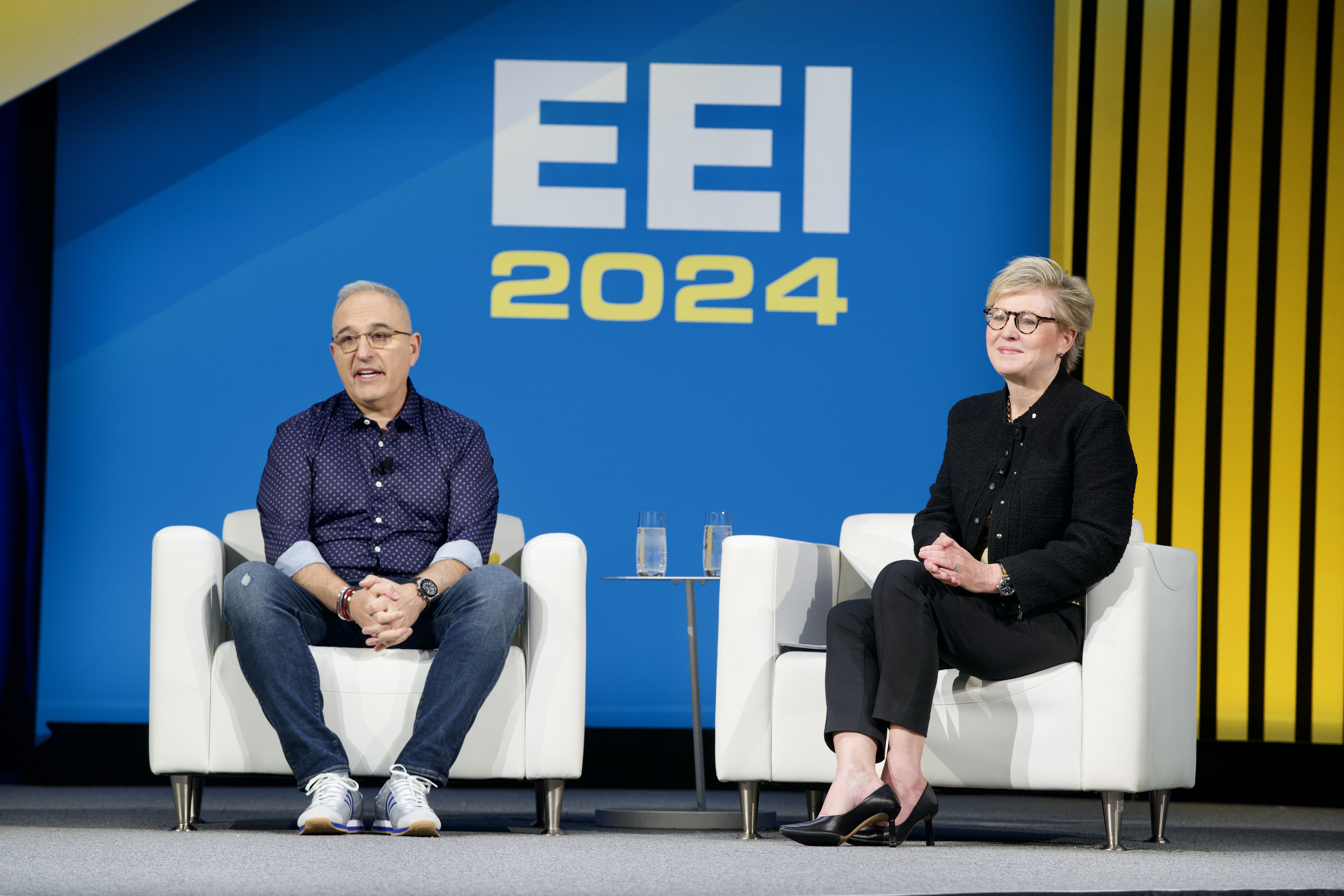
At EEI’s 2024 gathering, she shared a stage with Hewlett Packard Enterprise chief Antonio Neri. The pairing illustrates how closely the two businesses now meet: computing companies need electricity infrastructure, while electricity companies increasingly use computing to operate their systems. Their investment calendars have to find some common ground.
PGE’s next geographic step also remained a proposal with work attached. In February 2026, it announced an agreement with PacifiCorp for Washington utility operations and selected assets, in a $1.9 billion transaction involving Manulife Investment Management. About 140,000 Washington customers were covered by the proposed acquisition. PGE subsequently described an expected closing in mid-2027, subject to approvals. An agreement belongs on a different line of the ledger from a completed purchase.
The bill is part of the biography
Any account of Pope’s leadership has to spend time with the customer bill. PGE’s residential rates rose 18 percent at the start of 2024. In April 2026, regulators approved adjustments expected to add about $7.97, or 5 percent, to a typical residential monthly bill. Those are material changes to a recurring household expense.
The April decision reflected several filings, including updated power costs, approved storm expenses, distribution investments, and other adjustments. Their technical explanations do not make the household calculation disappear. A customer can understand why equipment costs money and still struggle with the amount being charged.
In July 2026, PGE proposed a further residential increase of about 3.9 percent for the following summer. Oregon’s Citizens’ Utility Board argued that residential customers were already paying too much and remained assigned too much of the company’s costs. The request required regulatory review. It was a proposal, with a dispute around it, rather than a settled price.
At the same time, a new large-customer tariff changed how costs were allocated. PGE said in its second-quarter announcement that data-center pricing was increasing approximately 30 percent while costs fell for other customers. Pope described that approval as the product of years of legislative and regulatory work.
The company’s 2025 annual report also reported more than $25 million in reductions to its cost structure and a 46 percent share of energy from clean, non-carbon-emitting sources. Those measures belong beside the rate changes. Together, they show why the job resists a single score. More clean power, lower operating costs, and a higher household bill can appear in the same account.
Expertise that has to travel
Pope’s career has given her reasons to move between different kinds of expertise. She has worked in finance, operated energy assets, and participated in civic and industry boards. Her public record suggests that the usefulness of any one specialty depends on whether it can travel to the next problem.
Her early work in banking did not tell her when a fleet should charge. Experience in software did not settle a transmission route. Each new responsibility required more people at the table and more details to understand. That is what makes her advice about developing expertise while broadening one’s view feel earned.
The test ahead remains unusually concrete for a person whose work involves so many forecasts. New resources must arrive when needed. Infrastructure must perform. Growth must pay an appropriate share of its costs. Customers will encounter the results through service they rely on and bills they have to pay.
Then someone will walk into a room and reach for the light. For all the planning, bargaining, construction, and capital behind it, the switch will still offer only two positions. Pope’s task is to make that small gesture dependable while changing much of what happens on the other side of the wall.