Before Bob Frenzel had to explain electricity bills, he had to help run a nuclear power plant on an aircraft carrier. His first career job was aboard the USS Dwight D. Eisenhower. A floating power station is an unusual graduate placement. It does, however, make the connection between energy and everything else rather difficult to miss.
Today, as chairman, president and CEO of Xcel Energy, Frenzel is making a related argument on land. Artificial intelligence may arrive on a screen, but its expansion requires turbines, transformers, transmission lines and people who know how to install them. The future has a surprisingly large order for concrete.
His career has moved through engineering, banking and power generation before arriving in Minneapolis. That sequence matters. The person asking customers and regulators to accept years of construction has worked with both the machinery and the money. Neither discipline offers much sympathy when a beautifully presented plan fails to add up.
A reactor before the boardroom
Frenzel earned an industrial engineering degree at Georgia Tech, graduating in 1992. He also completed the Navy’s Nuclear Power School. His six years on active duty included service as a nuclear engineering officer and weapons officer; afterward, he served in the Navy Reserve and reached lieutenant commander.
The shipboard beginning gives his energy career a physical origin. Electricity was already a working responsibility before it became an investment proposition. His later positions would require a different vocabulary, but the underlying subject stayed familiar: generating power, organizing resources and keeping an operation running.
Consulting followed, at Arthur Andersen, then investment banking at Goldman Sachs. From 2002 to 2009, he worked in Goldman’s investment banking division, becoming a vice president. His MBA came from the University of Chicago Booth School of Business. An engineering education had acquired a financial companion.
In 2009 he joined Energy Future Holdings, working on corporate development, strategy, mergers and acquisitions. In 2012 he became CFO of its electricity-generating subsidiary, Luminant. Energy Future Holdings filed for bankruptcy in 2014 and emerged in 2016. His résumé includes experience inside a business confronting financial distress, alongside the promotions.
Those years supply useful context for a utility chief’s current enthusiasm for investment. New demand can support new assets; financing and execution still decide what happens next. A career that passes through both a reactor and a restructuring offers plenty of reasons to read the small print.
- 2016Chief financial officer
- 2020President & COO
- Aug 2021President & CEO
- Dec 2021Chairman added
Learning the company in three jobs
Xcel hired Frenzel as chief financial officer in 2016, succeeding Teresa Madden. His responsibilities covered finance, tax, accounting and corporate development. In March 2020, he became president and chief operating officer, overseeing four utility operating companies as well as transmission, distribution and natural gas operations.
That second job broadened the assignment from allocating capital to overseeing the businesses using it. In August 2021, he succeeded Ben Fowke as president and CEO. The chairmanship followed in December. The succession gave him several years inside Xcel before he took the top position.
It also handed him an existing clean energy ambition. Xcel had announced its vision for carbon-free electricity by 2050 in 2018, during Fowke’s tenure. Frenzel’s task has been to carry that direction through a period when the expected appetite for electricity has changed substantially.
A successor can inherit a destination without inheriting the road conditions. More data centers, new industrial loads and electrification make the balancing act different. The company must plan additional supply while considering what existing customers will pay. A distant emissions target and next month’s bill occupy the same desk.
AI discovers the electricity meter
At the Minneapolis Federal Reserve’s January 2026 economic conference, Frenzel described an economy moving at different speeds. Ordinary growth across Xcel’s Upper Midwest territory looked relatively steady. Data centers were a faster-moving story. He was talking with Neel Kashkari about an industry that suddenly had technology developers at its door.
By June, Xcel reported a pipeline of roughly 20 gigawatts of potential data center demand. The word potential deserves its place in that sentence. A developer expressing interest and a customer taking electricity are different stages of a project. Construction decisions depend on how much of that interest becomes durable business.
Frenzel’s argument is that Xcel’s geography offers an advantage: access to renewable resources can help serve large new customers while continuing emissions reductions. That is a business proposition with conditions attached. Land, connections, equipment and commercial agreements all have to fit together before wind on a map becomes electricity at a building.
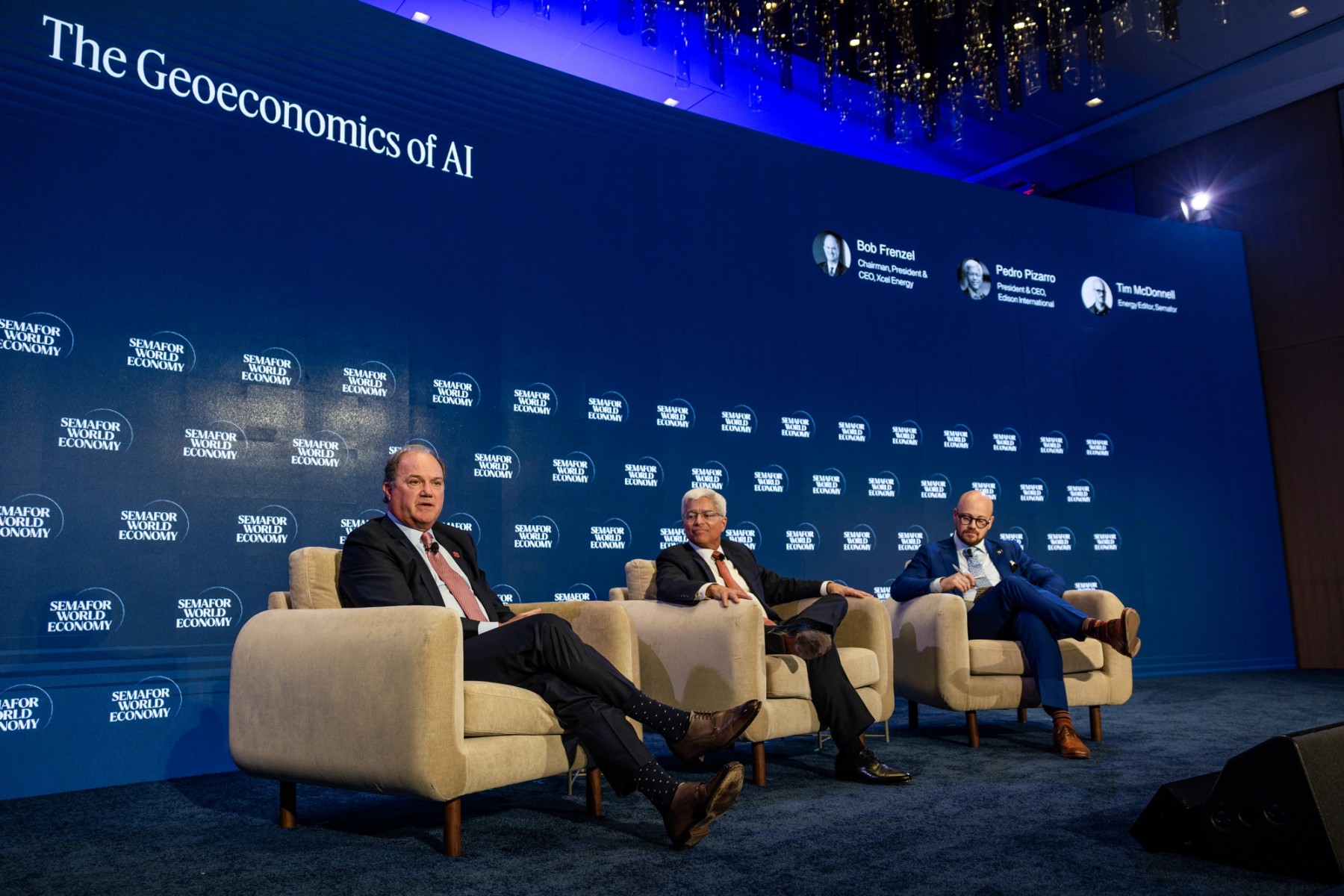
Speaking in Washington in April, he called for faster development of generation and transmission and coordination across federal, state and local government. “It’s not impossible to achieve,” he said. The qualification is revealing. His public optimism comes with a request for other people to make decisions, too.
At Minnesota Carlson that month, he returned to the relationship between electricity and economic activity. “Without electricity, you don’t have a bank, you don’t have a university, you don’t have research,” he said. For a former banker and engineering student, the examples were conveniently close to home.
The customer who brings a power plan
The proposed Google data center in Pine Island, Minnesota, puts the argument into a specific place. Announced in February 2026, the agreement couples a new electricity customer with plans for 1,400 megawatts of wind, 200 megawatts of solar and 300 megawatts of long-duration storage.
Google said it would pay the costs associated with its electric service. The arrangement uses a Clean Energy Accelerator Charge, a contract structure intended to support additional clean energy without moving those costs onto local customers. Google also committed $50 million to Xcel’s Capacity*Connect battery program.
A data center’s planned grid additions
There is a reason the contract deserves attention alongside the hardware. The economic case for adding a very large customer depends on who funds the expansion and who carries the risk. The agreement attempts to answer the question a household might reasonably ask: what does someone else’s server building have to do with my bill?
The distinction also keeps the story honest. Announced capacity describes plans. It does not establish that all the projects are built, connected or producing electricity. Frenzel’s challenge is to turn agreements into useful infrastructure while preserving the protections that helped make those agreements persuasive.
A transformer has its own calendar
The obstacles are stubbornly tangible. At the Fed conference, Frenzel described higher equipment prices, longer lead times and pressure on construction costs. A simple-cycle gas plant that once took about 18 months could now take four to five years, he said. Technology’s impatience meets a construction schedule.
That creates a planning problem. Waiting for absolute certainty about demand can leave a utility late. Building too far ahead can leave customers carrying assets they do not yet need. Both outcomes make for uncomfortable meetings. The work is deciding how to commit early enough without treating every inquiry as a guarantee.
“We need to look forward more and plan more.”
Bob Frenzel · January 2026
In September 2026, Xcel proposed a Texas tariff for large electricity users with long-term commitments, minimum monthly payments and termination provisions. The proposal requires regulatory approval. Its details show how the company wants to address projects that arrive slowly, shrink or disappear after infrastructure has been planned for them.
In October, Xcel separately proposed keeping Minnesota electric base rates flat for two years while continuing system investment. That request, too, needs approval. Base rates are one part of a bill. The proposal offers a specific measure of stability rather than a guarantee that every customer’s total payment will stay fixed.
These proposals make his broader argument available for public inspection. Customers do not have to share his excitement about computing to ask how its costs will be handled. Regulators, in turn, can examine the obligations behind the growth forecast. For Frenzel, persuading those audiences is part of the operating job, just as surely as arranging the next investment.
The responsibilities that stay on the ground
Growth is only part of Frenzel’s assignment. In September 2025, Xcel announced a $640 million settlement of Marshall Fire claims while admitting no fault. Wildfire exposure puts a different set of demands on utility leadership: preventing ignition, communicating risk and answering communities whose concerns are immediate.
Frenzel has discussed using Pano AI cameras to spot fires early, alongside the company’s work to strengthen its system. His AI agenda therefore runs in two directions. Xcel supplies electricity to the computing economy and uses computing tools in its own operations. Their usefulness has to be judged where the equipment meets the landscape.
His connections extend beyond Xcel. He serves on boards including Greater MSP, the Minnesota Business Partnership and nuclear industry organizations. Georgia Tech lists him as chair of its advisory board for 2026-27. The roles place him among regional employers, energy operators and the institution where he began studying engineering.
His advice to students is more personal than an infrastructure program. Choose work that interests you, put effort into it and take responsibility for your career. He describes authenticity as a leadership value. Away from work, his stated interests include family time, baseball fields, live music, golf and skiing.
There is something nicely ordinary about that list beside the reactor training and the gigawatts. Frenzel’s public ambition concerns infrastructure that will serve future generations. The nearer test arrives in homes and businesses every day: electricity available when needed, a bill people can manage, and a system worthy of their trust.
Continue the conversation
- Xcel Energy ↗Company website
- Bob Frenzel on LinkedIn ↗Personal profile
- The January conversation with Neel Kashkari ↗Watch on YouTube · Minneapolis Fed
- Navy beginnings and career advice ↗Minnesota Carlson · March 2026
- The Pine Island energy agreement ↗Google · February 2026
- Infrastructure and the AI challenge ↗Semafor · April 2026
- The Texas large-load proposal ↗Xcel Energy · September 2026
- Minnesota’s proposed base-rate plan ↗Xcel Energy · October 2026