Twenty years is a curious unit of time in the technology business. Products disappear. Platforms change their names. Yesterday's indispensable device becomes a drawer ornament. Yet twenty years is the promise Joe Dominguez keeps asking technology companies to make. At Constellation, the former engineer and federal prosecutor has helped turn the impatient ambitions of the digital economy into something the electricity business can use: a customer prepared to stick around.
Microsoft signed a twenty-year agreement tied to the planned revival of a Pennsylvania nuclear unit. Meta made a twenty-year commitment supporting an operating plant in Illinois. Amazon and Google followed with agreements announced in September and October 2026. Behind those announcements sits a fairly unglamorous problem. Equipment must be bought, people trained, permits secured and investment justified long before a power plant delivers an extra megawatt.
Dominguez's career has crossed the three worlds that meet at that problem: engineering, law and public policy. He now serves as Constellation's chairman, president and chief executive. His business involves machinery with long working lives and customers whose businesses can change almost overnight. Getting their calendars to agree has become a substantial part of the job.
A house with two kinds of ambition
Dominguez was born in Union City, New Jersey, to Cuban parents. His father worked in sheet metal and had wanted to become an engineer. His mother, who had not finished high school, read voraciously in English and Spanish. Education had a conspicuous place in the household. Her encouragement helped him pursue law after he first studied engineering.
He earned his mechanical engineering degree at the New Jersey Institute of Technology, graduating in 1984. The university later included him among its 2022 Alumni Achievement honorees. Rutgers supplied the next professional vocabulary: a law degree, earned magna cum laude, and recognition as a Dean's Scholar. The sequence gave him training in both how complicated equipment works and how complicated institutions make decisions.
His first plan for law was quite specific: become a patent lawyer. That intention lasted, he recalled, “about a coffee break.” Litigation proved more appealing. Another turn came when he pitched Exelon for outside legal work. Its lead lawyer, Bill Von Hoene, recruited him to work inside the company instead. He had arrived looking for a client and found an employer.
He became an assistant U.S. attorney in the Eastern District of Pennsylvania and a partner at White and Williams. In 2002 he joined Exelon. This was an education in the parts of electricity that happen away from turbines: litigation, regulation and negotiations over the rules under which power is produced and sold.
The machinery behind the meeting
From 2012 to 2018, Dominguez led Exelon's governmental and regulatory affairs and public policy work as executive vice president. In 2018 he became chief executive of ComEd, overseeing an electricity network serving more than four million customers in Chicago and northern Illinois. A policy argument now came attached to an operating obligation. Customers expected the lights to work.
In April 2019, speaking at the City Club of Chicago, he addressed climate change, solar energy, customer service and economic opportunity. Those subjects would recur in his later work. The connections were practical: changing the energy system requires equipment and investment, and it also creates work that someone must be prepared to do.
He has described his own preference as working “behind the scenes.” His advice to leaders included “create opportunities for others.” Together, those small phrases offer a less theatrical account of executive ambition than the usual biography. They place the emphasis on making an institution function and widening the entrance to it. He has also spoken about how feeling outside the mainstream can sharpen a leader's sensitivity to other people's experiences.
The attraction of that background, for an electricity business, is easy to see. Technical decisions have legal consequences. Legal decisions can determine whether equipment remains commercially useful. His résumé moves across both sets of questions, giving the current job a continuity that its collection of earlier titles might otherwise obscure.
His professional affiliations extend across that institutional world. He sits on boards including the Institute of Nuclear Power Operations, the Nuclear Energy Institute and Hispanics in Energy. KBR added him to its board in May 2024. These are connections across engineering, operational standards and representation, the same subjects that have occupied different stretches of his working life.
A new company with a long memory
In 2021, Exelon named Dominguez chief executive of Exelon Generation and incoming leader of the business that would become independent Constellation. The separation in February 2022 divided the competitive generation and energy supply business from Exelon's regulated transmission and distribution utilities. He had moved from managing a delivery network to leading a company that makes and sells power.
The distinction matters. Generating plants require customers, contracts and a reason for continued investment. A technically capable plant can still face a difficult commercial future. For Dominguez, preserving existing nuclear generation became a central part of the argument for a cleaner electricity system.
In a June 2022 address, he put nuclear energy alongside emerging uses such as clean hydrogen production and direct air capture. In March 2023, he urged congressional support for domestic nuclear fuel sources, pointing to dependence on foreign supply. His agenda reached beyond persuading customers to buy electricity. The plants needed fuel, operating permission and a policy environment that allowed them to keep producing it.
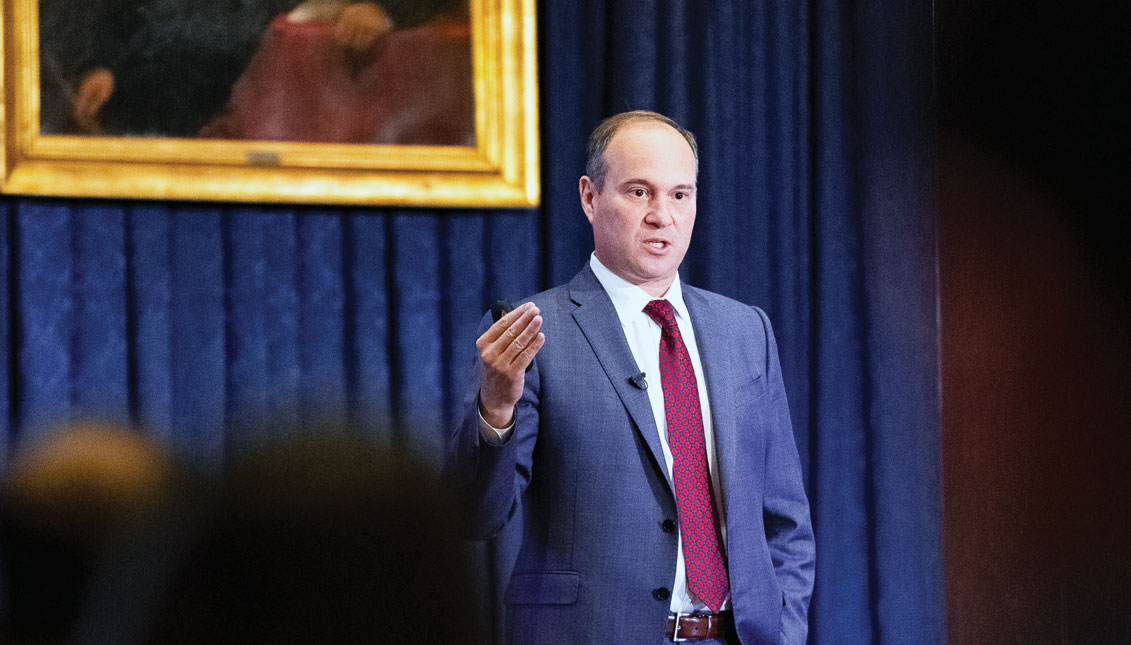
Joe Dominguez, discussing reliable power at Davos, 2026
The second life of Unit 1
That argument took a concrete form in September 2024. Constellation announced a twenty-year power purchase agreement with Microsoft supporting the restart of Three Mile Island Unit 1. The Pennsylvania unit had closed in 2019 for economic reasons. It is separate from Unit 2, the reactor involved in the 1979 accident.
Renamed the Crane Clean Energy Center in honor of former Exelon chief executive Christopher Crane, the project is intended to return approximately 835 megawatts of nuclear capacity to the grid. Microsoft's agreement supports matching its data centers' electricity use in the PJM region with carbon-free generation. The arrangement connects a new source of demand with equipment that already has a history.
By September 2025, Constellation had advanced the target restart to 2027 and reported about 500 full-time employees on site. That remained a project schedule, with regulatory work and physical restoration ahead. In November 2025, a federal loan guarantee of up to $1 billion supported the financing. A power purchase agreement can make an undertaking commercially plausible; the work still has to be completed.
That is part of the interest in Dominguez's position. He can argue for the value of nuclear generation in a conference room, then return to a business where value depends on inspections, training and equipment. An agreement has signatures. A restart has a much longer to-do list.
Four customers, several different jobs
Meta's June 2025 agreement addressed another problem. Its twenty-year commitment, starting in 2027, supports the continued operation of the Clinton Clean Energy Center in Illinois and provides for 30 megawatts of additional output. The announced 1,121-megawatt arrangement combines preservation with expansion. Keeping existing production available and adding capacity are both useful, but they describe different accomplishments.
Amazon's September 30, 2026 agreement supports investment at Maryland's Calvert Cliffs. The twenty-year contract covers 690 megawatts, including approximately 190 megawatts of planned new capacity. Those additions are scheduled for 2030 through 2032. Constellation described more than $3 billion of infrastructure investment. The schedule gives a sense of the distance between signing a deal and switching on its full benefits.
On October 6, Google and Constellation announced a twenty-year agreement supporting 890 megawatts of additional nuclear capacity through upgrades at eleven units in Illinois, Pennsylvania and New Jersey. The first increase is expected in 2028. A separate fifteen-year supply agreement covers 2,700 megawatts of existing generation. One part expands production; another underpins an ongoing supply relationship.
Same contract length.
Different kinds of capacity.
Capacity planned to return through a restart
Announced additions and restoration, as of October 2026. Bars compare planned uprates only; full contract volumes differ. Projects remain subject to execution and applicable approvals.
The comparison is a useful way to read his strategy. Restart a closed unit. Keep another operating. Upgrade plants to make more electricity from an existing site. Long contracts provide a commercial basis for several distinct kinds of work. The recurring number, twenty years, is the customer commitment behind the engineering.
The portfolio gets more complicated
Dominguez has also expanded beyond the nuclear argument. Constellation completed its acquisition of Calpine on January 7, 2026, bringing together nuclear generation with natural gas and geothermal assets. The combined company described 55 gigawatts of capacity and approximately 2.5 million customer accounts. Its headquarters remained in Baltimore, with a significant presence in Houston.
That combination makes his task broader. Natural gas contributes reliable generation while carrying a different emissions profile from nuclear and geothermal power. The enlarged portfolio asks him to reconcile the demand for dependable electricity with the company's clean energy ambitions. Those objectives require choices about which plants to operate, which to improve and where to spend capital.
He added the chairman's role on August 4, 2026. Charles Harrington became lead independent director. The governance change placed board leadership alongside his executive responsibilities at a company integrating Calpine and pursuing several long commitments to technology customers.
For someone who began with mechanical engineering, the current assignment has a familiar physical center. The cloud needs machinery. That machinery needs people, fuel and time. Dominguez has spent his career learning how technical systems and human institutions depend on one another. Now he is asking some very fast-moving businesses to make promises long enough for both to work.