At 15, Marc Gyongyosi built a full-scale Boeing 737 flight simulator. It had a cockpit, electronics, and software. Plenty of teenagers want to fly; this one gave himself the problem of making a room behave like an aircraft. There is something wonderfully inconvenient about that ambition. A flight simulator needs the physical controls and the digital world to agree. If either side fails, the illusion goes with it.
He was born in Munich and grew up in Salzburg, Austria, before coming to the United States to study computer science at Northwestern University. The attraction to machines followed him. During his first year, a robotics laboratory course taught by Brenna Argall helped him see how software could give hardware the ability to make decisions. He could build things that did more than respond to a switch.
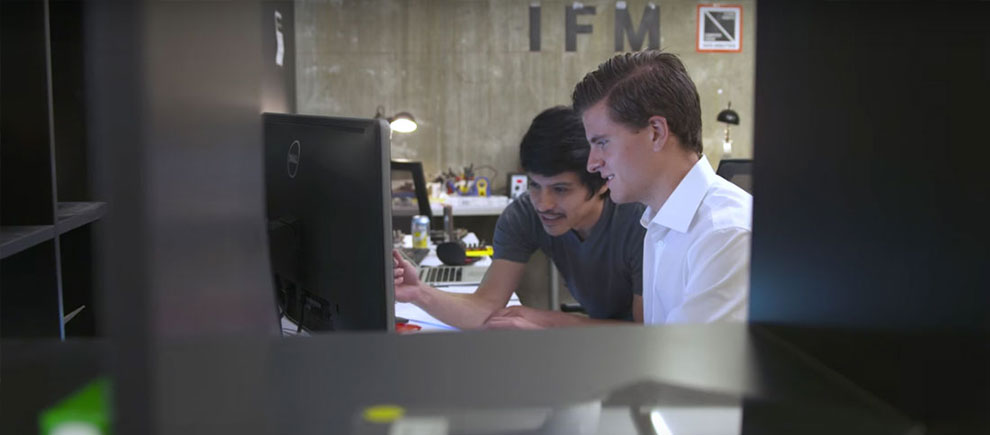
In 2014, while still a student, he founded Intelligent Flying Machines, or IFM. The name left little doubt about the enthusiasm involved. His prototypes also made their presence felt: he flew them on Saturday mornings in his dormitory, to the displeasure of neighbors in Kemper Hall. Entrepreneurship, viewed from the next room, can sound remarkably like an appliance having an argument.
When Northwestern opened The Garage in 2015, the startup gained a more suitable home. It offered workspace, prototyping equipment, professional advice, and a community of students building companies. The Wildfire accelerator arranged five interns for IFM. Rich Padula, an enterprise software entrepreneur and Northwestern alumnus, became a mentor, meeting with Gyongyosi to talk through fundraising and product decisions. The work acquired a business vocabulary alongside its engineering vocabulary.
The aircraft had to find its own way
Indoor drones presented an awkward technical puzzle. GPS, useful outside, would not guide a small aircraft through a warehouse. IFM used cameras and computer vision to understand its surroundings. Onboard processing mattered because a machine moving through a building needed to make sense of the scene as it went, while carrying hardware small enough to fly.
Gyongyosi demonstrated the work at NVIDIA’s GPU Technology Conference in 2016. His design experiments included using a single camera to save weight and employing visual feature tracking. Moving processing to a Jetson GPU improved performance and made room for a second camera. These were tangible engineering decisions: what the aircraft could carry, what it could see, and how quickly it could interpret the view.
IFM explored indoor inspection as well as warehouse inventory. One early description imagined a person in Chicago taking a remote walkthrough of a construction site in Miami. The drone would collect the visual material; someone elsewhere could inspect it. That idea already contained the thread running through Gyongyosi’s later work: make a physical place understandable to someone who cannot watch every corner of it.
He took IFM to TechCrunch’s Startup Battlefield in September 2016. In 2017, the company won the $25,000 Rice Brown School of Engineering Tech Innovation Prize and first place at Oregon’s New Venture Championship. At Northwestern’s VentureCat finals that May, IFM took the grand prize and a $30,000 check. Gyongyosi was graduating that year. His student project had customers to pursue and a payroll-shaped future.
“We don’t want to just be a research project.”
Marc Gyongyosi, 2016
A factory could lose a pallet
During his university years, Gyongyosi worked with BMW’s robotics research team in Munich. There, the contrast between manufacturing and warehousing caught his attention. Production processes were being optimized at fractions of a second. Yet a robot could sit idle for 40 or 50 minutes because a pallet of parts had been misplaced. People went looking through high racks with binoculars.
The detail is almost too good: binoculars in the background of advanced robotics. It puts the problem within reach of anyone who has ever misplaced a key. Making a machine faster has limited value while the thing it needs is somewhere else. Gyongyosi began following the missing inventory back into the warehouse, where his interest in vision found a practical reason to exist.
OneTrack dates its founding to 2017 and its first commercial deployment to 2019. The company’s present account of its mission connects physical operations with digital intelligence. Those words describe a considerable change in equipment from the early IFM years, but a consistent interest in the space between events recorded in software and events unfolding on a floor.
- 2014IFM founded
Indoor flying robots - 2017OneTrack founded
A warehouse problem - 2019First deployment
Cameras on forklifts - 2026AiOn expands
Operational AI agents
Twelve cameras and some forklift manuals
In his recollection of an early deployment, Gyongyosi arrived in Kent, Washington, in 2019 with 12 cameras, a laptop, and printed forklift manuals he had found online. The customer was Holman Logistics. The modest inventory makes a useful counterweight to the pitch competition checks: a business still has to turn up and install something that works.
He credits Brien Downie and the Holman team with backing the company before it had accumulated proof. Years later, he described that relationship as a lesson in the people behind a business. Early customers could help shape the product and improve the company itself. The manuals, cameras, and laptop were only part of what he brought into the building. The other part was an idea requiring someone else’s patience.
Another lesson was technical and rather deflating for an aviation enthusiast. Flying warehouse drones required supervision, and pallet labels were not always visible. To collect more data without spending every test session on site, he began attaching the drones to forklifts and drawing power from the vehicles. The cameras kept working. The flying machinery had been given a ground assignment.
Then a customer asked for footage after a forklift hit a wall. Existing cameras had not captured what happened. Gyongyosi’s experimental equipment might have. Here was a question extending beyond inventory: what actually happened during the work? The sequence helped push OneTrack toward observing warehouse activity more broadly. For someone who loved flight, accepting a forklift as the camera’s transport was a consequential concession.
Cameras, a laptop, and printed manuals.
His recollection of the 2019 Holman deployment.
A record needs an explanation
By 2021, Gyongyosi had been named to Forbes’ US 30 Under 30 list in Manufacturing & Industry. He was also arguing for tools that helped warehouse employees work more effectively, while expressing skepticism about how quickly full automation would become commonplace. His ambition extended to warehouses around the world, but the route involved the people already operating them.
That position is easier to understand alongside his education. Argall’s influence concerned how robots interacted with and helped humans. Work with Michael Rubenstein gave him experience with drones and co-authoring an academic paper. Looking back in 2023, Gyongyosi emphasized connections between disciplines and the value of stepping back from a problem to see the other areas it touched.
OneTrack’s WarehouseOS framing brought people, processes, and technology together. A warehouse management system could record a pickup and a drop-off. The cameras and analysis could help explain the trip between them. In a 2024 conversation, Gyongyosi said the company was operating in more than 100 warehouses, with thousands of sensors. That was his description of the business at that point, rather than a permanent census.
The practical distinction matters to his story. A transaction tells a manager that work occurred. Understanding the work can reveal why it took a particular path or where a process broke down. Gyongyosi has returned to the need for aligned people and procedures when introducing that visibility. A clearer picture still needs someone willing to change what happens next.
“Think simple.”
Marc Gyongyosi’s engineering mantra
Now the software gets a work assignment
His recent writing moves from cameras to the economics of software. In August 2025, he published “The Last Enterprise Software Company,” arguing for applications that could be created and modified through conversation. In March 2026, “The Multiple Migrates” carried the argument downstream: if software becomes cheaper to create, operational knowledge, customer relationships, physical assets, and proprietary data become more consequential.
These are his theses about where the industry is going. They also explain why a warehouse founder would care about AI that writes software. Customers have specific routines and calculations; an application built around their own work could reduce the distance between identifying a problem and responding to it. His attention has shifted toward who can put that software to use.
In July 2026, his essay “The Power Is in the Harness” focused on control. He used the analogy of people doing many tasks with one set of hands, then described a system that routes AI actions through a constrained interface. Permissions and audit trails were central to the argument. As the software becomes capable of doing more, he wants its access to remain understandable.
On August 26, 2026, OneTrack announced that CJ Logistics America had chosen AiOn for operations across more than 40 warehouses, expanding a seven-year partnership. The work included analyzing time between tasks, preparing labor performance information, and recommending changes to travel and product placement. Gyongyosi emphasized repeatable calculations: a language model should not invent a fresh definition of units per hour whenever someone asks.
A September 10 announcement brought Bonipak Produce into the picture. Its use of AiOn spans farming, cooling, and transportation data. Freight cost analysis was running; yield forecasting was identified as a next priority. Gyongyosi spoke about governing access to proprietary information. The business had traveled some distance from finding a pallet, while remaining occupied with the practical details of how things get made and moved.
Outside that work, his interests include running, skiing, and golf. He has flown as a pilot, though in his February 2026 Code Story appearance he described stepping back because of time constraints. He also appreciates an Austrian Wiener Schnitzel, a more edible reminder of where he grew up. The boy who built a cockpit still enjoys connecting physical objects with digital possibilities. These days, his machines can stay on the ground while he figures out what they should do next.