The Jersey City Saints had been collecting money outside supermarkets and holding raffles. A trip to a national baseball tournament in Myrtle Beach was approaching, and the fundraising still needed help. In June 2014, brothers Manmeet and Kamalpreet Virdi contributed $5,000. The team reached its goal. For once, the decisive play happened before anyone stepped onto the field.
The brothers already helped at practices. Their connection to the Saints extended beyond the moment a cheque became useful. They also owned Aequor and CAMPUS Education, businesses with a longstanding presence in Jersey City. The donation was a small, unusually legible episode in a career otherwise described through staffing, consulting and company leadership. Children wanted to travel. Money was missing. The brothers helped close the gap.
Manmeet Virdi’s working life has a similar recurring shape: establish a connection, give it practical support, stay involved. He co-founded Aequor with Kamalpreet in 1998 and remains its co-CEO. Education appears throughout his biography, as a business, a voluntary responsibility and a continuing personal investment. The interesting question is how those commitments have remained alongside one another for so long.
A company with a brother beside him
Aequor began in July 1998. By its fifteenth anniversary, the company was describing an international operation with technology development centres in India and a presence extending beyond the United States. Its headquarters were in Piscataway, New Jersey. Manmeet was identified as CEO and co-chairman; Kamalpreet as president and chairman. The titles have changed over the years. The partnership has remained visible.
There is something pleasantly resistant to fashion about that arrangement. Business biographies tend to organise themselves around a single protagonist, preferably standing alone against a large window. Virdi’s story keeps admitting another person into the photograph. Kamalpreet is there at the founding, there in the anniversary announcement, there beside the baseball team, and there in Aequor’s later descriptions of its co-CEOs.
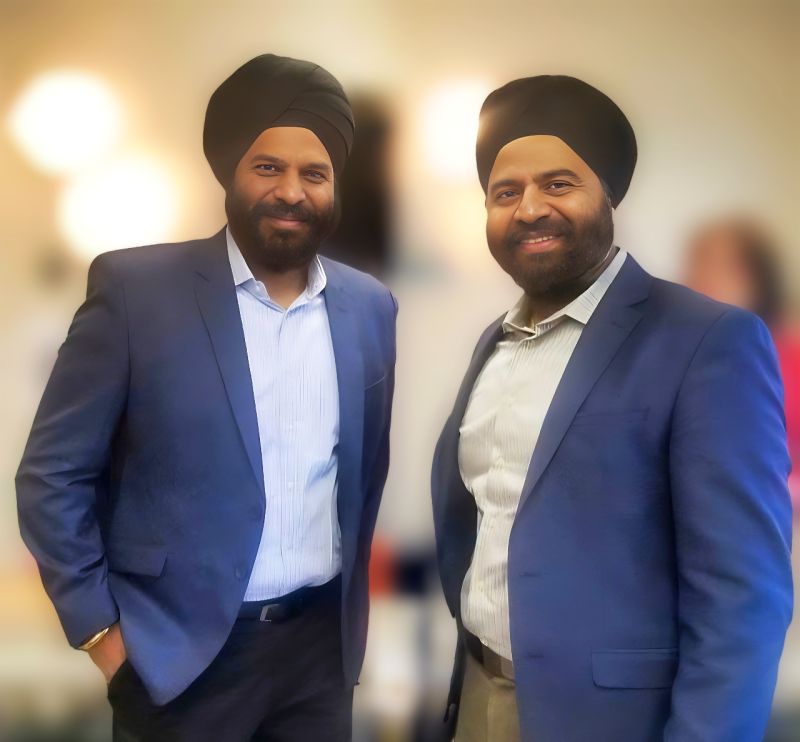
The distinction matters because this is a shared enterprise. It would be easy to attach every company achievement to one founder and lose the people who made it possible. Virdi himself repeatedly gives employees and clients room in his public remarks. His brother does too. Whatever their internal division of work, the outward account of Aequor has consistently made space for both.
In the 2013 anniversary announcement, the brothers put a number on the importance of existing relationships: they said more than 90 percent of business came from referrals or repeat customers. That was a company claim at a particular moment, rather than a permanent measure. It nevertheless tells us what they wanted to emphasise after fifteen years: people were returning, and people were recommending them.
Share of business the brothers said came from referrals or repeat customers at Aequor’s fifteenth anniversary.
The engineer who went back to class
Virdi’s education links a technical beginning to later business training. He earned bachelor’s and master’s degrees in computer engineering at the New Jersey Institute of Technology. He also pursued executive education at Columbia Business School. His LinkedIn profile places the Columbia period between 2008 and 2011, years when Aequor was already well beyond its beginning.
That sequence gives the education a particular texture. He was studying business while running one. Executive education occupies an interesting place in a founder’s biography: the classroom meets a person who already has employees, customers and decisions waiting outside it. Virdi’s technical degrees and subsequent business study sit together in an enterprise that has combined technology work with the work of finding people.
By 2015, he was discussing custom software and the practical business of turning raw information into something a customer could use. One project involved a Windows application, developed using an agile approach, with accompanying documentation. Design documents, installation notes and user manuals made the list. It is a reassuringly ordinary inventory. Software eventually has to survive someone trying to install it.
Those details bring the executive title down to working height. They show the kind of delivery Aequor was selling during that period: an application and the instructions required to make it useful. Virdi’s account connected technical work with understanding the customer’s business agenda. The emphasis was on an outcome that could be used, supported and explained, rather than a demonstration left glowing on a screen.
First the core, then the invitation to grow
In 2020, Virdi offered a compact explanation of Aequor’s approach: “Build your core and then go for more.” It has the advantage of sounding like something a colleague might actually remember. There is an order to it. The existing organisation gets attention before the next ambition takes up all the oxygen.
“Build your core and then go for more.”
Manmeet Virdi, 2020
That year, Aequor Technologies topped the midsize category in a New Jersey Top Workplaces feature. The company had also appeared on the previous year’s list. Virdi spoke about making the workplace worthy of the people in it, and described an employee population spanning more than forty nationalities. Those were his descriptions of the organisation in 2020, and they give the growth rule some human content.
He also expressed an ambition for Aequor to rank among the ten leading staffing companies in the United States. The aspiration was explicit; it should be read as an ambition. Paired with his insistence on building the core, it suggests a founder thinking about both the size of the company and the conditions inside it. Expansion would have to carry an organisation along with it.
Workplace recognition gives that discussion a useful setting. It directs attention to the people who experience a company between announcements. Recruiters, technical staff and colleagues elsewhere in the organisation all belong to the story of its operation. Virdi’s public comments return to them often enough that a profile focused entirely on the two founders would miss part of the account they give themselves.
Education keeps turning up
CAMPUS Education gives Virdi’s career another centre of gravity. Its school documents identify both brothers in the organisation’s ownership and leadership. The 2025 Manhattan catalogue lists Manmeet as president and Kamalpreet as CEO. A Jersey City catalogue identifies them as owners of CAMPUS Education, Inc., while distinguishing the local branch’s separate licensed operating arrangement. The details are institutional, specific and refreshingly free of slogans.
Schools create a different relationship with time from a staffing assignment or software project. Their catalogues set out people, responsibilities and the arrangements through which teaching happens. Virdi’s name appears in that machinery. Education in his biography has an administrative address: governing bodies, school leadership and the continuing task of keeping an institution organised for students.
His involvement also extended to Rutgers Preparatory School, where he served as a trustee from September 2013 to June 2021. That is a substantial span beside an existing executive career. The role places him within school governance as well as education ownership. It adds a local institutional commitment to an Aequor story that often travels internationally.
The school’s fundraising records make that connection more concrete. In a 2017 campaign, Virdi offered a $1,000 match. A 2022 campaign lists Manmeet and Harjeet Virdi making a $1,000 challenge gift. These are separate gestures in separate years. Set beside the trusteeship, they show participation continuing through more than one form of involvement.
A matching gift is a modest piece of social engineering: one person’s contribution gives another person a reason to act. It suits a biography full of connections that need practical backing. The amount matters, but so does the structure. A school can turn an existing supporter’s commitment into an invitation to the next supporter.
The second appearance
At the end of 2025, Virdi’s public holiday message thanked clients, partners and employees, then looked toward continued growth. The vocabulary was familiar from earlier chapters: appreciation for the people doing the work, recognition of relationships, and another year ahead. Decades after the founding, he was still speaking as part of the same company and alongside the same co-founder.
Continuity can look uneventful when compressed into a biography. A founding date becomes a line. A trusteeship becomes two dates. A business partnership becomes a title shared with a brother. Open those entries up and they contain repeated decisions to remain involved: another year of company leadership, another school responsibility, another contribution to an institution already known.
The Saints episode offers a useful way to picture that repetition. By the time the brothers supplied the $5,000, they had already been helping at practice. The donation arrived within an existing relationship. It changed what the team could afford, while the earlier involvement explains why the brothers belonged in the story at all.
There are grander ways to describe a founder’s legacy. Virdi’s record makes room for a smaller, sturdier image: children getting to a tournament because people who already knew them helped again. Aequor has grown across decades. Beside it sit classrooms, a school board and a baseball field. The second appearance is where this biography becomes personal.