Forty acquisitions in thirty-six months is a busy calendar. For Russell R. MacDonnell, who assembled SecurityLink in the 1980s, it was also an education with an expensive final examination. A banking crisis interrupted the expansion. He resigned; the bank foreclosed. In 1992, he gathered fresh investors and bought the northeastern assets back to form Alarmguard. The business he knew became the material for another beginning.
There was a second beginning that same year. With Jeffrey Atkins, who had run SecurityLink’s wholesale monitoring division, MacDonnell co-founded Rapid Response Monitoring. Two companies, two paths: Alarmguard would be sold to Tyco International for $187 million in 1999. Rapid Response would remain the continuing occupation. MacDonnell spent two years working on ADT acquisitions at Tyco before concentrating on Rapid Response in 2001.
A career can look wonderfully orderly when its dates are placed in a straight line. The interesting part here is the return journey. A founder who had already learned how to assemble companies went back to the assets of an earlier venture and began again. Later, after a substantial sale and a turn inside a corporate acquirer, he returned to the monitoring company he had helped create.
MacDonnell is its chairman and CEO, with a career in electronic security that reaches back to 1970. But the more revealing recent entry on his professional record concerns a classroom. In February 2025, decades after his first acquisitions, he added a Harvard Business School Executive Education CEO Presidents’ Seminar to his credentials. There is something pleasantly inconvenient about an experienced executive still making room for homework.
in its first 36 months
Rapid Response founded
sale price to Tyco
The family business had good ears
His apprenticeship began in Stamford, Connecticut, in the Sonitrol business established by his father, Russell A. MacDonnell. The distinction between the two Russells matters. The father opened the first Sonitrol franchise in the Northeast in 1970. The son would build a separate record across installation, acquisitions and monitoring. They shared a name and an industry; their careers belonged to different chapters.
Sonitrol gave the family an unusually literal reason to listen. Its audio detection system allowed central-station operators to hear activity inside a protected building and assess whether a burglary was taking place. The elder MacDonnell’s operation recorded actual break-ins. Those recordings made a practical demonstration of an otherwise abstract promise: someone elsewhere could hear what was happening and arrange a response.
The family’s account preserves a burglar’s moment of discovery: “Roger… we’re caught.” As product demonstrations go, it has the merit of brevity. It also explains the attraction of verification. A sound has context. Human judgment can distinguish something useful within it. Long before today’s software vocabulary arrived, the business depended on getting from a disturbance to a better understanding of the event.
The younger MacDonnell’s formal education took a different route into that world. He attended Williams College, studying history, and then Boston University School of Law from 1970 to 1973. His law-school years overlapped the early years of his father’s Sonitrol venture. The classroom and the family business belonged to the same period of his life, putting formal studies alongside an introduction to a trade he would continue for decades.
The family’s Syracuse connection developed alongside those earlier businesses. In 1985, MacDonnell opened Sonitrol Services of New York there. In 1999, that operation acquired Eastern Security Services. These are useful details because they show how several company histories can overlap without being interchangeable. Rapid Response’s wholesale monitoring work and Eastern’s installation and service business sit within a broader family history of electronic security.
“Roger… we’re caught.”A burglar on a Sonitrol recording, preserved in the family’s account
The company behind the alarm company
Rapid Response began in 1992 with MacDonnell and Atkins bringing together decades of industry experience. The partnership joined a company builder with an operator who already knew wholesale monitoring. Its customers included alarm dealers: the businesses that sell and service systems while relying on a specialist monitoring organization to handle the signals those systems send.
That arrangement gives MacDonnell’s work an unusual degree of invisibility. A customer may know the local company that installed the alarm while having little reason to think about the organization handling its messages. Yet a dealer’s promise to a customer depends partly on what happens at that other organization. Reliability has to travel through a relationship between businesses before it reaches the person who bought the system.
The company’s early software milestones show attention to that relationship. RapidLink, released in 1994, gave dealers proprietary access software. A Palm application followed in 1997, allowing mobile access to account information. RapidWeb arrived in 2000 with online, real-time dealer access. These names belong to successive eras of computing, but the practical direction is consistent: make the information needed for the job easier to reach.
The buildings grew, too. Rapid Response opened a 40,000-square-foot Central New York headquarters in 2004 and later opened its California operation in Corona. By the February 2025 Ubiety partnership announcement, its monitoring locations included Syracuse, Corona and Henderson, Nevada. The company described its service footprint as the United States, Canada, Mexico and the Caribbean. A business with Syracuse roots had acquired responsibilities well beyond one city.
The facilities are part of the operating choice. Rapid Response describes its monitoring as entirely in-facility, with redundant locations. Whatever technology a customer buys, the work still has to be organized somewhere, by people using a defined process. In MacDonnell’s long career, the devices have changed repeatedly. The need to make an organization answer for the service has stayed rather stubbornly in place.
A better question for a ringing alarm
In October 2024, Rapid Response announced a partnership with 3Si centered on verified crime information and law-enforcement response. The proposed connection brought professional monitoring together with a company already delivering tracking information to dispatchers. Its purpose was to improve the information available during felony incidents in progress, when knowing more about an event can affect how responders approach it.
MacDonnell’s statement emphasized giving law enforcement information for situational awareness. That is a specific ambition. An alarm can announce that something has happened while leaving the important details unresolved. The partnership addressed what could be conveyed about the incident, and how that information could support the people receiving it. The distinction is practical enough to survive a press release.
A February 2025 collaboration with Ubiety Technologies and KEYTH Security addressed another part of the same problem. Ubiety Halo’s Adaptive Alarm Response uses presence verification to help tailor the response to an alarm. The announcement described an approach that could consider who was present instead of relying solely on a static list of contacts.
The stated aim was to reduce unnecessary responses and make alarm handling more relevant to the situation. Those are the partners’ intended benefits, rather than a measured outcome to assume. Still, the direction is worth following: the system should offer context as well as a signal. For a business with roots in audio verification, that is a recognizable concern expressed through different technology.
Read together, the two partnerships make MacDonnell’s current work quite concrete. One concerns information reaching law enforcement during a crime; the other concerns information used to decide how to handle an alarm. Both put a premium on interpretation. After years of buying companies and building monitoring operations, he is still working in a business where a useful extra fact can change the next action.
The next generation gets a doorway
The family connection continues through Cooper MacDonnell, Russell’s son and the president of Eastern Security Services. Cooper began working at Rapid Response in 2011, joined Eastern in 2013 and became its president in 2023. His career connects three generations: his grandfather’s Sonitrol franchise, his father’s company building, and his own work expanding Eastern into Rochester and Buffalo.
There is a temptation to treat a family business as a photograph with job titles underneath. The sequence here contains actual apprenticeships and separate operating roles. Cooper moved through work at Rapid Response and then a decade at Eastern before becoming president. The surname supplies continuity; the intervening years supply something a surname cannot.
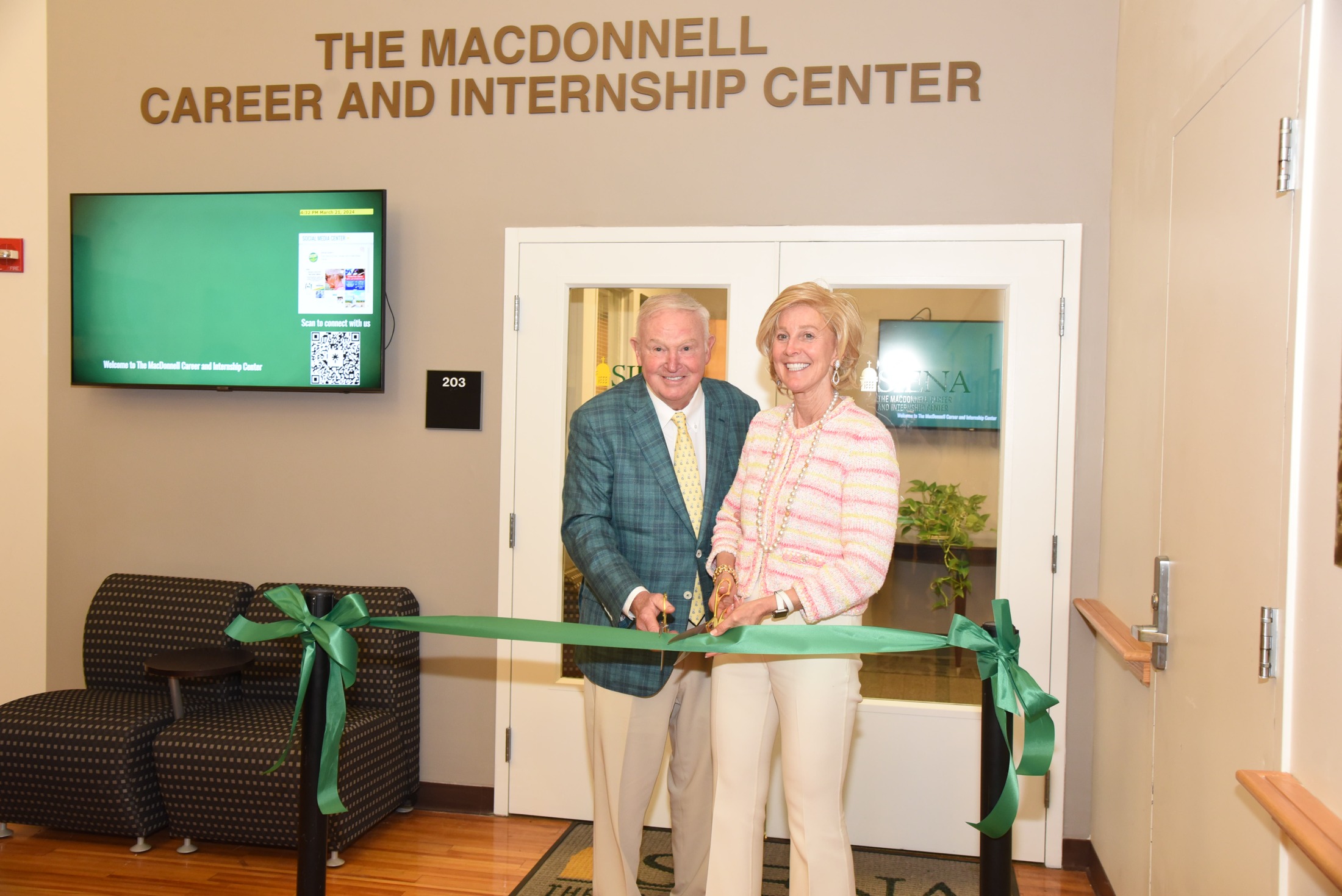
At Siena University, another doorway carries the family name. Jan MacDonnell, a trustee and member of the class of 1983, and Russell supported the MacDonnell Career and Internship Center. Their contribution helped the university invest in technology platforms serving students and alumni. In the ribbon-cutting photograph, the two stand beneath the center’s name, each holding scissors at the green ribbon.
The center’s work includes career advising, resumes, interviews, internships and connections with employers. It is a setting for the awkward beginning of a professional life, when ability and opportunity have not yet been properly introduced. Supporting that work gives the MacDonnell name a role outside an alarm company: helping other people find a first useful opening.
An executive still enrolling
MacDonnell lists a Stanford Graduate School of Business CEO Presidents’ Seminar from June 2023, followed by the Harvard program in February 2025. These are executive-education entries, distinct from his earlier college and law-school education. The dates make them interesting. They belong to a period when his professional record already contained more than enough material for an introduction.
His public description of himself is economical: a career entrepreneur in electronic security, a founder and CEO of seven companies. The seminars add a small complication to that tidy description. Building companies and attending programs for executives can coexist; experience need not close the door on formal study. For someone whose career includes a consequential restart, the willingness to remain a student feels particularly apt.
The visible pattern is one of returning to work with another set of tools. Family experience led into independent ventures. A failed expansion was followed by a new investor group and a new company. A sale was followed by years at Rapid Response. More recently, established monitoring operations have been paired with new ways to interpret the signals they receive.
MacDonnell’s story gives starting again an unusually practical meaning. There are assets to buy, partners to choose, systems to improve and students to help through a doorway. The career keeps acquiring another date. In 2025, one of those dates belonged to a classroom. After all those companies, he still had a reason to enroll.
Follow the work
Explore Rapid Response Monitoring, MacDonnell’s LinkedIn profile, Siena’s career and internship center, and Cooper MacDonnell’s company biography.
Further reading: the 2016 Hall of Fame profile, the 3Si partnership announcement, and the Ubiety and KEYTH collaboration.