An aisle is an agreeable thing. It lets a forklift pass, gives a worker room to turn, and makes a warehouse look reassuringly orderly. Inside a freezer, it also sends you a bill. Every cubic foot of empty passage belongs to a building that must stay cold. At RLS Logistics’s Delanco facility in New Jersey, the shelves move on rails. The aisle appears where it is needed. Elsewhere, there is room for food.
- RLS stores, transports, and fulfills orders for frozen and refrigerated food businesses.
- Mobile racking at Delanco makes room by reducing permanent aisle space.
- Its broader proposition: coordinate the warehouse, the shipment, and the information.
The expensive tenant: empty air
The detail is wonderfully unromantic. In 2018, RLS installed FLEXSPACE’s Poweracks beside conventional double-deep racking at Delanco. A supplier release reported 56% more pallet positions and a 23% lower cost per position for the mobile system. Those are comparison results from that installation, rather than a promise for every warehouse. Still, they expose an interesting habit: judging a building by its square footage when the customer buys space for pallets.
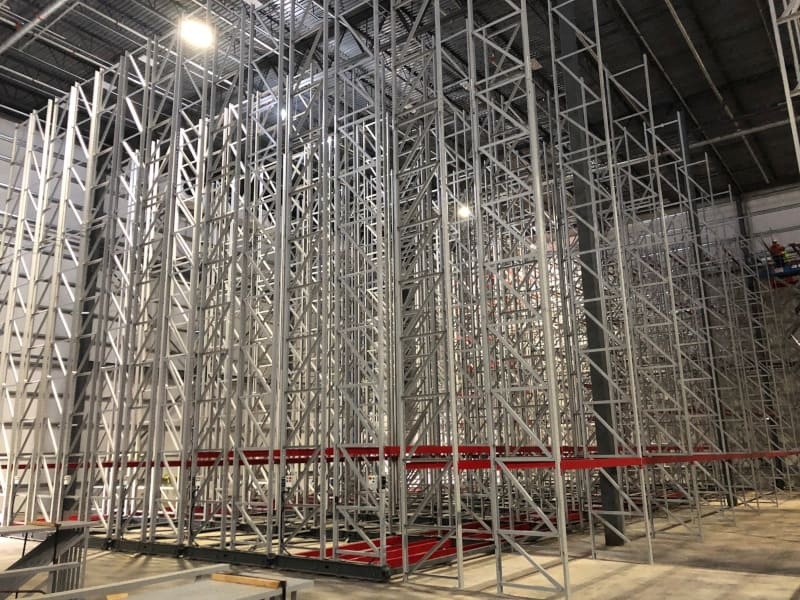
The economics extended into construction. Delanco used tall insulated panels and CO2 refrigeration. Architect David Manders described the logic plainly: “It’s always less expensive to go up than out.” Taller storage and denser storage answer the same question: how much useful capacity can fit inside the shell? Neither turns engineering into magic. The project still required different piping, electrical work, controls, and careful installation.
More food. Less aisle.
Double-deep = 100. Calculated indices from FLEXSPACE’s reported +56% positions and -23% cost per position. This compares storage systems, not total company costs.
A mushroom farm learns a second trade
RLS began with something considerably smaller than a pallet: a mushroom. Rosario Leo and his family established R. Leo & Son Mushroom Farm in 1968 after emigrating from Italy. In 1988, the family entered public cold storage with 10,000 square feet of temperature-controlled space. By a 2003 trade profile, the former mushroom buildings were doing duty as dry storage. The old business had left useful buildings behind.
Today, RLS earns its living through contracted warehousing, freight, handling, fulfillment, and managed logistics. A food manufacturer can use one service or combine several. Manufacturers, importers, retailers, and online food brands need different things; what connects them is a product that cannot shrug off a warm afternoon. RLS’s practical expertise sits at the junction of temperature, inventory, and delivery appointments.
There is another modest example of that thinking. As fulfillment grew, packaging materials and ambient goods occupied refrigerated space in Vineland. RLS opened a separate 36,000-square-foot food-grade ambient facility in 2019. Cardboard was taking up room intended for cold products. Moving it out created capacity without asking the cardboard to become any colder.
A delivery problem disguised as a growth problem
An anonymous frozen-food manufacturer in RLS’s managed transportation case study had won a large retail contract. Its manual routing and last-minute changes struggled to keep pace; drivers began refusing loads. The prospect of buying a transportation management system helped push the customer toward outsourcing.
RLS brought orders into its system, selected transport modes, established delivery schedules, and reviewed inbound freight as well as outbound. Backhauls and relocating raw materials reduced unnecessary movement. The company reports implementation within a month and an on-time delivery improvement of over 20%. Savings exceeded the forecast by over 24% - a different claim from cutting total spending by 24%.
The broader lesson is to study the return journey and the storage location alongside the outbound shipment. A cheaper truck cannot repair every badly arranged network.
A cheaper truck cannot repair every badly arranged network.
One login, several kinds of cold
RLS’s customer portal, anello, connects the less photogenic part of the operation. Customers can view inventory, delivery statistics, analytics, and adaptable dashboards, with EDI and API integration available. RLS announced its rollout in 2019 after in-house design work began the previous year. For a shipper using multiple services, the useful feature is seeing related information together. A dashboard earns its keep when someone can act on it.
Those services extend from pallets to parcels. RLS offers ecommerce pick-and-pack, kitting, and assembly from New Jersey and Utah. For Walmart suppliers, it is an approved transportation consolidator, combining shipments through its Newfield cross-dock and dispatching against day-specific schedules. The customer gets access to shared infrastructure and coordination rather than building each capability internally.
The family name stays; the affiliate changes
RLS occupies a market also served by Lineage, Americold, United States Cold Storage, and regional specialists. Its pitch combines family ownership with integrated service. One distinction matters when reading older expansion headlines: the acquisition affiliate RLS Partners became CORE X Partners in 2023, with its own management team. RLS Logistics continued under Leo family ownership. The two histories overlap; their present footprints should not be casually added together.
The operating company has continued investing. In July 2025, it announced that a Delanco expansion was scheduled to open that month, with roughly 8,000 new pallet positions. In August 2026, Family Business Magazine recognized CEO Russell Leo among its CEOs to Watch. His leadership follows years working alongside his brother Tony, who died in 2021.
What to copy before buying more space
Start with the unit that matters: cost per usable pallet position. Separate goods that need refrigeration from those that merely arrived beside them. Review delivery windows before celebrating a new customer. These are practical readings of RLS’s examples, and each requires attention to the actual operation.
Mobile racking needs a workable balance between density and access; consolidation needs compatible temperatures and schedules. Outsourcing needs reliable order data and clear accountability. A company selling shelf-stable goods or shipping a simple local route may have little use for this particular service mix. RLS makes its strongest case where food growth turns several manageable jobs into one difficult coordination problem.