The first Syfan family brokerage had a peculiar customer-service problem: the railway next door. When a train passed, the office shook and the horn interrupted telephone calls. Greg Syfan remembered having to put customers on hold. Steve remembered climbing through a window because the office had no keys. This was Gainesville, Georgia, in 1984. A respectable corporate origin usually acquires a little polish in the retelling. This one retained the window.
- The family sold Turbo Logistics in 2006, then launched Syfan Logistics in 2011.
- Its business combines freight brokerage with the trucks of affiliated Syfan Transport.
- Food, auto parts, and urgent shipments reward accurate information and people available around the clock.
A dog, a railway, and a second beginning
Jim and Gloria Syfan and their sons Greg and Steve began the original business with limited resources. Jim pledged a station wagon’s title and a ring to obtain a $6,000 bank credit line. The family named it Turbo Transport after their silky terrier. A dog supplied the brand; the family supplied the persistence. Greg recalled calling some prospective customers daily for a year before getting a load.
The crucial date for today’s company is 2011. Five years earlier, the family had sold the predecessor, Turbo Logistics. They returned because they missed their people and customers, according to their account of the restart. Syfan Logistics therefore arrived with something a new brokerage cannot buy off the shelf: years of relationships and familiarity with the work. Its anniversary newsletter called the return a rebirth.
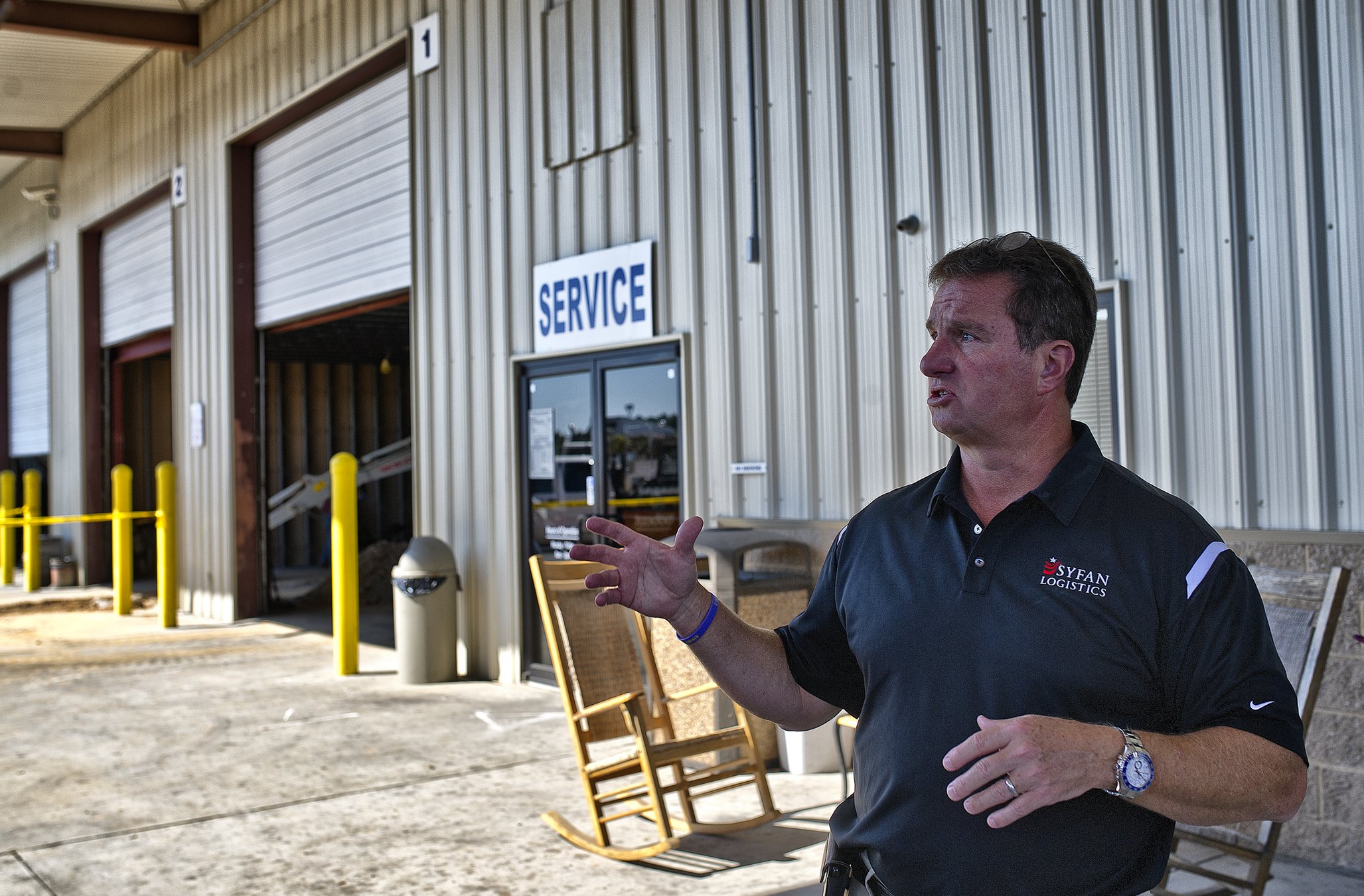
The price of being late
Gainesville’s poultry industry gave the family an education in freight with a short temper. Perishable goods require careful timing and temperature control. Auto parts impose a related discipline: the destination is a production schedule. A shipment’s value includes what happens if it misses its appointment. The useful comparison is the whole consequence of delay, rather than the quoted truck rate alone.
Syfan serves business shippers across the United States, Canada, and Mexico. Its menu includes full truckload, less-than-truckload, flatbeds, refrigerated transport, expedited deliveries, power-only hauling, and port drayage. Freight-management services extend into procurement, carrier selection, consolidation, and execution. A shipper can hand over an individual load or a more substantial freight program.
The arrangement combines two sources of capacity. Syfan Transport operates trucks and trailers; Syfan Logistics draws on outside carriers. That gives customers owned equipment alongside a wider pool for changing demand. The company also advertises primary cargo insurance and its own full-time communications staff, available 24/7. Buyers should examine the actual coverage and service agreement, since a reassuring phrase is no substitute for terms.
For a shipping manager, the starting point is an operational brief: what is moving, where, when, in which equipment, and under what temperature and handling requirements? From there, the relevant service becomes clearer. An urgent parts load needs a different plan from a container leaving a port or a trailer waiting for a tractor.
Truck and trailer assets
Additional freight capacity
In brokerage, much of the money billed to shippers pays the carriers moving their freight. That distinction matters when admiring size. Transport Topics’ 2026 table estimates Syfan’s gross revenue at $355 million and net revenue at $64 million. Neither number is profit. Compared with overlapping providers such as C.H. Robinson and RXO, Syfan occupies a smaller position, with particular experience in deadline-sensitive work.
The app that cried delivered
The company’s technology history contains a useful embarrassment. Earlier app-less tracking systems sometimes reported that freight had been delivered when it had not. Staff still needed repeated calls to find out where loads were. Drivers were reluctant to adopt tools that offered little benefit to them. Software had introduced another disputed account of reality.
In 2017, Syfan tried the Trucker Tools driver app in its expedited division after seeing a demonstration. The vendor integrated location information into Syfan’s McLeod transportation-management system. The app also helped drivers find fuel, rest stops, routes, and other practical information. Adoption became easier to understand: the person generating the data received something useful in return.
Vendor-reported results from the implementation period; not current operating guarantees.
The vendor reported higher confirmation accuracy, fewer check-calls, and stronger tracking compliance. It also described per-load pricing as more economical for Syfan than per-day pricing. The lesson is fairly portable: pilot a tool where mistakes matter, put its information inside the existing workflow, and make participation worthwhile. It depends on drivers using the tool and supplying usable data. A dashboard cannot manufacture either.
That history makes Syfan’s newer software choices interesting. Its 2025 newsletter describes adopting Zoom for unified communications and Transfix for pricing analysis using market rates and historical load data. Both address familiar brokerage chores: gathering the conversation around a shipment and deciding what capacity should cost. The value rests in the work they improve.
Ice cream, then accountability
Jim once wrote a principle on a board that placed caring for employees before customers, carriers, and profits. Greg remembered questioning that order. Customers, after all, paid the bills. His father’s instruction was brief.
“Notice the order.”Jim Syfan, recalled by Greg in 2022
The idea has visible expressions: meals, Friday treats, a fitness center, education, and team activities. Greg credits the approach with better productivity and lower turnover. The reasoning is plausible, although the public account does not establish causation. The harder evidence of customer acceptance includes GM’s supplier recognition: the automaker independently listed Syfan among its award winners in April 2025.

Knowing what to let go
Family ownership does not remove the freight cycle. Greg described the downturn beginning in 2023 after the pandemic-era boom. The family subsequently sold Turbo Terminal Tractors to Mantucket Capital, explaining that it wanted to concentrate on logistics and services while an equipment specialist developed that business. Attachment had to coexist with a choice about attention.
By 2026, the second company was celebrating fifteen years. Syfan reported another GM supplier recognition in September and its ninth consecutive appearance on Inbound Logistics’ Top 100 Truckers list in October. These are useful signals of continuity. A prospective customer still has to ask how that accumulated experience applies to its own lane, cargo, and deadline.
Meanwhile, Georgia Trend reported a 16% increase in Syfan’s load count in 2024. Shorter routes and inland-port opportunities add another dimension to growth. The model still carries the costs of staff, equipment, and coordination. For a buyer shopping solely for the lowest spot quote, those capabilities may carry little weight. For someone responsible for perishable food or tomorrow’s assembly schedule, the relevant question is wonderfully plain: who can act when the plan goes wrong?