There is a charming lack of obviousness to Malika Shrivastava's résumé. It begins with the cool arithmetic of investment banking and strategy consulting. Then come diapers, personal care, a smartphone, an operating system, an app store, a browser, a lock screen and, finally, artificial intelligence used inside clinical workflows. LinkedIn likes a straight line. Shrivastava's career prefers a well-packed suitcase.
The connecting thread is not industry. It is the moment when an unfamiliar product has to enter a person's life and explain why it belongs there. At Procter & Gamble, where Shrivastava worked on Pampers in Southeast Asia and India and later ran Whisper in India, that moment lived in domestic routine. At Google, it arrived through Pixel, Android, Play and Chrome. At Glance, it happened before a user had even unlocked the phone. At Qure.ai, where she became the company's first Chief Marketing Officer in July 2026, the conversation moves through hospitals, health systems, public agencies and global partners.
The objects keep changing. The operator's question remains stubbornly similar: how does a new thing become clear, credible and useful to the people expected to adopt it?
The school of ordinary attention
Brand management at P&G is an education in constraints. Nobody wakes hoping to admire a positioning document. The shelf is busy, the customer is busy and the household already has habits. A brand manager learns to notice the small frictions: what people say, what they do, which detail earns a second glance and which message expires before it reaches the end of the sentence.
Shrivastava spent more than five years inside that system. From 2011, she worked across Pampers in Southeast Asia and India, then became country manager for Whisper in India. Those roles placed her close to categories where usefulness is concrete and communication cannot survive on abstraction. The product must fit a routine. The promise must survive contact with the aisle.
In late 2016, she moved to Google as the go-to-market lead for Pixel in India. The shelf became a software ecosystem. A smartphone launch is part device, part operating system, part retail choreography and part cultural weather report. The job widened again when she moved into consumer strategy, insights and operations, then became Head of Growth for Android, Play Store and Chrome.
“I'm much more interested in potential, curiosity and how you think than in ticking every box.”Malika Shrivastava, on hiring her Qure.ai team
It is tempting to treat the famous product names as the story. They are better read as repetitions. Pixel asks why one phone deserves a place in a crowded market. Chrome asks why a familiar utility should remain the default. Android and Play ask how an ecosystem grows without feeling like an ecosystem to the person tapping the screen. Each problem has its own mechanics. Each rewards the same respect for attention.
A screen before the screen
Shrivastava joined Glance in 2021 to lead product growth and go-to-market strategy. Glance made the lock screen a surface for content and discovery - a proposition whose simplicity hides an unruly collection of questions. How much novelty is welcome? How does a product explain itself when it arrives before an explicit request? What travels across markets, and what must be rebuilt?
Her work there included scaling the India business and spearheading expansion into the United States. That move added another kind of translation. International growth is frequently described with arrows on a map, as if geography were the difficult part. The harder work happens in expectations, distribution, partnerships and language. A product can cross an ocean overnight. A proposition has to clear customs the slow way.
By the time Qure.ai appointed her in 2026, Shrivastava had accumulated three complementary disciplines: the consumer intimacy of packaged goods, the ecosystem scale of a global technology company and the improvisation required to grow a newer platform across markets. Qure.ai gave that mix a more institutional audience.
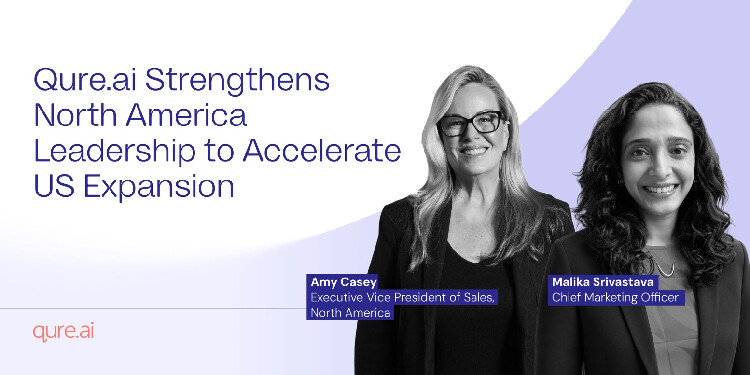
The first-CMO problem
A first CMO inherits an appealing and awkward freedom. There is no previous officeholder's machine to operate. There are also no previous officeholder's excuses. Shrivastava's brief covers global brand, communications, product marketing and market development. Those functions are often drawn as separate boxes. In practice, each one changes the meaning of the others.
A brand promise without product specificity becomes perfume. Product marketing without a larger narrative becomes a parts catalogue. Communications without market context becomes noise. Market development without trust becomes an expensive sequence of meetings. The useful work lies between the boxes.
One brand, four very different questions
Shrivastava has said she wants to help make Qure.ai a brand recognized for innovation and also loved, trusted and respected by providers, partners, policymakers and future talent. It is an ambitious sentence because those audiences do not share a scorecard. Recognition can be won with repetition. Respect requires evidence. Trust is a long receipt.
The appointment also says something about Qure.ai's stage. The company began in 2016. A decade later, the creation of the CMO role suggests that the next operating challenge is not merely building products or entering markets. It is arranging a global company's proof, vocabulary and reputation into a system that can travel.
“Qure.ai represents a rare combination of technological innovation, meaningful real-world impact, and a deeply mission-driven culture.”Malika Shrivastava, on joining Qure.ai
The hiring post as self-portrait
Soon after joining, Shrivastava published a hiring note for two roles on her team: a Marketing Director for US go-to-market work and a Product Marketing Manager. The adjectives were familiar but carefully arranged - smart, curious, humble, comfortable with ambiguity and high-agency. Then came the more revealing invitation. People who were not completely qualified but believed they could be very good should reach out anyway.
She cared more, she wrote, about potential, curiosity and how a person thinks than about checking every box. The sentence works as a small management manifesto. A new marketing organization inside a changing category cannot be assembled entirely from perfect matches. Perfect matches are easiest to find for work the world already understands.
The traits also mirror Qure.ai's published team framework: humble, hungry and smart. Shrivastava's version adds comfort with ambiguity, the natural habitat of a category builder. Brand work at this stage is partly architecture and partly expedition. The map improves only after somebody walks beyond its neat edge.
What operators can steal
The portable lesson in Shrivastava's path is not to collect industries like passport stamps. It is to collect ways of seeing. Packaged goods teaches that habit beats novelty. Consumer technology teaches that a product belongs to an ecosystem whether the customer notices it or not. International expansion teaches that a message that travels unchanged may arrive meaninglessly. Institutional technology teaches that credibility is built through many people, not performed by one campaign.
Her career also argues for a less theatrical definition of marketing. The work is often presented as amplification: find the story, turn up the volume. But volume is useless when audiences hear different frequencies. Sometimes the more valuable act is translation - preserving the substance while changing the language, the proof and the route by which it arrives.
The advantage of arriving late
There is another useful wrinkle in Shrivastava's appointment. Marketing is sometimes installed before a company knows precisely what it has learned. Qure.ai had ten years of institutional memory by the time she arrived: products built, markets entered, partnerships formed and a team assembled around an explicit mission. A first CMO joining at that point does not face a blank page. She faces a crowded archive.
The editorial task is selection. Which stories reveal the company rather than merely flatter it? Which details help a buyer understand the operating reality? Which words can be used consistently by a product manager in Bengaluru, a commercial leader in North America and a partner elsewhere without turning into corporate porridge? The answers cannot be delegated to typography. They require judgment about what the company is prepared to repeat and prove.
Shrivastava's background is well suited to that abundance. P&G trained compression. Google trained coordination at scale. Glance trained adaptation. Together they offer a method for turning a decade of company knowledge into something sharper than a slogan: a shared way of explaining what matters.
That is a sensible reading of Shrivastava's new chapter. She is not moving from consumer brands into a world without consumers. She is moving into a world where every decision has several consumers at once: the person using a tool, the institution adopting it, the partner integrating it and the policymaker evaluating its place. The brand has to remain recognizable in every room without becoming vague enough to mean nothing.
Diapers, browsers, lock screens and clinical AI make an eccentric dinner party. Shrivastava's career seats them together anyway. Each began as somebody's complicated idea. Each had to earn a place in ordinary behavior. The next task may be her most delicate translation yet: help a global technology company sound as clear as the work demands, and as human as the people doing it.