Samantha Goldman had a perfectly sensible arrangement with the spotlight: other people stood in it. She worked behind the camera, prepared executives for their appearances, and watched her two sisters move through public life with a composure that seemed almost supernatural. One was a reporter who interviewed President Obama. Another was an actress who could carry two characters in two shows at once. Goldman, by her own account, could feel her legs shake during a small company presentation.
This would be a charming piece of trivia if she had chosen a quiet profession. Marketing leadership is not quiet. It asks a person to explain a company to customers, a strategy to a board, a plan to a sales team, and occasionally herself to a hall containing 2,500 strangers. Eventually Goldman saw the contradiction. If she knew how to ready other people for the stage, she could learn to ready herself.
The solution was not a heroic personality transplant. It was a ladder. She returned to business school to talk with MBA students. She joined panels. She spoke at industry events. She learned that conversation suited her better than a march through slides. Then Pardot invited her to tell the Lyft Business story during a Dreamforce keynote. The format was an interview. The audience was 2,500 in the room, with more watching online. A friendly chat, in other words, if one ignores the population of a small town.
The glamour of doing the homework
A week before the keynote, the confidence she had ordered had not arrived. Goldman imagined freezing, saying the wrong thing, or boring everyone at scale. Her preparation became wonderfully uncinematic. Her actress sister ran lines with her and reminded her to breathe. Her manager supplied notes. Goldman bribed coworkers with wine and dinner so they would rehearse with her. She found a song, played it repeatedly, and walked onstage.
There is a useful distinction in that story. Goldman did not defeat nerves. She built a process sturdy enough to carry them. She started below the keynote, found a format that fit, asked people to help, and practiced until breathing returned. Confidence followed action, as it annoyingly tends to do.
That pattern - identify the discomfort, then design the supporting structure - appears throughout Goldman's work. Her career has crossed consulting, banking, enterprise benefits, transportation, workplace services, financial technology, collaborative software, parking technology, and care software. The category changed. The central task did not. Each business contained several audiences and a complicated machine behind the promise. Her job was to make the promise clear without pretending the machine was simple.
Her training makes the route less surprising. Goldman studied psychology at the University of Pennsylvania, then earned an MBA focused on marketing and general management at the University of Michigan's Ross School of Business. Before the chief marketing titles, she worked in campus recruiting at Citi and in Deloitte's human capital practice. One discipline asks why people behave as they do. The other asks how organizations turn that behavior into a working system. Marketing gave her a place to combine them. When she returned to Citi after business school, it was in global marketing. From there she moved to Castlight Health, first in B2B marketing and later in user marketing, learning to speak to enterprise buyers and the people expected to use what those buyers selected. The job was already becoming translation in stereo.
Global marketing
B2B and user
Enterprise
Global CMO
CMO
Look below the dashboard
At Lyft, Goldman described enterprise marketing as a discipline of narrowing before expanding. Her team focused on one vertical at a time. It aligned with sales, studied ride data, and tried to understand the full path from buyer awareness to passenger loyalty. Marketing and engineering had to cooperate because personalization depended on good data pipelines. A dashboard could report a result. It could not always explain it.
Her sharpest observation from that period was that the visible issue is rarely the real one. A weak campaign can be blamed on a headline, a channel, a segment, timing, sales follow-through, product friction, or the tidy villain of the quarter. Goldman argued for a process that keeps digging. The marketer is responsible not only for making the promise but for checking whether actions across functions live up to it.
The portable playbook: pick a distinct use case, align with sales, connect the right data, and keep asking why until the explanation suggests an action.
That approach traveled well. At Even, the product had to make sense to employers and employees. At Mural, an individual could begin using the product while an enterprise buying motion grew around the account. Goldman spoke about linking product-led growth to an enterprise go-to-market strategy, choosing clear use cases, and building customer champions who could carry the story inside their own organizations. Revenue remained the north star. The route to it ran through actual human behavior.
Culture requires a calendar invite
Goldman's time at Mural made another hidden problem visible. Distributed work removed many accidental conversations. The office water cooler was not a strategy, but it had quietly done strategic work: people learned what colleagues cared about, noticed who needed help, and built enough familiarity to disagree without turning every disagreement into a constitutional crisis.
Her response was deliberate informality. She reserved 30 minutes for Coffee Chat Fridays. The conversations were intentional but not formal. In weekly meetings with vice presidents and direct reports, she used a shared template and asked a small question with a large aperture: What is high priority for you this week, at work and at home?
The prompt is worth stealing because it does several jobs without wearing a management-consulting costume. It establishes priorities. It supplies context. It tells a team that life outside the meeting may affect life inside it. Most importantly, it gives people a predictable opening through which candor can enter. In a room, a leader might catch context over coffee. Across time zones, someone has to make the opening on purpose.
Goldman also made a useful argument about offices: being together needs a reason. An office day should answer what people will do together that makes presence valuable. Otherwise, everyone has merely changed the location of a desk, adding train fare and worse coffee. Purposeful days can hold collaboration and relationship building. They do not need to pretend that every minute of human connection produces an immediate line in a quarterly report.
This is where her public-speaking story and management philosophy meet. Both replace vague encouragement with design. Do not simply tell a nervous speaker to be confident. Give her smaller stages, the questions in advance, a rehearsal, and someone who reminds her to breathe. Do not simply tell a remote team to connect. Give them a recurring half-hour, a shared frame, and a question they know is coming.
A wider system to explain
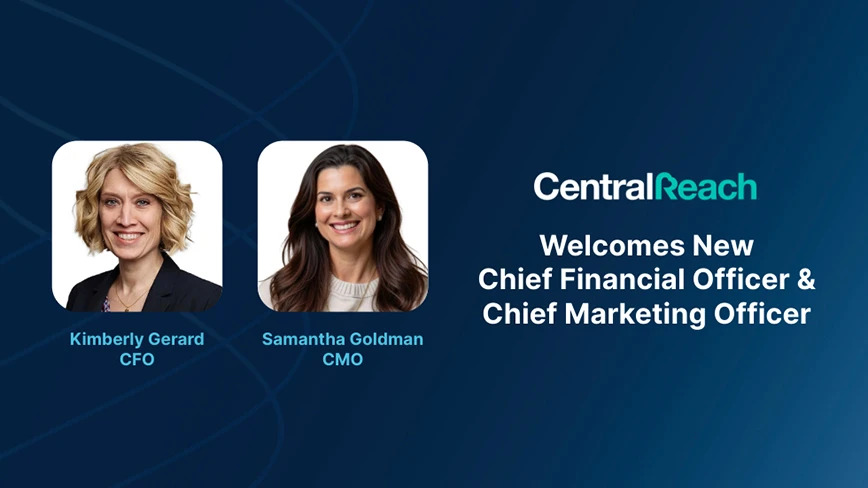
Goldman joined CentralReach as Chief Marketing Officer in 2025. Her remit covers brand, product marketing, communications, and growth. It is the kind of portfolio that can become four adjacent departments sending one another calendar invitations. Her record suggests a more connected view: the brand is what the system promises, product marketing explains why specific people should care, communications makes the story legible, and growth tests whether it moves.
The company serves specialized professional communities through a broad software and services platform. Its vocabulary includes operations, scheduling, billing, learning, data, and secure records. The temptation in a complex category is to advertise the diagram. Goldman's career has trained her to begin elsewhere: with the use case, the audience, and the friction that prevents someone from getting where they need to go.
Her recent public posts show the operating system taking shape. She has recruited for demand generation, marketing operations, product marketing, and AI marketing roles. She described the team she inherited as thoughtful, collaborative, low ego, and focused on work with visible impact. The words are pleasant. The job descriptions beneath them are more revealing: build full-funnel programs, translate product capabilities, own the stack, create repeatable processes, and use AI where it helps the team move faster and measure better.
The through line is not fearlessness. Goldman has been unusually plain about fear, emotion, uncertainty, and the unlovely mechanics of preparation. The through line is the decision to work with reality. People get nervous. Teams lose informal contact. Campaigns conceal their causes. Complicated products invite complicated explanations. Each problem becomes manageable when someone cares enough to construct the next useful step.
Years ago, Goldman stood behind the camera because it felt natural. Then she crossed to the other side, carrying rehearsals, notes, a repeated song, and a small coalition of helpers. She did not leave the operator behind. She brought the operator onstage. That may be why her leadership ideas feel practical: every platform, literal or otherwise, needs someone underneath checking the bolts.