Before Lynn Fernando had a corporate title, she had a door charge. In high school, she organized parties for friends, hired a DJ and promoted a theme. In college, she worked with DJs on events at clubs, lounges and houses. Someone had to persuade people to come, negotiate the arrangements and make the relationships work. Fernando was learning marketing with an unusually immediate feedback mechanism: either people showed up or they didn't.
It is a useful beginning for someone whose later career would run through Disney, Amazon and the advisory business she co-founded, REV Global. There is a recognizable line between assembling an audience for a party and assembling the partners, channels and customers around a business. The budgets change. So does the dress code. The question of who has a reason to walk through the door survives.
Fernando describes herself as a brand and commercialization architect. The title has the sound of a building permit, but the work is fairly concrete: connect what a company offers to the people who might buy it, then make that connection repeatable. Her career offers a way to examine how an instinct becomes a profession, and how a profession becomes something its practitioner wants to own.
An education in other people’s machinery
Disney and Amazon supplied very different settings for that work. At Disney Parks, Experiences and Products, Fernando led partnership marketing and promotions. She later moved into marketing leadership at Amazon Fashion. Her professional background also includes Nestlé, and her advisory work draws on brand management, e-commerce and strategic partnerships. These are jobs concerned with the space between an appealing idea and a customer's decision to spend money.
Her enterprise work includes commercial strategy for Walt Disney World's fiftieth anniversary. A celebration across parks and resorts requires partners and distribution as well as something worth celebrating. At Amazon Fashion, her work included The Drop, an influencer-led commerce model, and a partnership with Project Runway. Each puts a different kind of audience in contact with an offer: park guests, a creator's followers, a television show's viewers.
Taken together, these projects suggest why she treats brand and revenue as connected responsibilities. A name people recognize still needs a route to market. A partnership still needs a commercial purpose. A launch still needs someone thinking about what happens after the first burst of attention. Fernando's present practice carries those concerns into businesses with fewer departments available to distribute the work.
- DisneyPartnership marketing
and promotions - Amazon FashionMarketing, commerce
and brand partnerships - REV GlobalCommercial advisory
and ownership
Selected career chapters; not a scale of years.
The uncomfortable attraction of starting again
A successful corporate career can make a change harder to explain. By 2021, Fernando was talking about precisely that problem: she had an established life and two children, yet felt an urge to contribute in a different way. She described wanting the challenge of pursuing the next cold call again. There is something faintly comic about earning enough seniority to escape cold calls, then discovering you miss what they demanded of you.
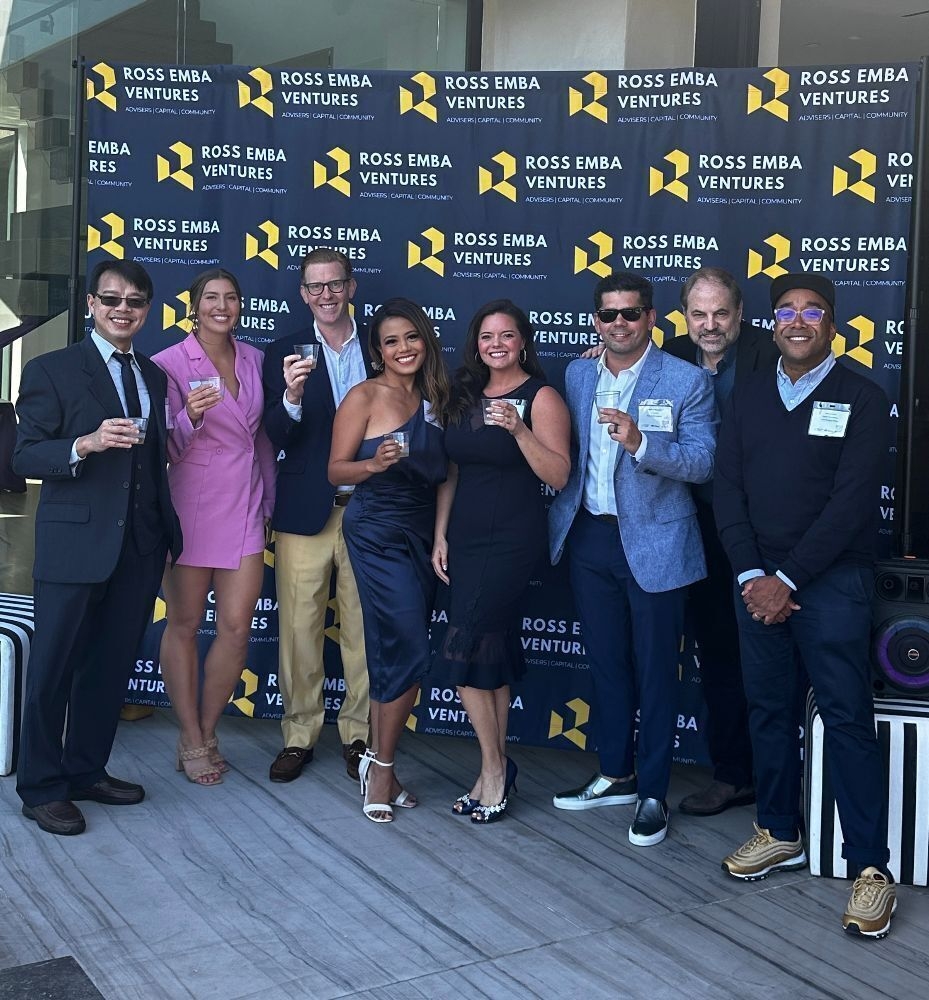
Her executive MBA at the University of Michigan's Ross School of Business became part of that transition. She helped found Ross EMBA Ventures, bringing the relationships of business school into an entrepreneurial setting. The classroom offered a place to meet other experienced people reconsidering their next move. A career change becomes more practical when the person across the table is also working out how to make one.
By May 2022, she had moved from a thirteen-year Disney career to Amazon. Her story therefore includes both a move between large companies and the development of her own ventures. Reinvention arrived in stages. The useful experience accumulated inside those institutions could travel with her, even as she reconsidered the setting in which she wanted to use it.
A network with work to do
In May 2023, Fernando joined a Michigan Ross gathering celebrating ten years of the executive MBA program in Los Angeles. More than 150 students and alumni attended, representing ten graduating classes. She spoke about the relationships among Michigan graduates in California and the links to their counterparts in Ann Arbor. Her enthusiasm was directed at what people could do for one another once they knew one another.
“The network is the Michigan Ross difference,” she said. A business-school network can be an expensive collection of names. It becomes more useful when someone can turn a name into an introduction, a collaborator or the right person for a particular assignment. That practical reading of community runs through Fernando's work.
REV emerged from the Ross executive MBA community. In September 2023, it announced REV Advisers, offering businesses interim executive expertise. Fernando and fellow co-founder Raphael Bennett served as co-CEOs. The proposition gave a company access to experienced leaders for a defined need, without immediately committing to a permanent appointment. A network acquired a job description. For Fernando, relationships were becoming part of a service a business could actually use.
The brand has to reach the till
Today, Fernando's commercial practice covers strategic advice, fractional leadership and larger enterprise mandates. Her clients may need help with partnerships, market positioning, channels or the processes behind revenue. The arrangement depends on the assignment. Sometimes a business needs a sounding board. Sometimes it needs an experienced person taking responsibility for execution while its own team gets on with running the company.
Her REV Global work also includes mergers and acquisitions for operators and smaller established businesses. The connection to marketing is closer than it first appears. A buyer considering a company needs to understand how it wins customers and whether that process can continue. A founder considering a sale has reason to make the business less dependent on the founder remembering every conversation.
This is the practical terrain behind Fernando's architectural language. Who brings in the customer? Which partnership creates useful distribution? Can another person run the process next week? Such questions are less photogenic than a launch. They also have the advantage of remaining relevant after the launch photographs have been filed away. Her work sits where the attractive promise of a brand has to become an operating habit.
Before the AI, a rather awkward question
Fernando's writing about artificial intelligence often begins with a small interruption. An executive wants AI because the board expects it, or because competitors seem to have it. She asks: “What problem does it solve?” The question is short enough to fit into the pause before a software demonstration starts. Answering it can take considerably longer.
Her filter has three parts. Identify the specific bottleneck. Decide whether removing it would materially help the business. Then ask whether AI is the appropriate tool. A new hire, a revised process or ordinary automation may be a better fit. The order matters because the purchase is otherwise liable to become the plan.
The same reasoning appears in her criticism of AI projects launched without baseline measurements. Faster email production proves little if nobody has decided what improvement should look like. She argues for preserving human judgment and measuring business outcomes. That is a recognizable marketing discipline applied to a newer instrument: define the customer problem and the desired result before deciding which machinery deserves the budget. The software can wait its turn.
Find the bottleneckWhat, specifically, is slowing the business?
Check the consequenceWould fixing it change a meaningful outcome?
Choose the toolDoes AI fit this job better than the alternatives?
Who gets the next invitation?
Fernando also co-founded the Ayana Foundation, which supports women founders through development, community and access to funding. Its programs include coaching, pitch preparation and investor introductions. Here, access has a specific meaning. A capable founder may still need help reaching someone prepared to listen, understanding the fundraising conversation or presenting the business in terms an investor can assess.
On October 13, 2026, Ayana and Chloe Capital held Chloe & Cocktails in Beverly Hills during LA Tech Week, with J.P. Morgan as presenting sponsor. The reception brought together women founders, investors, limited partners and operators. Ticket proceeds were directed to Ayana's Founder Readiness programs. The event placed the social gathering alongside the less glamorous preparation that can make an introduction useful.
Writing afterward, Fernando identified a gap she had heard about repeatedly: investors wanted suitable opportunities, while founders needed routes into those investors' conversations. She also urged founders to generate revenue early and build communities that buy. Her approach joins two responsibilities that can easily drift apart: prepare people to enter the room, and give the room a reason to welcome them.
“The network is the Michigan Ross difference.”
Lynn Fernando · 2023
The audience closer to home
There is a smaller audience for Fernando's work, too. In a Mother's Day reflection, she described her older son wanting to start a streetwear business. Her children had watched her work at Disney and Amazon, study for business school and build ventures. Now one of them wanted to know how to build a brand. It is a pleasing occupational hazard for a marketing executive: eventually, a business proposal arrives from inside the family.
Fernando has said that entrepreneurship can be learned by watching others. That conviction gives the family story its weight. A child sees someone making choices about work long before he understands a cap table or a distribution agreement. Watching a parent change direction can make the possibility of choosing a direction more tangible. In Fernando's telling, the example had traveled further than she expected.
The pattern across her work is a preference for making an opportunity usable. A party needs attendees. A commercial partnership needs a customer. A professional network needs a reason to connect. A founder needs preparation as well as an introduction. Fernando keeps returning to the practical arrangements that let people participate. The rooms have grown more formal since the DJ years. She is still thinking about who will come through the door, and what they can do once they arrive.