The letter was for his son. The consequence was a new company for his father. In 2018, Michael Nyman was running a business he had spent years helping assemble when his youngest child, Matt, received an invitation to join USC's football team. Another departure from the family home was approaching. Nyman began thinking about the time it would leave him, and what he might do with it.
There is something pleasingly ordinary about that trigger. A communications executive accustomed to arranging attention for other people found his own next chapter in the family post. No dramatic rescue was required. He had clients, a position and a business that had grown under his leadership. The decision involved leaving success while it still looked like success.
Acceleration Community of Companies, usually shortened to ACC, launched in July 2018. Its founder had a question with a practical edge: could he assemble specialist businesses that would help each other without spending their working lives competing for the same assignment? An agency group offered reach and resources. Its internal arrangements could also get in the way.
That question has become the organizing principle of his second act. Nyman is based in Los Angeles, where entertainment, publicity and consumer marketing regularly share a table. He has spent his career connecting those worlds. At ACC, he has made the seating plan part of the business strategy.
02First, learn how the pieces fit
Nyman graduated from USC in 1986 with a bachelor's degree in sports information. He went on to co-found Bragman Nyman Cafarelli with Howard Bragman and Brad Cafarelli. The initials BNC became a familiar part of the entertainment communications business. The firm was later sold to Interpublic, giving Nyman experience as both an entrepreneur and an executive inside a larger corporate group.
In December 2009, BNC merged with PMK. Brand marketing and communications met an established talent publicity business, and Nyman helped lead the combined organization as co-chairman and CEO. This was a career spent close to the people who make culture and the companies that want a place in it. Bringing those constituencies together demanded more than a useful address book.
The merger also gave him a working education in coordination. A company can put two names on its stationery in an afternoon. Getting their people, expertise and commercial interests to produce useful work together is a longer undertaking. His later interest in complementary businesses makes sense against that background: he had already spent years inside the machinery.
He has kept relationships from that period in view. When announcing ACC's DKC deal, he named former colleagues including Monica Chun, Scott Floyd and Rick Faigin alongside Bragman, Cafarelli and Cindi Berger. Today, Chun is ACC's president, Floyd its chief community and performance officer, and Faigin an executive partner. The new organization has room for people who knew the old one.
03A balance sheet with social consequences
An acquisition announces who owns a company. It says much less about how the people inside will behave on Monday. Nyman's answer has been to give agencies defined specialties and a financial reason to collaborate. ACC's early model put its businesses under a single profit-and-loss structure. That design makes the accounting arrangement part of the human arrangement.
Consider the alternatives. If neighboring teams can each claim the same brief, an introduction may cost the person who makes it. If their skills fit together, the introduction may make the project possible. A pleasant speech about teamwork has to contend with that arithmetic. Nyman's design tries to make the arithmetic support the speech.
MKG works in creative and experiential marketing. Pink Sparrow handles design and fabrication. Pixly brings influencer marketing, while Stripe Theory works with data and analytics. ACC Advisory supplies consulting. These are different jobs in the making of a campaign: deciding what it should achieve, finding the people who can carry it, constructing an experience and understanding the response.
By 2026, Nyman was explaining how ACC rewards cooperation through recognition, cash or equity. His ambition is captured in a compact piece of terminology: “a doing company.” It is a phrase with a publicist's economy. The actual test is less quotable. Does the client get useful access to several specialties, or simply several meetings?
Selected specialties within ACC's wider agency network.
04Back to campus, with questions
Nyman's connection to USC extends beyond the degree and his son's football invitation. He is co-chair of the Annenberg Board of Councilors and helped establish a think tank linking the university with industry. The work gives his interest in younger audiences a setting where those audiences can participate rather than merely be described.
In June 2024, ACC released “Unveiling Gen Z: What They Want You to Know in Their Own Words.” USC public relations master's students worked with professor Matthew Le Veque and ACC professionals on the research. Their account of the course emphasized an unusual advantage: the students belonged to the generation the project was studying.
Among the themes were multiple identities, satirical marketing, social currency and an expanded understanding of the third place. Each complicates a tidy customer portrait. People may belong to several communities at once. A brand's earnest message may encounter an audience fluent in irony. Places to gather need not fit the old categories. Purchasing can carry a social meaning beyond the object bought.
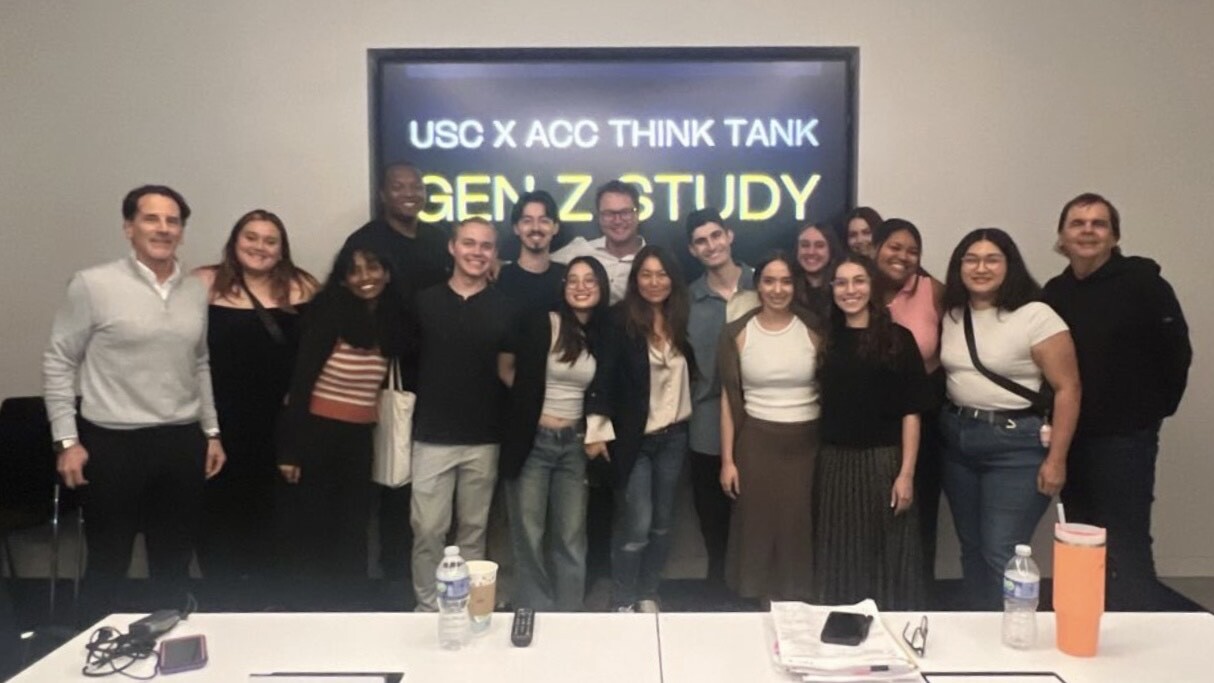
The classroom photograph catches Nyman at the left of a group of students, with a Gen Z study slide behind them. It is a useful image for a career built around attention. Here, the people whose attention companies seek are in the room. They have questions of their own, and the executive has a reason to listen.
05Public relations comes around again
In September 2024, ACC acquired a majority stake in DKC. The transaction was its sixth acquisition and brought the group to 550 employees across 12 US offices at the time. Solace Capital, ACC's majority shareholder, and ACC also brought in Verance Capital as a strategic investor. The expansion had capital behind it as well as an organizational theory.
DKC added a communications business with relationships across entertainment, technology, lifestyle and sports. Its sports work had included the Big East, Manchester City, Formula 1 and the NBA. For a founder who studied sports information, this was a familiar subject arriving through a new business route. Sports increasingly shares audiences, personalities and distribution with the entertainment world he knows.
Sean Cassidy became DKC's CEO, with Matthew Traub becoming president. Nyman described the acquisition as a full-circle moment in his own career. The description carries a specific meaning: a founder whose first company was in public relations was adding a substantial PR firm to the organization he had built after leaving PMK-BNC.
The point was also wider capability. A client working across publicity, social content and a physical event could draw on several businesses within ACC. That proposition does not guarantee a campaign will work. It does explain why a specialist might join a group: the next assignment may require skills beyond the ones that made the agency valuable in the first place.
ACC at the September 2024 DKC acquisition
06Familiar faces, new assignments
In May 2025, publicist Ina Treciokas launched Ingenuity Group within ACC's portfolio, based in DKC's Los Angeles office. She brought clients including Sarah Jessica Parker, Harrison Ford and Allison Janney. Her stated direction was talent and brand consultancy, with an emphasis on helping clients develop narratives, creative platforms and opportunities across their working lives.
That distinction suits Nyman's long interest in the space between entertainment and commerce. A performer can be associated with projects, collaborators and ventures that require different kinds of advice. A publicity assignment may therefore open into a larger question about identity and direction. ACC's collection of specialties is designed to have people available for those adjoining questions.
In August, ACC appointed Cosette Rinab its first creator-in-residence. The role connected a working creator with strategy across the agency group, including platform storytelling and experiences online and in person. It offered another way to put the people who understand an audience into the process of advising brands about it.
Then, in November 2025, ACC launched PMK Entertainment. Cindi Berger became CEO, reporting to Nyman, and Alan Nierob became president. The announcement described a 35-person team. The PMK name and Berger's arrival gave this chapter a recognizable echo of Nyman's earlier career. Starting again, in his case, has included working again with people whose judgment he already knows.
“The potholes never go away, but the path does get smoother”
Michael Nyman, reflecting on his career on LinkedIn
07The next brief is still unwritten
Nyman has also worked in the institutions surrounding the business. Governor Jerry Brown appointed him to the California Film Commission in 2014; he later served as its chair. USC recognized him with an Alumni Merit Award in 2019. In 2025, he appeared on the Los Angeles Business Journal's LA500 list. These roles place his commercial work within a longer Los Angeles career.
His conversations continue to circle around change. At ADWEEK's Cannes program in June 2025, he and Michael Kassan were scheduled to discuss agency consolidation, private equity and artificial intelligence. In July 2026, a podcast conversation with Robin Bonn covered advice, collaboration and following consumer demand. The vocabulary changes with the market. The recurring concern is how an organization should respond.
There is a personal version of that concern, too. Reflecting publicly on an interview with Ben Weiss, Nyman described a career shaped by moments, other people's lessons, circumstances and determination. He used the image of a North Star to explain the need for direction, without pretending the journey stops having potholes. It is a practical admission from someone professionally occupied with polished narratives.
ACC remains an answer he is building, rather than a conclusion he can announce. Each addition asks the same awkward questions about boundaries, incentives and trust. His career has given him plenty of practice at putting businesses together. The distinctive wager of this chapter is that people with different skills will find reasons to use them together. A letter for his son created an opening. Nyman chose to fill it with another beginning.