Lux Narayan went online to learn how to publish a book and found himself studying the audience instead. He took six courses, delivered across 56 livestreams. There was plenty to absorb about writing, editing and marketing. There was also a peculiar little drama unfolding in the chat: a presenter would ask a question, people would answer, and most of those answers would slip away unread. The invitation had been issued. The conversation had somehow missed its own appointment.
For somebody whose working life had involved persuading clients, recruiting colleagues and pitching investors, this was an interesting failure. The machinery for bringing people together was already there. So were the people. Their words were arriving on cue. Yet the person at the front could acknowledge only a fraction of them. An audience could be present, attentive and industriously typing while remaining practically invisible.
That frustration became StreamAlive, the company Narayan now leads as co-founder and CEO. It also offers a useful way into a career that otherwise looks rather crowded: entertainment, advertising, software, a TED talk, a fable, occasional comedy. Follow the job titles and the route bends repeatedly. Follow the question of who gets heard, and the bends begin to make sense.
A sales pitch with an unexpected ending
At IIM Calcutta, Narayan and friends planned an event-management venture called Rope Trick. They approached Amitabh Bachchan Corporation Limited looking for business. They came away with employment offers. Their prospective customer had decided to hire the people making the pitch. The venture lasted roughly a month. For an aspiring entrepreneur, a famous first boss and an appealing salary proved a fairly effective counterproposal.
He had studied mechanical engineering at IIT Madras before his MBA. His account of those years gives the extracurricular benefits considerable weight: football, friendships and people who would remain part of his life. Future co-founders came from his engineering-college circle. He met his wife, Lakyntina Lyngdoh, at business school. In hindsight, the campus had been doing some very long-term recruiting.
There is a pleasing tension in this beginning. The résumé suggests technical preparation followed by management training. The story he tells makes room for friendship, an abandoned business plan and a job he had approached as a potential supplier. It leaves contingency in the picture. A career can acquire a tidy sequence of titles without having been tidy while it was happening.
When brands had to join the conversation
Before Unmetric, Narayan was a co-founder of Vembu Technologies, which worked in online data backup. Unmetric brought a different problem into focus: companies were publishing into social networks, watching competitors publish too, and trying to understand what any of it meant. A brand could count its own responses. Deciding whether it was doing well required a wider view.
In a 2014 conversation with Robin Carey, he described brands facing an obligation to converse. That distinction mattered. Advertising could once arrange the message and buy its distribution. Social platforms put replies, comparisons and competing performances in plain view. Unmetric's business was to help marketers interpret that activity, compare content and make better-informed decisions about their next move.
Its platform supplied social benchmarking, audience-engagement insights and analysis of content performance. On October 24, 2019, Falcon.io, Cision's social media management division, announced that it had acquired Unmetric. The announcement set out plans to bring the product's capabilities and team into Falcon. For Narayan, who had led Unmetric through the acquisition, it marked the end of one substantial chapter.
Seen from his later work, the connection is easy to appreciate. Social analytics asks whether communication has produced a response. An interactive presentation asks what to do with that response while everybody is still in the room. There are different customers and different technical problems, but a familiar impatience with treating an audience as a blank surface.
Breakfast, with 2,000 other lives
Alongside the company-building ran an unusual reading habit. Narayan liked newspaper obituaries. His 2017 TED talk, “What I learned from 2,000 obituaries,” turned that interest into an examination of how lives are remembered. The material came from 20 months of New York Times obituaries in 2015 and 2016. A private curiosity had become a project with colleagues and, eventually, a six-minute public talk.
The team examined the short descriptions that compress a life into a headline. Among their findings: the arts accounted for 40 percent of the people in the sample, and the average age of a first major accomplishment was 37. These figures describe a selected set of newspaper subjects. They are useful provocations for thinking about achievement, rather than a timetable anyone needs to obey.
The exercise also kept directing him toward people whose names he had never known. A common thread was helping others. That is a rather different measure from celebrity: it asks whose world became more useful, more interesting or more workable because somebody lived in it. Reading the ending became a way to reconsider the middle. The analyst had found a dataset capable of questioning the analyst's own assumptions.
A childhood game escapes the notebook
In 2021, Narayan published Name, Place, Animal, Thing. Its title borrows the childhood game in which players fill categories against a chosen letter. The book uses a fable, following a character named Kai, to approach a question that also runs through Narayan's newsletter and workshops: how should a person answer when asked what they do? A job title is a very small container for a life.
This is especially amusing territory for a founder. Business biographies are built to establish credentials efficiently. They name institutions, promotions, financing and exits. A book about a fuller personal introduction makes a little trouble for that convention. The engineer who became an executive has chosen a form with room for an invented character and a schoolyard game.
His own interests make the case without much instruction. His author biography lists hiking, scuba diving and flying. His earlier speaker biography adds origami, molecular gastronomy and a fondness for documentaries with bad ratings. That last preference is a modest act of independence in an age of recommendations: somebody has to give the poorly reviewed documentary a chance.
He also helped found and volunteered at ShareMyCake, the nonprofit started by his wife to encourage children to direct birthday giving toward causes they choose. It is a small but telling connection to the obituary project. Both make room for contribution as part of a person's story. In one, children get an early opportunity to decide what they care about; in the other, adults are remembered for what their care produced.
“You can find micro-canvasses for creativity in everything that you do.”Lux Narayan, In the Balance
Put it in the chat
Learning to publish the book returned him to the classroom, where the disappearing answers caught his attention. In a conversation with Jason Falls, he explained how the repeated experience gave the product idea its shape. The previous founding team began working together again. An early proof of concept used YouTube Live, followed by work to bring the approach to other platforms.
The practical idea is easy to picture. A presenter asks where people are joining from. Participants type locations into the chat they are already using. A map makes their answers visible to the room. Other interactions turn responses into word clouds or polls. The audience gets a shared picture of itself, and the presenter gets something more informative than the reassuring sight of a participant count.
This is a problem of attention as much as software. Asking a question creates an expectation. If the answer vanishes, the exchange feels unfinished. Showing a room its responses gives the next remark somewhere to begin. The map and the word cloud are useful because a presenter can react to them. The interesting part is what people say after the graphic appears.
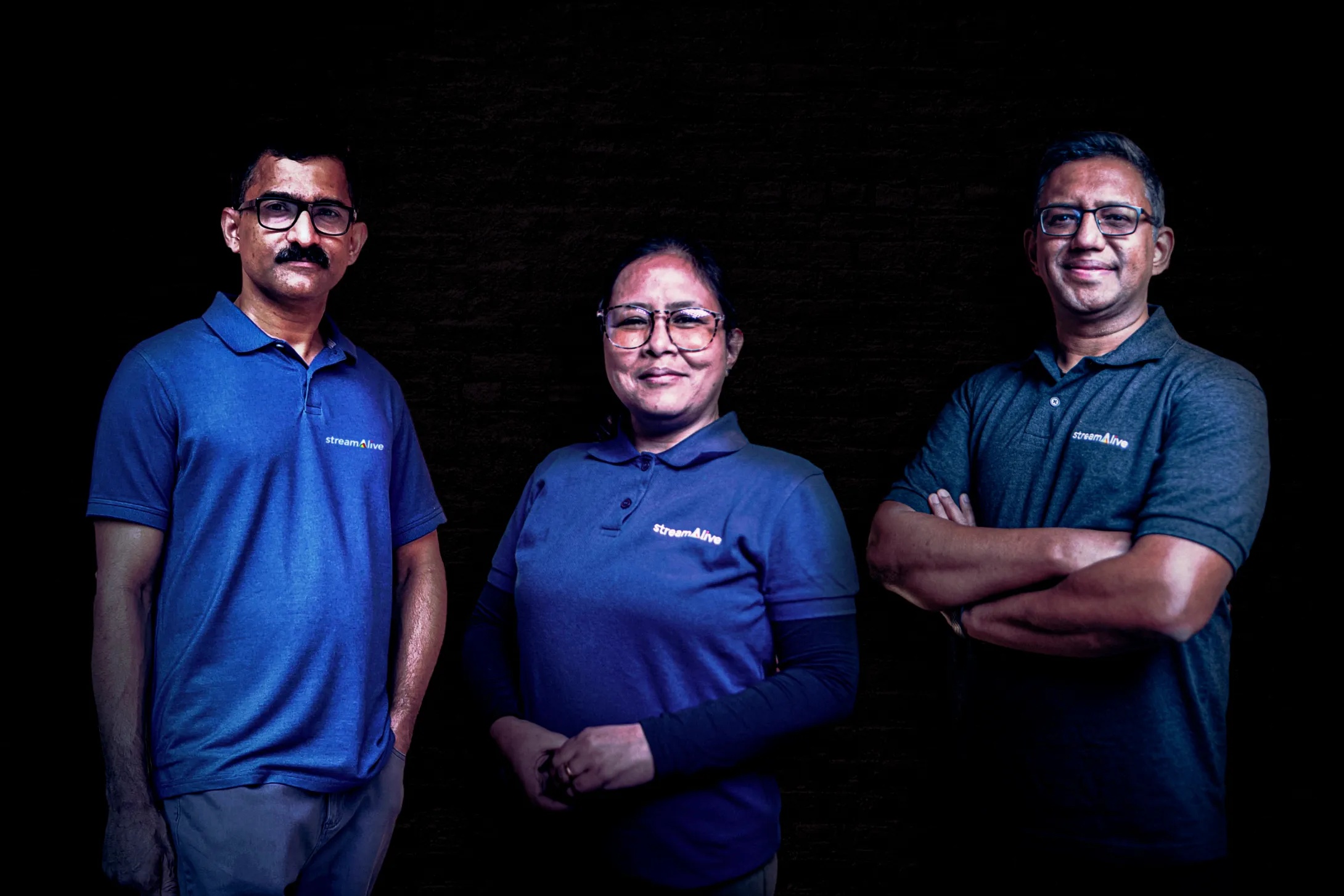
The team brought history with it. Narayan's fellow founders include Joseph Varghese and Lyngdoh, with connections reaching back through Unmetric and college. A new product did not require an entirely new set of working relationships. The founders' photograph has the cheerful uniformity of matching company shirts; the less visible common equipment is years of knowing one another.
The storyteller has homework, too
Comedy gives Narayan another way to test the distance between speaking and being heard. He has performed stand-up, including a five-minute set at New York's Comedy Cellar, and taken part in improv. His personal links include a recording of his stand-up debut. It is an unusually public form of homework. A slide can advance regardless of whether its argument landed. A joke receives its assessment in the room.
There is family history behind the interest in speaking. His workshop biography says his grandfather started a public-speaking school in Madras in the early 1970s and his uncle continues to run it. Narayan's own version moves between software and storytelling. The family connection is suggestive without requiring a grand theory of inheritance: several generations have found something worth working on in the space between a speaker and a room.
His current StoryMining workshop begins with finding personal material, then shaping it. Participants map names and places, recover moments and work a story into tellable form. AI tools enter the process to help organize and refine what has been found. As of October 2026, the course page lists a December 5 cohort. The project extends his interest in an introduction that carries more than a title.
The obituary reader, the founder and the occasional comic each face a version of the same editing problem. What deserves attention? What can be left out? What will somebody else recognize as meaningful? Narayan has made companies out of those questions, but he keeps finding reasons to return to them personally. The book led him into online classes; the classes sent him back into software. Curiosity has a habit of adding another assignment just when a project appears finished.