A hundred jobs was the number Rajesh Padinjaremadam had in mind. A modest enough ambition to say aloud, a substantial enough ambition to make payroll interesting. By the time he said goodbye to RapidValue in 2022, his account of the journey included more than 1,500 jobs created. The number described opportunities made over the life of a business, rather than everyone occupying a desk at once. It was also a revealing choice of opening subject for a departing chief executive.
He could have begun with a transaction. RapidValue had attracted institutional investment and, later, a majority acquisition by Aspire Systems. Instead, he began with people. His farewell returned to employees who had taken responsibility and customers who had taken a chance. For a career spent helping companies adopt new technology, the remembered cast was distinctly human.
Today, Padinjaremadam is co-founder and Chief Operating Officer of Wizr AI. The title has changed since his years as RapidValue’s CEO. So has the technology. There is a recognizable continuity, however, in the sort of work he chooses: helping established businesses make something useful out of a technological shift. His career has repeatedly occupied the space between a promising invention and an organization ready to use it.
A phone was the easy part
Padinjaremadam studied engineering at IIT Madras and management at IIM Calcutta. His early working life included Infosys and Deloitte Consulting. That background placed him close to the unglamorous machinery of enterprise change: business processes, systems and the people expected to operate them. A new interface is only one part of that machinery. Someone still has to understand what the business needs to accomplish.
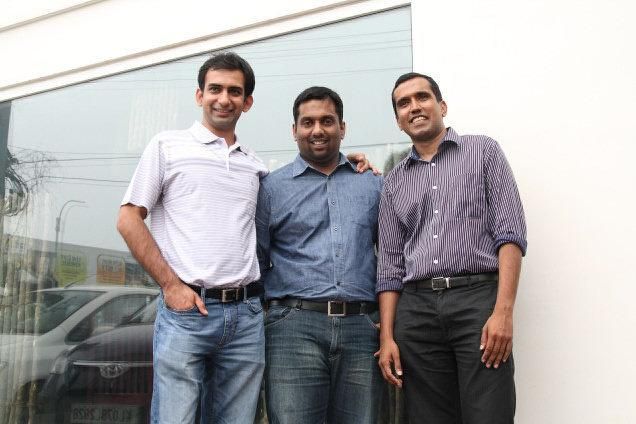
RapidValue emerged in the late 2000s, with accounts dating its formation to 2008 and its operating journey to 2009. Padinjaremadam, Sirish Kosaraju and Rinish Nalini built the founding team. Their opportunity was enterprise mobility. Smartphones were opening new possibilities, while companies had substantial operations that still needed connecting to those devices.
A purchase order, inventory record or sales order is hardly a red-carpet guest. Yet moving those functions onto a mobile device could change how someone worked. RapidValue built around that practical demand. Padinjaremadam’s first venture belonged to a category of technology businesses whose best result is often that another person encounters less friction during an ordinary day.
The cheque could wait
The early financing was personal: founders’ savings, with support from family and friends. Padinjaremadam later explained that remaining self-funded had been a deliberate choice. Mobile technology was moving quickly, but enterprise buying plans were still developing. Adding money before those plans became clearer could mean building capacity or backing a technology ahead of demand.
His warning was memorable: a premature capital injection could resemble a rocket setting off in the wrong direction. Speed is an awkward consolation when the destination is mistaken. The restraint was commercial rather than romantic. RapidValue concentrated on large enterprises and funded startups with budgets to spend, keeping the work close to customers capable of paying for it.
By May 2014, RapidValue reported more than 200 employees. Helion invested ₹25 crore that month. The business had crossed from a small founding group to an organization with an international customer base. Padinjaremadam’s argument for investment now concerned expansion, including growing the team in the United States and Europe. Capital had a more defined job to do.
The timing gives his story some texture. He was willing to raise money, and willing to wait. The question was what the money would enable at that particular stage. A growing company can spend the same rupee on an informed next step or an expensive assumption. The difference is often hidden until the bills arrive.
Room to outgrow a title
The team needed more than funding. In advice shared in 2013, RapidValue’s co-founders encouraged entrepreneurs to conserve cash, secure paying customers and give colleagues opportunities to take ownership. They also stressed choosing compatible partners with complementary abilities. The advice treated company building as an exercise in relationships as much as planning.
There were visible attempts to make those relationships part of working life. At RapidValue’s Kochi operation, employees organized Pakalpooram, a monthly gathering for games and activities. In a personal account, designer Hari Gopalakrishnan described helping run it. His recollections also included colleagues teaching one another, presenting ideas and developing an internal knowledge-sharing project. These are small scenes, but a workplace is largely made of small scenes.
By 2020, RapidValue was describing Influence, its peer-to-peer learning framework. For a services company, employee development has an immediate business consequence: the capability of the organization depends on what its people can do. Training creates room for more demanding work. Giving someone responsibility creates a reason to learn it.
Padinjaremadam’s own education came with recognizable institutional names. His reflections on hiring have emphasized looking beyond them. The distinction is useful. Credentials describe part of a person’s history; responsibility tests what they can do next. His stated preference has been to give capable people a larger field of action.
“Hire people who consistently outperform their title.”
Rajesh Padinjaremadam, on team building at Wizr AI
The company changed hands. The work continued.
In June 2020, Aspire Systems announced its majority acquisition of RapidValue, buying out Helion’s entire stake. The rationale concerned engineering capacity, leadership, sales and the ability to serve customers across a broader footprint. Padinjaremadam described opportunities to grow and cross-sell services. An enterprise services business was entering a larger organization with related capabilities.
The announcement initially envisaged independent operations with close collaboration. That makes the acquisition a distinct moment from Padinjaremadam’s departure. A deal can change ownership while the people running the business continue working through its next stage. The signing date and the goodbye need not share a calendar square.
His farewell came in 2022. It brought the story back to the ambition with which it began: a hundred jobs, followed by a much larger cumulative tally. Counting that way gives the company’s history a particular emphasis. Each job is an opportunity to enter, learn, earn and move forward. The number becomes a record of participation as well as growth.
There is a similar emphasis in the people he thanked. Early customers had accepted the risk of working with a young firm. Employees had accepted responsibility inside it. The business needed both kinds of confidence. His goodbye acknowledged the exchange rather than treating the company as the solitary accomplishment of its chief executive.
A familiar table, different seats
Wizr AI began in 2023. Padinjaremadam returned to company building with Kosaraju, now Wizr’s CEO. Padinjaremadam took the operating role, leading go-to-market work and operations. The returning partnership came with a different division of responsibilities. Familiar collaborators do not have to keep the same chairs forever.
Wizr’s leadership also includes Srinivas Keshavalu and Shahjahan Tapadar, whose professional histories include RapidValue. That continuity brings knowledge of enterprise customers into a new technological setting. It also makes the new venture a story about connections accumulated through work: people who have already built things together choosing another problem to tackle.
Wizr works on enterprise AI adoption and software engineering. Its customer-support offering, Cx Hub, was launched in 2024. In a reflection at the start of 2025, Padinjaremadam described the team’s progress from its 2023 beginnings and work with enterprise customers. Customer support supplies a practical setting for the technology: inquiries arrive, information must be found and someone needs a useful response.
The enterprise focus is consistent with his earlier career. A promising technology enters a company that already has systems, permissions and established routines. The work includes making those pieces function together. AI changes what can be attempted. The surrounding organization still determines much of what can be put into use.
What gets built around the technology
Padinjaremadam has carried his interest in team design into the AI discussion. In a public reflection on software delivery, he described smaller teams and changing roles as AI takes on more development tasks. He presented this as an observation from enterprise work. It raises an interesting tension for a founder whose first ambition was expressed in jobs: the tools for creating a business can also change the work inside it.
His more recent comments on established enterprise systems offer another clue to his approach. He has pointed to the workflows, permissions and exceptions those systems hold. A convincing demonstration is easier than accounting for all of that accumulated business knowledge. The operating challenge starts where the demonstration stops.
Across the two companies, his public arguments return to a few concrete decisions: find customers with problems worth solving, spend with a purpose and give people room to handle responsibility. Those decisions are less picturesque than a technological breakthrough. They are also decisions a founder has to keep making after the launch announcement has disappeared from view.
The hundred-job ambition remains a useful place to begin understanding him. It put an organizational goal beside a technological opportunity. RapidValue grew beyond that original measure; Wizr AI has opened another chapter. Padinjaremadam is again working with colleagues, customers and a technology whose practical uses are still being worked out. There is plenty left to build around the invention.