A purchase order can spend longer waiting for a signature than a person spends flying across an ocean. Somewhere inside that delay is a manager who needs information, a system that holds it, and an inconvenient distance between the two. RapidValue built a business in that distance. The smartphone supplied the screen; the company supplied the engineering that made the screen useful.
- The work: mobile apps, enterprise integration and digital product engineering.
- The advantage: reusable connectors and software components, adapted to a customer’s systems.
- The turn: Aspire Systems bought a majority stake in 2020; the RapidValue brand joined Aspire in 2021.
This is an unusually practical corner of technology. Its protagonists are expense claims, inventory records, service visits and approvals. Few people admire an invoice workflow. Almost everyone admires getting one out of the way. RapidValue’s history is interesting because it shows how much business can live inside that small distinction.
An app is only as good as the doors it opens
Brocade, the communications company, wanted a unified mobile experience for back-office work. RapidValue’s published case study describes three obstacles in Oracle’s standard mobile applications: trouble with customized modules, no single sign-on across solutions, and separate apps for separate functions.
Brocade chose RapidValue’s eQuipMe suite. The implementation connected business systems including Workday, Salesforce and Taleo, and brought functions together behind one sign-on. The case reports delivery in about four months and a reduction in approval times from one to five days to two to four hours. These are vendor-published project results, rather than a promise about the next customer.
The revealing detail is where the first attempt met resistance: existing customizations and identity requirements. A mobile interface cannot wish those away. The choice becomes an architectural one: make employees navigate the boundaries between systems, or do the integration work so they can finish a task.
Three founders, one unfashionable opportunity
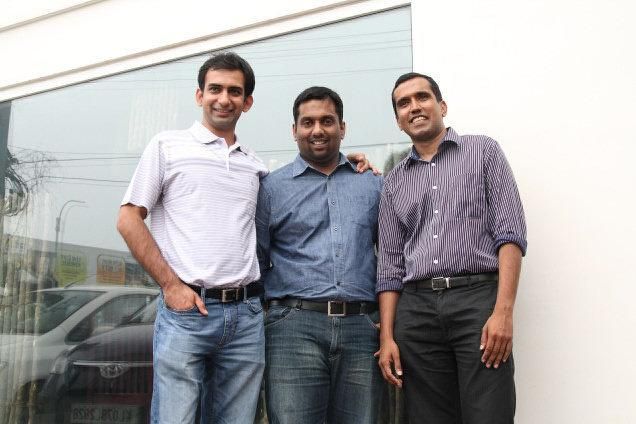
Rajesh Padinjaremadam, Sirish Kosaraju and Rinish Nalini saw an opportunity in enterprise mobility as smartphones began changing everyday transactions. Historical funding coverage dates the company’s founding to 2009; an earlier account describes self-funding beginning in 2008. Their eventual roles divided the work into chief executive, operations and technology.
By May 2014, the company reported more than 50 customers and 350 mobility projects. Its market included large enterprises and younger businesses. The following September, RapidValue announced a dedicated US development center in Irvine, alongside its Pleasanton headquarters and Indian operations. Named customers in that announcement included University of Phoenix, Karmaloop, MedAmerica, du and Naukri.com.
The variety matters. A retailer and a healthcare organization may need very different applications, yet both can face the same underlying problem: useful information stranded in a system that is awkward to reach. RapidValue sold engineering across that divide. Its services stretched from mobile strategy to development, integration and ongoing support.
Custom work, with parts worth keeping
The company’s position becomes clearer through its named tools. At Oracle OpenWorld in 2014, RapidValue launched an Oracle mobile framework under the eQuipMe name. It combined prebuilt modules, connectors and applications for such work as field service, procurement, inventory, HR and approvals. The framework was aimed at organizations with Oracle systems already installed.
That detail defines the market. RapidValue was helping customers extend systems they already depended on. Its launch material described customizable components and offline access. The commercial appeal was a head start on work that otherwise required fresh development, while leaving room for the peculiarities of a real business.
AccuRate applied a related idea to testing. RapidValue described it as an automation accelerator built with more than 600 prebuilt functions drawing on Appium, Selenium and Protractor. AsseteZe addressed connected equipment: remote monitoring, service automation and predictive maintenance. The scope had expanded beyond the phone, but the pattern remained recognizable. Assemble reusable capabilities around an operational problem.
This was a services business with software assets. Customers engaged RapidValue for consulting, design, implementation, testing and support. Its accelerators made that work more repeatable. The distinction matters when comparing it with a ready-to-buy application: a component library still needs people who understand the customer’s processes and can integrate it correctly.
The cost hiding inside a faster test
One of RapidValue’s testing whitepapers offers a useful accounting lesson. For an unnamed North American higher-education customer, its example put manual regression testing at 32 hours per release across eight devices, or 768 hours annually. Automated execution took three hours per release. But the paper also counted 360 hours for initial effort and maintenance, bringing the annual automated total to 432 hours.
The arithmetic yields 336 fewer hours, about 44 percent. That is a more useful number than execution speed alone. Automation requires investment before it produces repetition cheaply. RapidValue’s paper also discusses the maintenance burden when interfaces change. A buyer can copy the accounting discipline: include setup, upkeep and release frequency in the comparison. A rarely repeated test, or a constantly changing interface, may make the economics less attractive.
A daytime festival for the people doing the work
Engineering services depend on the people who deliver them. In a 2013 interview, Padinjaremadam described decisions resting on the “merit of the argument rather than seniority.” The same company portrait described Pakalpooram, a monthly gathering whose name was explained as a daytime festival in Malayalam. Employees played games, performed and recognized colleagues.
“merit of the argument rather than seniority”
Rajesh Padinjaremadam, on RapidValue’s culture in 2013
By December 2020, the company was describing a different set of rituals: virtual counseling, online certifications, expert sessions and remote celebrations during the pandemic. Its announcement of Computing’s Rising Stars Company of the Year award highlighted talent development, including the learning initiative Influence and its hackathon.
Those details are more informative than a declaration that people matter. They describe activities someone can schedule, fund and maintain. They also belong to their dates. An early interview and an award announcement tell us how RapidValue presented its workplace then; they are not a survey of every employee’s experience.
The buyer wanted the engineers, too
Helion Venture Partners invested approximately ₹25 crore in May 2014, commonly reported as about $4.2 million. Six years later, Aspire Systems acquired a majority stake in RapidValue and bought out Helion’s entire holding. The June 2020 announcement emphasized digital engineering capacity, leadership and sales capabilities.
Padinjaremadam described broader global reach and the opportunity to cross-sell services. Aspire’s leadership described RapidValue as a differentiated organization that could add engineering strength. The stated rationale was scale and complementary capabilities. It gives a concrete explanation for the strategic choice without requiring a tale of founders suddenly losing faith in independence.
Helion’s institutional investment
Aspire acquires a majority stake
RapidValue becomes Aspire Systems
Initially, the companies planned to operate independently with close collaboration. In October 2021, Aspire publicly announced that RapidValue Solutions was now Aspire Systems. Anyone approaching this business today should begin with Aspire. RapidValue’s standalone history explains part of the engineering capability that entered that larger organization.
Start with the unfinished task
The useful lesson for a technology buyer is to choose a unit of work before choosing a screen. Follow one approval from request to decision. Identify the information, permissions and systems it touches. Then examine whether a standard application already handles the task or whether custom integration earns its cost.
RapidValue’s approach fits a particular kind of customer: an organization with established systems, meaningful integration requirements and enough repeated work to benefit from reusable components. A company whose standard software already meets its needs has less reason to commission another layer. A beautiful mobile interface will also do little for a process whose rules nobody has agreed on.
There is a modest pleasure in this story. Enterprise transformation becomes comprehensible when it ends with a person completing something ordinary. RapidValue’s distinctive work was close to that moment: connecting systems, adapting components and checking that the result held together. The office could fit in a pocket only after somebody dealt with the office.
Follow the work
Explore current services and the company’s historical channels.