The instruction was short enough to fit on a student club’s noticeboard: give them responsibility. In his account of LUTES’s 2024, Niilo Tallberg described a change in who got to run things. Members outside the board began leading events and programs. The team doing that work expanded to 52 people, while the board concentrated on the organization as a whole.
That year, he reported, the society organized more than 75 events, added over 300 members and helped more than 30 startup teams advance their ideas. These are measures of activity, rather than company survival. They nevertheless describe a place where entrepreneurship had become a recurring appointment. Someone had to book the room, recruit the speakers and make the next event happen.
LUTES, the LUT Entrepreneurship Society, makes a useful subject precisely because its work starts before a company has much to put in a pitch deck. It serves people trying to decide whether they can become founders at all. The first opportunity may be a conversation, a workshop or a project with their name attached to it.
A campus club with somewhere to go
Founded in 2011, the nonprofit draws its core membership from LUT University and LAB University of Applied Sciences. Its base is Parvi in Lappeenranta. The current website calls the organization a “Human accelerator” and reports more than 1,200 members, over 40 nationalities and more than 90 events a year. Those are the society’s own figures, a snapshot of its present pitch to newcomers.
There is an earlier, more precisely dated marker. A 2025 academic study by Mika Artturi Tonder recorded 597 members at the end of 2024. The research examined how students construct an entrepreneurial identity through language, interaction and belonging. That is an unusually apt way to look at a society whose immediate output includes people becoming comfortable enough to try.
Consider the practical problem Parvi addresses. A student can have an interesting technical idea and still lack a teammate, someone to question the assumptions or a reason to return to it next Tuesday. LUT University describes the shared space as a meeting point for students, businesses, entrepreneurship support services, the university and associations. Repeat encounters give a tentative idea more chances to survive its owner’s initial enthusiasm.
The summer has a price: your time
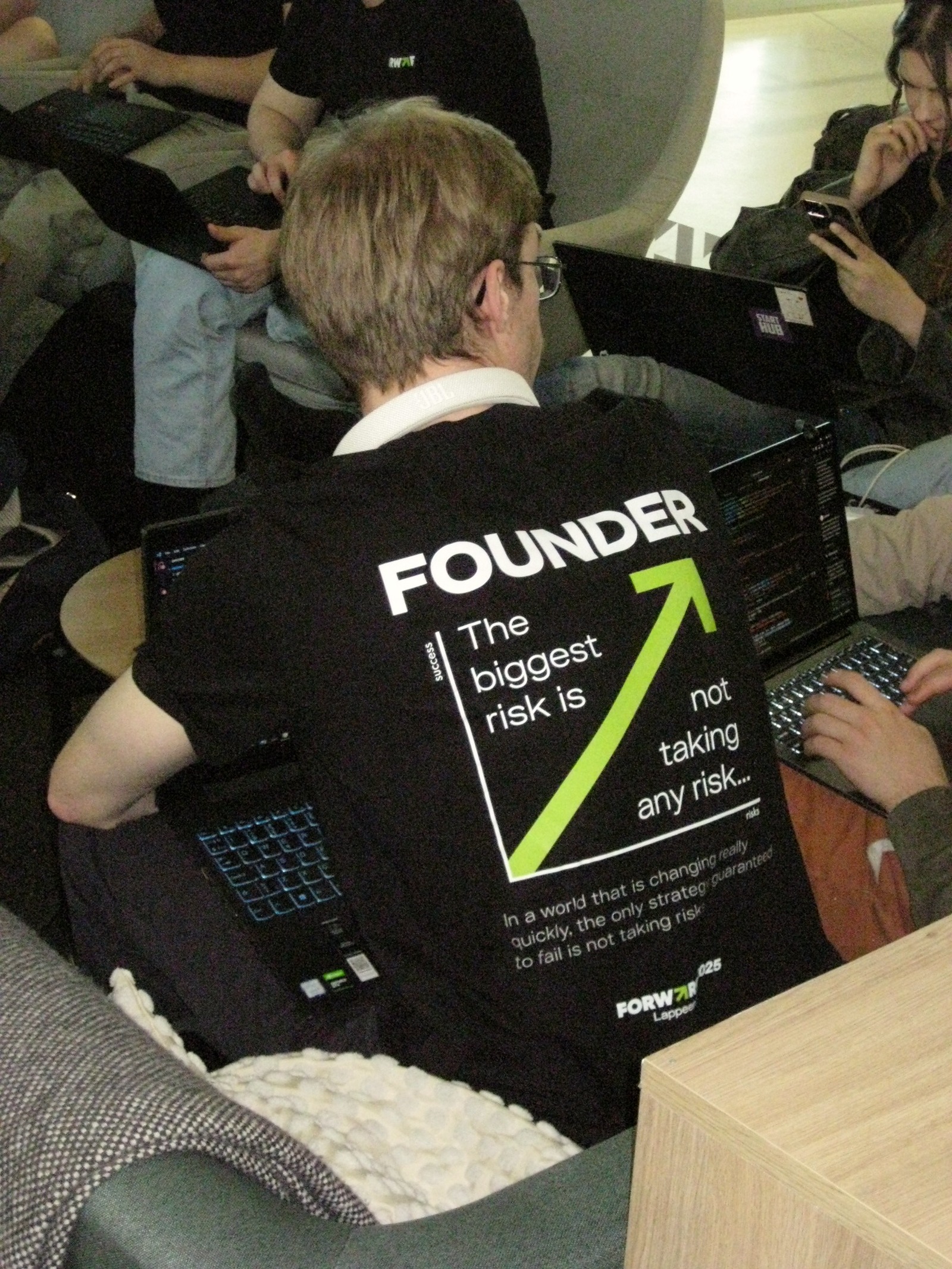
Forward is the society’s summer accelerator for first-time founders. Its published 2026 offer asked for ten weeks in Lappeenranta, from May 18 to July 26. There were no participation fees and no equity taken. Core workshops, check-ins and mentor meetings required attendance in person. Students completing the program were offered 10 ECTS credits.
The work is concrete: talk to prospective customers, build a basic product, test it and present the progress. Solo applicants and teams were welcome; a finished product was unnecessary. The timetable matters as much as the invitation. By September, those summer dates are past, so the useful next step is to check the next cohort’s terms rather than treat an old application button as a fresh opening.
For an applicant, the difficult calculation is likely to concern the calendar. Ten weeks committed to building can compete with paid work, study plans and time elsewhere. Removing the entry fee helps; it cannot make that choice disappear. The offer fits someone willing to spend a summer testing assumptions in public. A person looking for occasional remote advice would be choosing a different kind of service.
Sixty-three testers, then a trophy
Warm’s account of the 2024 Forward summer supplies the welcome mess behind the program description. Writing as the dating startup’s COO, Kristian Boström described changes in the team before and during its early journey. Several initial participants did not continue, and Jere joined the remaining builders. Recruiting users also fell short of the plan: the team wanted 100 MVP testers and reached 63.
The product was unfinished in specific ways. Map functionality still needed work as other parts of the code progressed. Some planned investor contacts remained outstanding. Yet Warm won the demo-day pitch competition. The account ends with confidence and more work to do, rather than a claim that the business had been solved.
63% of the target. A useful result to examine, even when the pitch wins.
That distinction is worth keeping. A competition rewards what judges see on the day. Customer testing asks another question: does this thing work for the people expected to use it? A reader can copy the discipline of setting a recruitment target and reporting the actual number. It makes progress discussable without requiring either triumph or catastrophe.
Who pays for the room to experiment?
In October 2023, LUT University announced that Säästöpankki Optia was donating €150,000 to LUTES. The bank connected the gift with its 140th anniversary and with support for startup activity in Eastern Finland. This was funding for a student entrepreneurship community, with a regional purpose attached.
That distinction matters when reading LUTES as a company profile. Legally, it is an association. Its operating logic includes donations, program sponsorship and membership arrangements. Its rules allow membership fees, with the autumn meeting deciding their amounts. Forward’s sponsors are displayed on its program website. These forms of support help explain how an accelerator can advertise free participation.
The beneficiary and the backer need not be the same person. Students gain opportunities to experiment; businesses and other supporters help maintain a setting where new ventures and relationships may develop. The €150,000 announcement offers a concrete example of that bargain. It should be understood as a donation to the society, not as startup investment raised by one of its participating teams.
The board gets a year. The work must last longer.
Student control is written into the rules. Full membership is available to degree students at LUT and LAB, subject to approval. Full members vote; supporting and alumni members do not. The chair and board members serve calendar-year terms. The structure regularly puts authority into the hands of another group of students.
Oskari Salmivesi is listed as president on the 2026 board page. Other named responsibilities cover finance, partnerships, marketing, operations and academic affairs, startups, events, and community communications. That spread reveals the organization’s practical expertise: it must coordinate people and programs while helping others learn to build businesses.
“Give them responsibility.”
Niilo Tallberg / reflecting on LUTES in 2024
Tallberg’s account ties the project model to wider participation. The organizational lesson is straightforward: give a member something they can lead, with a result other people can see. Annual leadership turnover makes the accompanying handover especially important. Contacts, budgets and unfinished tasks have to remain intelligible after the person who remembers every detail has moved on.
There is an opportunity cost for organizers, too. Tallberg estimated spending about 40 hours a week on LUTES during 2024 and said his next year would focus on finishing his bachelor’s work and beginning master’s studies. His account makes the volunteer commitment tangible. A society depending on that level of involvement needs more people able to carry responsibility.
Eight routes, with different clocks
The current lineup gives different levels of commitment a name. Velocity compresses early testing into a week. Katalyst offers a four-month incubator with workspace and mentor check-ins. Fortress is a three-week residency for defence and dual-use prototypes. Forward occupies the summer. These are distinct entry points for people at different stages, rather than a single course everyone must follow.
Hackathons, travel to other hackathons, Taival excursions and Idearace complete the eight-program directory. Idearace’s 2024 terms describe joint organization with Business Mill, including a student category open to higher-education students throughout Finland. LUTES therefore operates within a wider support network. University courses, local advisers and other entrepreneurship societies offer adjacent routes; some can be useful alongside membership.
The journey has to bring something home
LUTES’s international activity has included adapting its teaching as well as visiting startup cities. Ambitious Africa described a collaboration with Home Street Home in Makongeni, Kenya, for which LUTES contributed content based on its Forward framework. The intention was to fit the bootcamp’s goals and learn about the Kenyan entrepreneurship setting. Copying a program meant changing it for the people using it.
The relationship had a later chapter. Home Street Home’s 2024 annual report describes a three-day entrepreneurship bootcamp held with LUTES from November 5 to 7. Thirty-one students from KTC took part in identifying problems, developing business concepts and practicing pitches. It is a specific example of the society’s educational work beyond its Finnish campus.
A January 2026 account describes a different kind of trip: roughly two weeks in San Francisco and Silicon Valley in late 2025, with approximately 30 meetings. Participants began preparing outreach in October. The stated purpose included bringing lessons back to Finland and advancing their own projects. Arranging the conversations was part of the work before anyone boarded a plane.
For a student wondering where to begin, LUTES offers several sensible first moves: attend an event, talk to people at Parvi or find a program that matches the time available. For someone running a student organization elsewhere, its most portable idea is smaller than an international excursion. Give another member a real project, enough authority to run it and a reason to come back with results.