The overlooked business of every hardware boom is the stuff around the star. Gold rushes need shovels; smartphones needed cases, screen protectors, chargers, cords, earphones and small speakers with big promises. LTEMP Corporation occupied that crowded, practical edge of the market. From an address on Oakdale Avenue in San Francisco, it described itself as designer, manufacturer and distributor, then offered retailers a shortcut through an accessory aisle that could feel infinite.
Its proposition was simple: curate the fast movers, buy or make them at scale, and put them in the hands of sellers who did not want to negotiate with a dozen factories. LTEMP welcomed retailers, wholesalers, distributors and entrepreneurs for wholesale and OEM work. In its own words, the catalog was supposed to reduce “decision making frustration” and increase profit. That is the whole middleman pitch in eight words, and it is better than pretending another USB cable changed civilization.
The public footprint now feels like a box discovered at the back of an electronics shop. The current website lands on a Wix 404. LinkedIn still describes a two-to-ten-person consumer-electronics company. Old posts preserve products, prices and advice. A corporate-record service reports that the California corporation incorporated in August 2012, dissolved in November 2020 and was later listed as suspended by the Franchise Tax Board. The operation may be gone; the selling lessons are not.
A catalog built around the phone, not inside it
LTEMP did not need to guess which smartphone would win. It needed to make sure the winner still required a cable. Its advertised assortment covered cases, screen protectors, chargers, USB and auxiliary cables, memory cards, headsets and speakers. It also pitched product design and manufacturing help, a higher-touch service for customers who wanted their own idea made tangible.
That placed the company between a factory and a neighborhood retailer. A factory optimizes production. A retailer optimizes shelf space and cash turnover. LTEMP's job was translation: identify something sellable, wrap it in usable copy and packaging, make it available in wholesale quantities, then explain whom it was for. This was not pure ecommerce, nor was it a classic branded-hardware company. It was a small distribution and merchandising machine.
The customer was often another seller. LTEMP told store owners not merely what an item did, but how to close the sale. For the $13.99 Woozik W-350 wired earphones, it recommended keeping a demo unit at the counter. For the Woozik Magic, a compact Bluetooth speaker with colored lights, the advice was even more theatrical: dim the store and start a light-and-music show.
“LTEMP recommends owners to provide a demo product that customers can borrow and try out at your counter.”2016 Woozik W-350 product post
What it cost, and what the buyer really bought
Only one clear consumer price survives in the public material: $13.99 for the W-350 on Amazon in June 2016. LTEMP did not publish the wholesale cost in that post, so its retailer margin cannot be reconstructed responsibly. But the low ticket tells us where the product sat. This was an impulse-friendly replacement for the earbuds that came in the box, aimed at students, travelers, office workers and ordinary listeners rather than studio engineers.
The W-350 had a microphone, a flat 1.2-meter cable, metal housing, silicone tips and the once-universal 3.5mm plug. The review also conceded that long sessions could become uncomfortable. That admission is more commercially useful than it looks. It separates the everyday customer from the demanding one, reduces disappointment and gives the seller a reason to trade an audiophile up to something else.
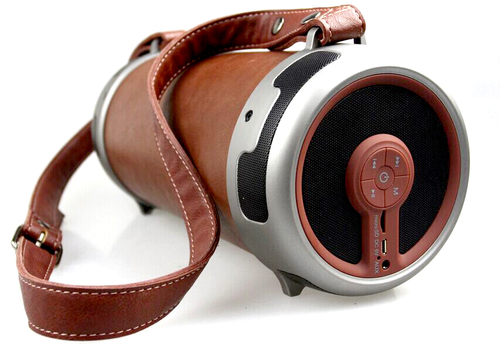
The S29 speaker was more ambitious: Bluetooth at a claimed ten-meter range, FM radio, microSD playback, AUX input, a 1,800mAh battery, six hours of stated play time and a faux-leather shoulder strap. It was less a pristine audio object than a portable list of reasons to say yes. The Woozik Magic followed the same logic with seven colors and ten LED patterns. Its published weakness was wonderfully specific: a charging cable only 60 centimeters long.
The difference was curation - until it wasn't
LTEMP competed with other accessory wholesalers, OEM factories, marketplace merchants and every retailer willing to source directly. Its distinction was not a defensible technology. It was a bundle of small conveniences: a local point of contact, a broad catalog, OEM conversation, finished merchandising language and fewer decisions for the store owner.
The company also showed at the 2015 International CES, according to that year's exhibitor directory. That put LTEMP in the industry's main bazaar, but a booth listing is evidence of attendance, not market dominance. The more interesting achievement is humbler. A small team kept producing product-specific explanations that named uses, users, drawbacks and display tactics.
The weak spot was ownership of demand. If shoppers came asking for an iPhone cable, Amazon, a nearby distributor or a factory-direct marketplace could offer one too. Curation helps when buyers are confused. It helps less when search, reviews and logistics make the product legible without a middleman. And every extra SKU creates inventory, compatibility and obsolescence risk. A case made for yesterday's phone can become dead stock overnight.
What failed first
No public postmortem explains why LTEMP faded, so motive and sequence should not be invented. The records do reveal early cracks. The company filed the LAWA trademark in December 2012 for phone cases, USB cables, adapters and car chargers. The application was abandoned in February 2014 after no statement of use was filed. That does not prove a product failure. It does show that the proposed brand did not complete the federal registration path.
Next came the website's disappearing act and the legal corporation's reported 2020 dissolution. Those are operational facts, not a confession. There is no public evidence of a funding round, acquisition, bankruptcy narrative or decisive strategic pivot. Nor is there evidence of what “changed their mind.” The honest answer is that the archive records changing status, not changing minds.
Even LTEMP's beginning is slippery. LinkedIn says the business had provided products since 1999. A company-authored Medium post says it had been in the market since 2010. California incorporation data starts in 2012. These dates can describe different things - family trading history, an informal operation and a legal entity - but the public material does not reconcile them. For anyone telling a company story, that is another portable lesson: choose one origin and document it.
The part worth stealing
Copy the translation layer. A list of specifications is not a proposition. LTEMP turned “Bluetooth plus LEDs” into a counter demonstration and turned “flat cable plus microphone” into a budget choice for a student. It identified who should buy, where they would use the product and what the retailer should physically do next.
Copy the willingness to name a flaw. The short charging lead and long-session discomfort did not destroy the pitch; they bounded it. Good hardware copy helps the wrong buyer leave before becoming an angry customer. Also copy the narrow demo. A trial is powerful when the value is sensory and immediate: sound, light, fit, grip, weight. It is far weaker when setup takes twenty minutes or when the product needs weeks to prove itself.
The reusable playbook
- Curate around a growing platform, but own a reason customers cannot instantly price-compare.
- Write for the reseller and the end user: margin story first, use case second.
- Give every unfamiliar product a ten-second demonstration.
- Publish one concrete drawback to clarify who the product is not for.
- Keep legal status, trademarks, domains and founding story as current as the catalog.
This approach will not work under every condition. It breaks when shipping and returns erase the margin, when certification costs overwhelm a small run, when platform changes strand inventory, or when the retailer can buy the same item directly with equal trust and speed. It also fails when the demonstration creates delight but not repeat demand. A flashing speaker can stop a shopper. It cannot, by itself, build a durable company.
LTEMP fits into the market as a compact example of the hardware middle: not the smartphone maker, not quite the factory, not merely the shop. The company tried to make the unruly shelf easier to buy and easier to sell. Its surviving work is most valuable now as a reminder that distribution is a product, merchandising is a service, and the boring machinery behind both must last longer than the gadgets.