Lorenzo Esparza’s parents had a sensible plan. Their sons would enter the professions. Medicine and law offered recognizable routes to a better life, and there were two sons to distribute between them. Esparza earned the law degree. The rest of his career declined to follow the outline.
There was Paramount Pictures, where he learned about the economics behind entertainment. There was private wealth management, where that knowledge could travel. And in June 2016, there was Manhattan West, an investment firm he launched after leaving J.P. Morgan Securities. A résumé can make these turns look tidy. Living through them requires considerably more nerve.
His story is about becoming comfortable enough with one world to move into another. It is also about ownership: understanding who participates in a business, how they are paid, and who takes responsibility when the decisions become your own.
A degree with an unexpected sequel
Esparza grew up in a modest-income family, the son of immigrants from Mexico. His father worked in construction; his mother was a bank teller. Finance interested him before it became a plausible occupation. As a child, he watched CNBC, fascinated by markets even when he could not make much sense of what he was hearing. The screen offered a glimpse of possibilities outside his immediate experience.
After a bachelor’s degree at UC Santa Barbara, he went to Loyola Law School in Los Angeles, graduating in 2000. An internship at Paramount opened another route. He entered the studio’s business side, working in its television division in Chicago and Miami. Legal training had brought him to the door; a commercial career gave him a reason to stay.
Hollywood sells stories, but someone must also understand the agreements behind them. Esparza became interested in transactions and profit participation: the arrangements through which work can produce a financial return. That was a useful subject for someone whose curiosity about capital markets had survived law school. The diploma was still useful. It simply had to tolerate a change of plot.
The next classroom was the market
In October 2007, Esparza joined Bernstein. The timing placed his new career close to the financial crisis. His route later included RBC and J.P. Morgan Securities. These were different organizations, but the recurring work was with people whose money needed management and whose trust had to be earned.
The studio experience gave him something specific to bring to entertainment clients. He had worked inside their industry. A career change does not erase the preceding job; sometimes the preceding job is precisely what makes the new one credible. For Esparza, Hollywood was experience he could carry into another professional setting.
He has recalled learning a demanding work ethic early, including weekends picking strawberries with farm workers alongside his father. At Bernstein, a weekly meetings target became something to exceed. Those recollections help explain the persistence behind the changes in title. He did not arrive in finance with an inherited guide to its opportunities. He arrived with curiosity, a credential, and habits developed elsewhere.
The freedom had to work on Monday
Leaving a large institution is an appealing story until one considers everything the institution was doing. Clients need accounts, investments, borrowing arrangements, and people who answer practical questions. A founder gains freedom and promptly acquires a list of things that must continue to function.
Esparza spent a year working on his vision before launching Manhattan West. He has described starting the firm as a career highlight and has encouraged departing advisors to keep their attention on the business they want to build, while leaving on good terms. A grand exit can be entertaining. A professional one is more useful.
One practical problem was lending. His team needed a solution for existing client loans before independence could become workable. They supplied TriState Bank with a spreadsheet detailing the arrangements that needed to move. Esparza said the bank was able to match or improve the size and rate of each loan. The transition depended on those details as much as it depended on the new firm’s name.
This is the portion of entrepreneurship that rarely gets a movie. The founder’s ambition has to survive contact with a client’s ordinary requirements. A borrowing arrangement may offer less dramatic material than a resignation, but it can determine whether the client is willing to follow.
“It was more about wanting to run to something”
Lorenzo Esparza, reflecting on independence in 2021
He launched Manhattan West in June 2016. The decision put him on the other side of the ownership question. Earlier, he had studied how people participated in businesses. Now he had a business to make work.
Hollywood, with the balance sheet attached
Manhattan West developed around private wealth services and private investment opportunities. Its clients have included athletes, entertainers, media executives, and high-net-worth families. That combination brings the public business of fame into contact with the much quieter business of managing what it earns.
By December 2022, the firm had closed its inaugural private equity fund, focused on media, entertainment, and sports. Its activity included a management buyout of Round Room Live and a growth investment in Vino Vault. Matt Gibbons led the private equity fund. These were team efforts, extending the firm beyond the conventional picture of an advisor selecting a client’s publicly traded investments.
Round Room’s live entertainment business provides a particularly clear connection to Esparza’s earlier working life. The firm’s investing also reached the Formula 1 Exhibition. Here, entertainment was both a world familiar to the founder and a business in which the organization could invest. Audiences see the show; investors must consider the enterprise that makes the show possible.
The distinction matters when describing his achievements. A portfolio investment is the work of an organization and its investment professionals. Esparza’s contribution sits in building and directing the firm that brings those people, client relationships, and investment capabilities together.
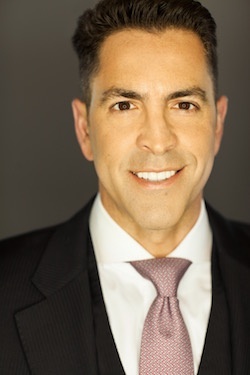
Before the billion-dollar milestone, there was still a firm to build. A separate press portrait from that chapter.
A client’s life has more than one column
In his public conversations, Esparza returns to the idea of connecting services. Investment management sits alongside business management, tax work, and planning. The organizing idea is a private client ecosystem, with several kinds of professional knowledge available inside the firm.
His 2022 conversation with Ed Lopez covered proprietary strategies, building a client base, hiring, multifamily real estate, and allocating to alternatives. Another discussion that year explored how technology and investment platforms were changing access to private markets. The subjects suggest an executive interested in the machinery of the business as well as its investment menu.
That breadth makes his law-and-studio background easier to understand. Contracts, business economics, and portfolios ask different questions about the same money. Connecting them requires people with different expertise. It also creates a practical demand on leadership: the organization must make those specialties work together for a client.
An editorial map of the business, not a portfolio allocation.
More names on the career map
Esparza has spoken with Hispanic students about private equity, venture capital, private debt, and capital markets. He recognizes the narrow career map that pointed him toward law school. Introducing other professions gives students more possibilities to investigate before they commit to a path.
He has also described the difficulty of entering finance without a family background that makes its opportunities familiar. Budgeting and saving are understandable ideas; the structure of an investment industry can remain remote. His account puts career awareness alongside financial education. Knowing that a profession exists is an early step toward imagining yourself in it.
The same question reaches hiring. In his descriptions of Manhattan West, he emphasizes an open search for candidates rather than assuming that the right person must resemble the people already in charge. Diversity, in that account, follows from widening the pool. That is a concrete position about how a firm looks for talent, rather than a prediction about anyone’s results.
In 2023, he received Wealth Solutions Report’s Hispanic Entrepreneur of the Year recognition. Recognition gives the story a public marker. The student conversations give it a more immediate purpose: making an unfamiliar working world easier to see.
An institution, not a finish line
By October 2023, Manhattan West had surpassed $1 billion in assets under management in its first seven years. Esparza built the business alongside co-founding partner Angie Spielman. The figure describes assets entrusted to the firm, an important measure of scale and responsibility. It is separate from the founder’s own wealth.
A milestone reached by 2023, seven years after launch. Client assets, not personal net worth.
The work continued beyond that milestone. In April 2026, the firm announced Francois Schramek’s promotion to partner. Esparza highlighted Schramek’s investment insight and international client relationships. The announcement described a practice connected to family offices across several regions, showing how far the organization’s working geography had extended from its Los Angeles base.
Today, Esparza leads strategic direction and daily operations and chairs the investment committee. He also serves as general partner or managing member of more than 30 investment funds. Away from work, he enjoys golf and surfing and lives in Los Angeles with his wife and two sons.
His stated ambition is to create an organization with staying power, looking toward institutions such as J.P. Morgan, Apollo, and KKR. It is an aspiration, with the years of work still attached. The parents who pictured a professional career gave their son a starting point. He has spent the subsequent chapters discovering what else that education could make possible.
Keep reading. Keep listening.
- Manhattan West · Lorenzo’s biography
- Lorenzo on LinkedIn
- The 2016 launch
- Career and ownership · 2023 interview
- Hispanic advisors and the $1B milestone
- Student outreach · audio and transcript
- Planning the move to independence
- Client lending during the transition
- Hispanic Entrepreneur of the Year
- Opening the financial career map
- Live entertainment and the first PE fund
- Alternative investing · VanEck conversation
- VanEck’s video podcast playlist · YouTube
- Alt Goes Mainstream · 34-minute conversation
- April 2026 · a new partner