A customer taps “place order.” Somewhere else, a restaurant begins a quieter transaction. The sale enters a point-of-sale system. The delivery app subtracts its commission. A promotion changes the subtotal. A refund arrives days later. The bank receives a deposit that resembles none of the numbers anyone remembers. Dinner was served. The arithmetic is still in the kitchen.
That arithmetic is Loop AI’s business. Founded in San Francisco in 2022 by Anand Tumuluru and Sundar Annamalai, the company began by helping restaurant groups reconcile third-party delivery revenue. It now sells software that joins financial, marketing and operating data across the systems a restaurant already uses. Its pitch is plain: if the operator cannot trace an order to a deposit, the operator cannot know whether growth is profitable.
- Loop AI serves multi-unit restaurant brands and franchise operators, especially those selling through several delivery channels.
- It matches sales, fees, refunds and payouts, then feeds the same data into marketing and operations workflows.
- In February 2026, Loop AI said it served more than 300 brands across thousands of US locations.
- The company announced a $6 million seed round in 2024 and a $14 million Series A in 2026.
The founding nuisance
The founders had a useful advantage: they knew the annoyance from both sides of the screen. Tumuluru had worked as a software engineer at Uber during the delivery boom and had operated a restaurant. Annamalai had built AI systems for Uber’s arrival-time estimates. They had also run a restaurant together, according to the company’s seed announcement. Their first customers did not meet a polished “AI workforce.” Annamalai recalls taking a scrappy Streamlit demo to conferences in 2022 to win design partners. That detail says more than a dozen grand mission statements: first make the ugly spreadsheet go away, then see what else the data can do.

The company’s legal name, Full Meals Technology Inc., has a pleasing literalism. But the work is decidedly post-meal. Restaurants once could compare a register tape with a cash drawer. Delivery adds several intermediaries, each with its own clocks, labels and incentives. A franchise group with dozens of stores can end up running a miniature audit department just to learn what happened last Tuesday.
The deposit is the plot twist
Loop’s finance product pulls together point-of-sale records, delivery marketplace statements, payment data and accounting systems. It reconciles sales to settlements, exposes deductions and prepares journal entries. The current product also presents a broader business intelligence layer: teams can ask questions in ordinary language, but the answers are meant to rest on approved definitions and validation rules. This matters because a fluent answer based on unreconciled numbers is merely a prettier mistake.
At MIXT, an 18-location fast-casual chain, the company says the reconciliation problem had made month-end close slow and error-prone. Its case study reports more than 100 automated journal entries a month and a close that became three times faster. It also describes direct posting into Restaurant365, the group’s accounting system. The figures are customer-reported, and their usefulness lies in the specificity: a finance team got time back from chasing marketplace statements.
“Loop AI has significantly streamlined our 3rd-party reconciliation process.”Vincent Laurel / Controller, MIXT
The tool is aimed at the person whose spreadsheet gets wider every time a new delivery platform, store or promotion appears. A single operator with one counter and one payment provider may find the math manageable. A multi-unit group with hundreds of daily payouts has a different problem: errors become ordinary, and ordinary errors become expensive.
The menu beyond bookkeeping
Once the data is joined, Loop can ask a second question: what should the restaurant do with it? Marketing software compares promotions and ad spend against attributed sales and net returns. Operations tools watch store availability, order errors and customer feedback. The business intelligence product lets users build dashboards and reports from connected systems. Loop lists connectors for point-of-sale platforms, marketplaces, accounting systems, banks, labor software, cameras, loyalty programs and review feeds.
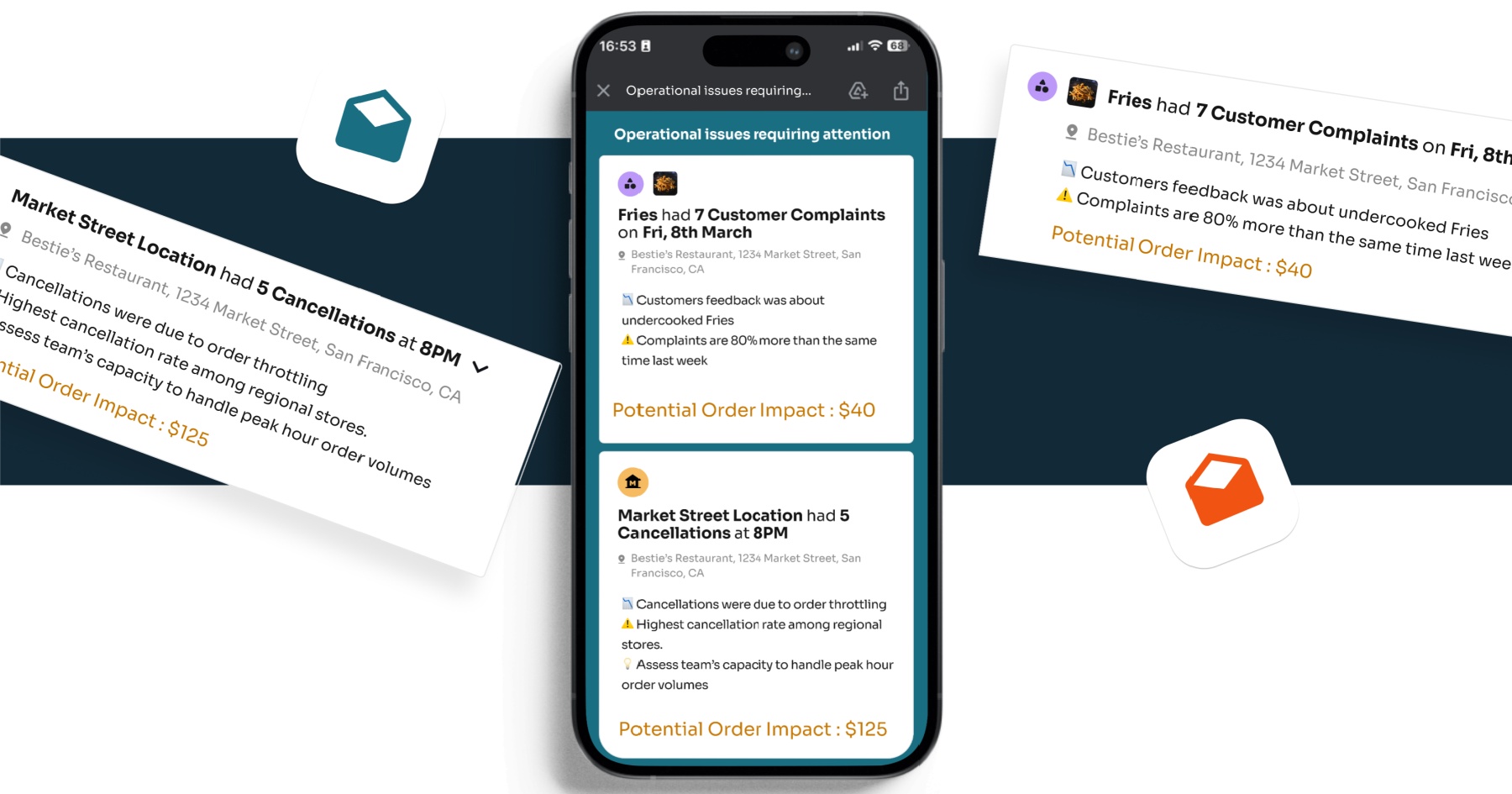
Consider a location that looks open on its own schedule but has been paused inside a delivery marketplace. The kitchen may be staffed; the app has effectively locked the front door. Or consider a promotion that lifts sales but lowers gross payout. Loop’s distinction is the attempt to connect these operational and marketing events to the money. A platform dashboard can show what happened inside one marketplace. Loop wants to compare across the marketplaces and then check the bank.
In another case study, Centennial Hospitality Group, owner of WingShack and two other brands, said Loop’s marketing analysis helped it see where delivery spend worked. The group reported a 3% increase in delivery gross payout, a reduction in marketplace fees of up to 30%, and an 8% sales increase in its first month using the product. Those outcomes belong to that customer and that rollout; they are a useful example, not a universal rate card.
The wager on boring expertise
Loop AI sells to businesses, through demos and enterprise relationships; it does not publish a standard price list. Its competitive pressure comes less from one tidy rival than from a familiar arrangement: marketplace dashboards, a point-of-sale report, accounting software and a patient employee trying to make them agree. Restaurant software companies offer pieces of the same territory. Loop’s wager is that the bridge between them is valuable enough to become the main workspace.
That wager attracted Base10 Partners and Afore Capital in a $6 million seed round in 2024. In February 2026, Nyca Partners led a $14 million Series A, with Base10, Afore and other investors participating. Loop said the money would expand its products and team. The announcement also claimed sixfold growth since 2024 and named Lazy Dog and Starbird among customers. Funding is evidence that investors see an opportunity. It is not evidence that every restaurant needs an agent to read its ledger.
For a restaurant leader, the copyable idea is smaller and more useful than the AI language. Pick one recurring question with financial consequences: Which promotions produce a real payout? Which stores vanish from delivery apps at peak hour? Which fees differ from contract terms? Agree on the definition, connect the source records, and compare the answer with cash. Only then automate the next decision. Loop’s own path began with this sort of narrow discomfort, not with a universal chatbot.
That is why the company’s most revealing product screen may be the least theatrical one: sales, deductions, settlement, books. The customer sees a meal arriving. The restaurant sees whether the meal was worth selling. Somewhere between those two views, Loop AI has found a business.