The short shipment
- What it does: Relay learns, improves, and runs operational workflows across inboxes, ERPs, WMSs, carrier portals, voice, and chat.
- Who buys it: manufacturers, grocers, retailers, logistics providers, and 3PL or 4PL operators with high-volume exception work.
- Why it is different: BackOps sells completed outcomes with approvals and audit trails, not another dashboard describing the problem.
- The proof point: one customer processed more than 500,000 claims; another cut a billing cycle from about 28 hours to 14 minutes.
- The useful lesson: start AI where there is a deadline, a dollar value, and a scoreboard.
Somewhere in a warehouse, a pallet arrives with three boxes missing. This is not, at first, a software problem. It is a small human emergency. Someone opens an email, locates the purchase order, checks the warehouse system, visits a carrier portal, asks for a photograph, reads a contract, files a claim, updates a spreadsheet, and writes back to a customer who has already asked twice. The company owns expensive systems for nearly every noun in that sentence. The verbs still belong to a person.
BackOps was built for the verbs. Its platform, Relay, sits between the systems a company already has and the outcome it needs. An inbound message can trigger a hunt through an ERP, a warehouse-management system, a carrier website, and an old email thread. Relay gathers the context, applies the company’s rules, takes permitted actions, and asks a person when judgment is required. Then it updates the systems and replies. The customer does not receive a helpful suggestion. The work gets carried forward.
The systems knew. Nobody had acted.
Sean McCarthy encountered this peculiar gap from the operations side. He was an early hire at Amazon Shipping and led global sales, spending time with warehouse customers whose scale varied wildly. The striking observation was not that the largest operators had complicated problems. It was that everyone had versions of the same problem. A shipment exception crossed the boundaries between software products, departments, and outside companies. The operator became the integration.
Henry Ou came from the other direction. He had led applied machine-learning teams at Apple and ByteDance and had run an ERP integration business. He understood why the familiar fixes failed first. Traditional automation works nicely when inputs are stable and every branch can be written in advance. Logistics is made of edges: a changed portal, a missing document, a special customer rule, a carrier who answers by phone, an experienced employee who knows when the SOP is wrong.
“The problem wasn’t effort, it was that the tools weren’t built for the complexity of the work.”BackOps, on the founders’ shared diagnosis
The pair founded BackOps AI in San Francisco in 2024. McCarthy brought the memory of the warehouse floor. Ou brought the knowledge that a clean API diagram rarely survives contact with the warehouse floor. Relay was the compromise: software able to work across APIs, browser portals, email, Slack, voice, and text, with people left in the loop at approval points that actually deserve them.
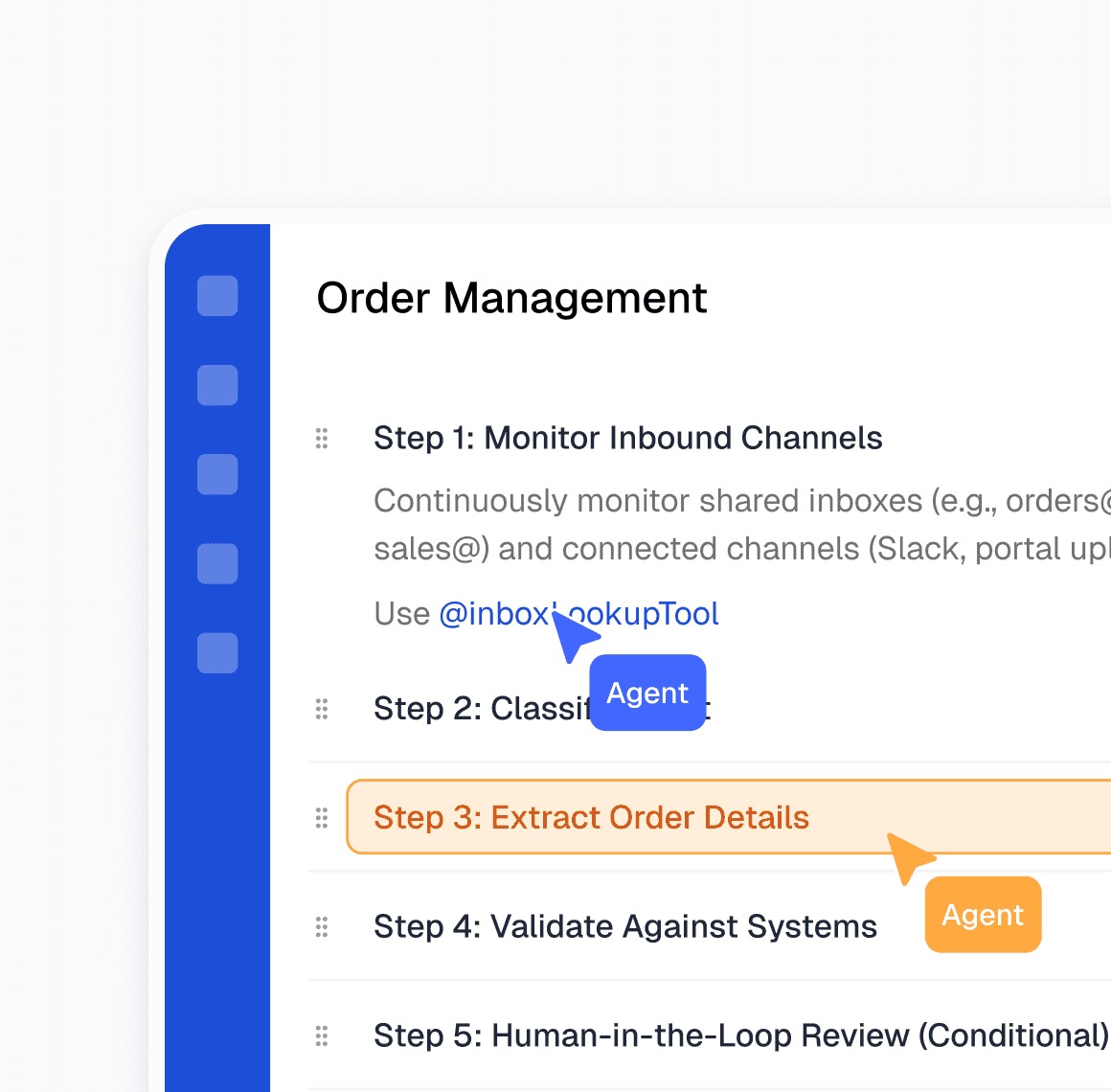
Then the customers changed the noun.
At first, BackOps spoke the standard language of workflow automation. Read the email. Update inventory. File the claim. Each was a useful task. But deployments began to reveal a larger unit of value. A task can be complete while the underlying problem remains open. A claim form can be generated but never submitted. A customer can receive a status update while the lost shipment continues its tour of the continent.
In the six months after its March 2026 Series A, the company changed its mind about what it sold. BackOps began calling the unowned territory the “Resolution Gap”: the distance between identifying an operational need and reaching the required outcome across systems, internal teams, and outside parties. It is good positioning because it is also a familiar irritation. Anyone who has been told “the ticket is in the system” understands that a recorded problem and a solved problem are different objects.
The customer numbers, while company-reported and anonymous, explain the change. One organization has processed more than 500,000 claims through BackOps. Its monthly claim volume grew 150 times without additional hiring, while automated resolution increased from 87 percent at launch to 99 percent. Another customer had a billing process spanning 13 locations and an estimated 11,000 staff hours a year. It was preparing to hire five billing specialists and a supervisor. BackOps says the average cycle fell from roughly 28 hours to 14 minutes.
Those examples are not really about typing faster. They are about continuity. Relay keeps the case alive while information arrives, decisions happen, and systems change. It records what was done and why. For an enterprise buyer, that lineage matters almost as much as speed. BackOps says deployments run in isolated single-customer environments, with encryption, configurable retention, approval thresholds, and audit traces. The company reports SOC 2 Type II and ISO 27001 certification.
03 / The product and the peopleA platform that arrives with muddy boots.
Relay has two connected jobs. First, it learns the operation. It analyzes SOPs, tickets, email histories, logs, and recorded workflows to find how work is truly performed - including the unofficial route an experienced employee takes when the official process becomes silly. The AI Process Center can record an employee walking through a task and convert that performance into a process map and automation plan.
Second, Relay executes. It monitors communications, extracts documents, applies business rules, works through internal and external systems, and escalates exceptions with the relevant context attached. Common starting points include carrier claims, order inquiries, inventory rebalancing, appointment scheduling, freight billing, document processing, and customer notifications. The users are the people usually stranded between systems: operations, customer service, finance, warehouse, and supply-chain teams.
That service-heavy posture is part of the product, not an apology for it. BackOps argues that a company should not blindly automate its current SOP. The old process may contain redundant handoffs, inherited rules, and workarounds built for software that no longer exists. Before Relay runs a workflow, the team tries to improve it. The business model is therefore enterprise software paired with implementation expertise - a closer cousin to an operating partner than a downloadable bot.
This is also where BackOps differs from the nearest alternatives. A visibility platform shows the late shipment. Robotic process automation follows a deterministic sequence until an interface or input changes. A general-purpose AI assistant drafts a response. A systems integrator connects applications. BackOps is trying to combine pieces of all four around one promise: carry the specific process through to its desired result, and bring in a person with the evidence when authority or judgment runs out.
04 / Capital follows the wedgeFour rounds, and a name quietly disappears.
Investors funded the expanding definition. Gradient Ventures led a $2 million pre-seed in October 2024. Construct Capital led a $6 million seed in June 2025. Theory Ventures led a $26 million Series A in March 2026. Six months later, Insight Partners led a $42 million Series B, with the existing investors continuing. Publicly announced funding totals $76 million.
Capital for the middle
With the Series B came a small edit that says a great deal: BackOps AI became BackOps. In 2024, AI was an identity. By late 2026, it was plumbing. The company now describes itself as a resolution layer for businesses that make or move physical goods, a category spanning logistics, manufacturing, industrials, groceries, and third-party logistics. Its named customers remain private, but BackOps says they range from regional brands to major multinational automotive, retail, grocery, and industrial businesses.
05 / A playbook worth borrowingStart where the scoreboard lives.
The most transferable idea here is not the phrase “agentic AI.” It is workflow selection. BackOps recommends beginning with work whose value can be counted: money recovered from claims, hours removed from status checks, response time improved, stockouts avoided, or revenue protected. A measurable workflow earns trust because the buyer can tell whether the machine worked. It also gives the implementation team a reason to investigate the process before automating it.
Carrier claims are a neat example. The evidence is scattered and the filing rules vary, but an eligible reimbursement has a dollar value and a deadline. Order status is another: the question is simple, yet the answer may require several systems and a vendor call. Stock rebalancing ties the work to sales that might otherwise disappear. Each is narrow enough to test and consequential enough to matter.
Relay’s sweet spot is not every task. One-off research, drafting, and straightforward analysis are often better handled by general tools. Nor is a complicated process automatically a good candidate. The workflow needs enough repetition and economic consequence to repay process mapping, integrations, controls, and upkeep. If a company cannot define the outcome, grant safe system access, identify approval boundaries, or measure the result, it has work to do before an operations agent can help.
BackOps’ real observation is almost embarrassingly ordinary: large organizations have spent years buying systems of record, yet the work between those systems is still held together by memory, persistence, and an alarming number of browser tabs. The company is betting that the next valuable layer of enterprise software will not merely know what happened. It will know what must happen next, do the permissible parts, and find the right human for the rest. In the warehouse, the missing middle has finally applied for a badge.