A corporate receipt is a tiny confession. It says what a company needed, who it trusted, what it paid, which manager approved it and whether the invoice ever matched the order. Collect enough of those confessions and you get something more useful than an expense report: a working map of how business actually moves.
Coupa has spent two decades drawing that map. The Foster City software company routes sourcing, contracts, purchase requests, supplier checks, invoices, employee expenses, payments and supply-chain decisions through one cloud platform. In 2026, the company said its network encompassed more than 3,500 buying organizations, over 10 million suppliers and roughly $10 trillion in accumulated transaction data. Its customers had recorded more than $300 billion in lifetime savings.
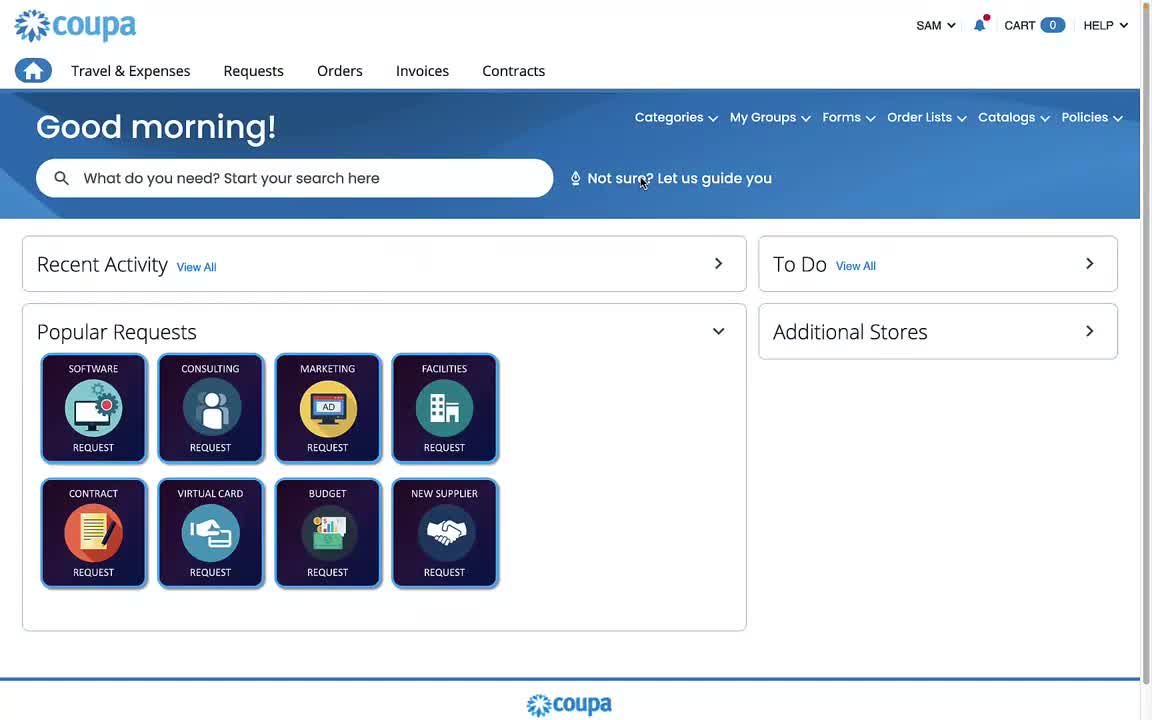
Those numbers explain Coupa better than the usual alphabet soup of P2P, S2P and BSM. The product is a controlled front door for company spending. An employee searches for a laptop or files a marketing request; policy and approvals appear before money leaves; the purchase order, receipt, invoice and payment remain connected. Finance sees commitments before they hit the ledger. Procurement sees where suppliers or categories can be consolidated. The supplier gets one path to transact.
The consumer trick that made the data possible
Dave Stephens and Noah Eisner, both veterans of Oracle's procurement world, founded Coupa in 2006. Their useful heresy was that enterprise purchasing should borrow from consumer shopping. The idea sounds cosmetic until you follow the economics. If the requisition screen is miserable, employees route around it. If employees route around it, spend becomes invisible. If spend is invisible, the promised savings never materialize.
Coupa released its procurement module in 2008 and an early supplier network in 2009, the year Rob Bernshteyn became chief executive. Expenses, invoicing, analytics, sourcing, contracts and supplier tools followed. The architecture was cloud-first and deliberately sat across multiple ERP systems. Where an ERP records the accounting result, Coupa tries to manage the choice that created it.
The first thing to fail in a spend transformation is usually not code. It is participation. An employee emails a favorite vendor. A supplier refuses another portal. A plant keeps its spreadsheet. The data fragments, and the benchmark becomes a guess. Coupa's own published target - all enterprise users and nearly all suppliers active on the platform - reveals the dependency. Adoption is not a soft change-management metric. It is the raw material.
The Coupa flywheel
What $8 billion bought
Coupa raised roughly $165 million privately, including an $80 million round in 2015 that put its valuation around $1 billion. It went public in October 2016, raising $133 million. The public years financed a broader ambition. In 2019, Coupa paid about $214.6 million for contract specialist Exari. In 2020 it spent approximately $1.5 billion on LLamasoft, adding software that lets companies model factories, warehouses, inventory and transportation routes before changing the physical network.
The LLamasoft price is the revealing one. Coupa was no longer satisfied to police office supplies and purchase orders. It wanted to connect the design of a supply chain with the money required to run it. That put the company across the table from SAP Ariba, Ivalua, GEP, JAGGAER and Oracle, while specialists attacked individual slices such as intake, cards or accounts payable.
Thoma Bravo had first invested when Coupa produced roughly $30 million in revenue. In February 2023, the software investor completed an all-cash take-private deal valued at about $8 billion, with a minority investment from an Abu Dhabi Investment Authority subsidiary. Shareholders received $81 a share, a 77 percent premium to the unaffected closing price cited when the agreement was announced. Leagh Turner became CEO later that year.
The software records the transaction. The network remembers what a good transaction looked like.YesPress analysis
From copilot to purchasing agent
Under private ownership, Coupa's language shifted from business spend management to autonomous spend management. The distinction is action. A dashboard tells a category manager that laptop prices are high; an agent can identify alternatives, prepare a sourcing event, route the decision and monitor the result. Coupa calls its agent experience Navi. The wager is that recommendations grounded in actual purchases will beat generic answers produced from public-web text.
A 2025 acquisition of Cirtuo brought AI-assisted category strategy. Then came a rapid 2026 assembly: Rossum for reading invoices and other transaction documents; Tonkean for routing requests across procurement, finance, legal and IT; and Coupa Compose for building and coordinating agents. Coupa Catalyst adds forward-deployed engineers and solution architects. The company also introduced outcome-oriented pricing for parts of the package - an acknowledgment that customers want a result, not another AI license.
The customer evidence is concrete, though mostly reported by Coupa and its partners. VF Corporation began with a familiar mess: no central purchase-order system, indirect-spend data scattered across ledgers and a global workforce. After standardizing requests and digitizing invoices, VF reported $20 million in upfront savings, $50 million in additional cash flow, $2 billion in captured transactions and 4,000 employees using the new policy. Xylem later reported savings of up to 15 percent on requests for proposal using Navi, while Jabil identified $13 million in spend-savings value.
What changed their minds was not a dazzling bot. It was visibility at the moment a decision could still be changed. A ledger can explain last month's overspend. A connected purchase order can warn about it before approval. Once that trail is reliable, AI has something sturdy to act upon.

The bill arrives before the value
Coupa does not publish a simple price card. Enterprise contracts bundle modules, transaction scope and services; implementation often involves an Accenture, KPMG or another systems integrator. That makes the real cost larger than a subscription. A buyer must clean supplier records, connect ERPs, redesign approvals, migrate contracts, train employees and persuade vendors to participate. The bill arrives early. The savings arrive only after behavior changes.
This is also where the model can misfire. A 180-person business with uncomplicated purchasing may not need a network-scale source-to-pay platform. An organization unwilling to standardize its processes can merely digitize its confusion. Thin transaction volume weakens the case for sophisticated benchmarks, while poor master data makes autonomous action risky. For those buyers, an ERP module or lighter tools such as Procurify, Precoro, Zip, Ramp or Airbase may solve the immediate problem with less ceremony.
There is corporate scar tissue, too. SAP's Ariba unit sued Coupa in 2014 over alleged trade-secret misappropriation. The companies settled in 2015; Coupa acknowledged possessing Ariba information, agreed to procedures preventing misuse and made an undisclosed payment. It was an early reminder that breaking into a mature software category can be legally expensive as well as technically difficult.
What another operator can copy
- Start with the doorway. Make the approved path faster than email, spreadsheets or personal cards.
- Capture before analyzing. Connect requests, orders, receipts, invoices and payments before promising AI.
- Pilot the operating model. Prove roles, approvals and integrations in a bounded unit before global rollout.
- Onboard both sides. Buyer adoption without supplier participation leaves half a network.
- Automate last. Let agents act only where policy, data quality and accountability are explicit.
Where Coupa sits now
At 20, Coupa sits between the financial system of record and the messy human act of asking for something. Its expertise is the connective tissue: procurement rules, supplier identity, contracts, invoices, payment rails and supply-chain scenarios. The open integration platform matters because most large customers will not replace their ERP, banks, risk feeds or specialist tools simply to adopt Coupa.
Its advantage over a point solution is context across the buying cycle. Its advantage over an ERP suite is a product designed to work across ERPs and suppliers. Its weakness is the same breadth: more modules, more integrations and more organizational change. The autonomous future will not erase that trade-off. It will amplify it. An agent with complete context can save time; an agent trained on fragmented approvals and duplicate vendors can make confusion move faster.
That is why Coupa's $10 trillion receipt pile is compelling but not magical. The dataset can show how peers pay, source and save. It cannot make an employee use the system, reconcile a broken supplier record or decide how much autonomy a CFO should delegate. The company's next chapter depends on solving those stubbornly human problems while its software starts doing more of the work.
Coupa is foundedOracle procurement veterans Dave Stephens and Noah Eisner start the company.
A $133 million IPOCoupa lists on Nasdaq after a decade of building cloud spend tools.
Supply chain, acquiredThe $1.5 billion LLamasoft deal pushes Coupa into network design and planning.
An $8 billion resetThoma Bravo takes Coupa private and the company begins a leadership transition.
The agent stack fills inCompose launches; Rossum and Tonkean add document intelligence and orchestration.