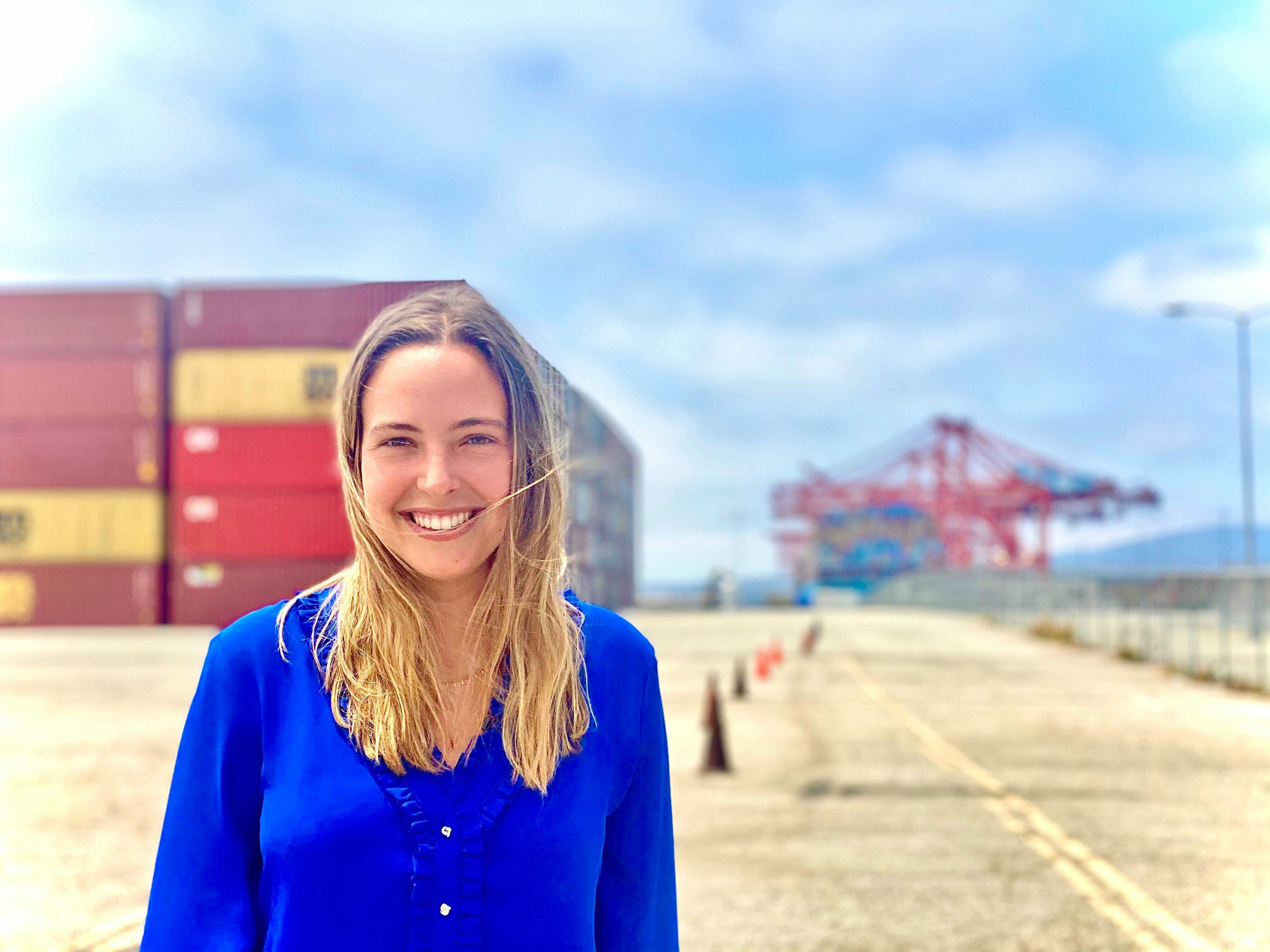
Ninety percent of everything you have ever bought spent part of its life inside a steel box stacked on a ship. That box passed through a port. And until recently, what happened to it there - how long it sat, who held it up, why the bill arrived the size it did - was, in Alexandra Griffon's words, a black box. You paid. You did not ask. There was no one to ask.
Griffon is the co-founder and CEO of BlueCargo, a freighttech company that exists for one reason: to open that box and read what is inside. The product audits freight invoices, tracks containers in real time across the chaos of American ports, and disputes the detention and demurrage charges that quietly drain importers of cash. It sounds narrow. It is not. Detention and demurrage - the fees you pay when a container sits too long - run into the billions every year, and a startling share of those bills are wrong.
Her case is simple and slightly subversive. The invoice is not the truth. It is a claim. And a claim can be checked against the lifecycle of the container that earned it.
Paris, New York, then the port
Griffon did not grow up around trucks. She studied at ESSEC Business School and then UC Berkeley, and her first jobs were the polished kind: mergers and acquisitions analyst at Lazard in Paris, then sales and stock analyst at Guerlain, the luxury house, in New York. Spreadsheets and perfume. It is not the resume you would predict for someone who now spends her days inside the logistics of Los Angeles and Long Beach.
The pivot came through the work itself. Before BlueCargo, she worked on yard-stacking algorithms inside terminal operators in the US and Europe - the literal Tetris of deciding which container goes where in the yard. That is where the realization landed. Ports were not just busy. They were opaque. Capital froze inside them. Fees piled up inside them. And nobody had built the instrument to see through them.
A classroom, a co-founder, a company
She met Laura Theveniau during their master's program at UC Berkeley. Theveniau came from the other side of the table: computer science and machine learning, two years as a data scientist in advertising before turning her attention to containers. One founder fluent in finance and operations, the other in data and models. The concept for BlueCargo ignited between them, and in 2018 they took it to Y Combinator, the Silicon Valley accelerator that has launched some of the most consequential startups of the last two decades.
Then COVID happened, and the thesis stopped being theoretical. Ports clogged. Ships anchored offshore for weeks. Detention and demurrage bills exploded, and shippers who had never questioned a port invoice in their lives suddenly had every reason to. The black box was costing them visibly, painfully, monthly. BlueCargo was already standing exactly where the pain was.
Static versus dynamic
The cleanest way to understand what Griffon built is a distinction she draws herself. A static audit tells you that you were billed. A dynamic audit tells you what happened and why, based on the container lifecycle. The difference is the entire company. Most freight audit catches arithmetic errors after the money has moved. BlueCargo aims to reconstruct the story - which terminal, which day, which delay, whose fault - so the dispute is not a complaint but a proof.
"We built BlueCargo to answer the questions shippers actually ask," she has said. "Who was responsible for the delay? Could it have been avoided? And can we prove it?" That last word does the heavy lifting. Proof is what turns a customer service argument into a recoverable dollar.
The pragmatist on AI
Griffon talks about artificial intelligence the way a builder talks about a good drill - useful, not magic. She is openly skeptical of supply chain companies trying to invent their own foundational models. "No supply-chain company is going to build a better structural model than what already exists," she argues. "The key is to use the best technology available and apply it to real supply-chain problems." Her favorite proving ground is the one she lives in: "Freight auditing is where AI stops being a theory and starts delivering value."
It is a refreshingly unhyped position from a founder in an industry drowning in the word. Start small, she advises customers. See value fast. Anticipate issues early instead of chasing errors after payment. The pitch is less revolution, more accountability - and in logistics, accountability has historically been the scarce resource.
Recognition, and the next stack
In September 2024, Griffon was named a Rising Star in the Women in Supply Chain Awards, run by Food Logistics and Supply & Demand Chain Executive, an honor for leadership and mentorship in a field that has not always made room for either. BlueCargo, for its part, kept collecting its own validations, named a Top Tech Startup in supply chain technology in 2025. The company that started as two people now runs around forty, supports more than 700 importers and forwarders, and operates across the major US gateways of Los Angeles, Long Beach, and New York/New Jersey.
The mission she keeps returning to is broader than fee recovery. It is to empower transportation and logistics businesses of any size with the digital tools, data, and services they need to better serve global trade. The small forwarder should be able to fight a wrong invoice with the same evidence as the giant. That is the leveling she is after - turning the port from a place where things disappear into a place you can search.