An insurance policy contains a small collection of stubborn facts: a number, a name, an expiration date. At Beacon Funding, accountants used to copy those facts into a customer relationship management system. The work was repetitive, necessary, and vulnerable to mistakes. It was also a useful place to begin understanding Liventus, a software company whose subject is the distance between having information and being able to act on it.
- Liventus builds custom software and connects the systems businesses already use.
- Equipment finance is its home ground; healthcare, manufacturing, insurance, and ecommerce also figure in its work.
- Its proposition now combines engineering services with products for analytics and credit analysis.
A lender’s vocabulary
Founded in 2002 by Samuel Oliva and Dan Levin, Liventus describes itself as having been born inside an equipment-finance company. That origin helps explain its unusual fluency in subjects few software buyers would put on a conference T-shirt: lease booking, underwriting, insurance expiration, repossession. These are the working parts of a lender. Getting one wrong can make the next part wait.
 Samuel Oliva / CEO
 Dan Levin / President
Today, Liventus reports more than 150 engineers across US and India delivery centers. Its services cover custom development, modernization, systems integration, AI automation, analytics, and ongoing support. Microsoft technologies feature heavily in its work. It occupies the space between an organization’s operating requirements and the software available to satisfy them.

Beacon Funding provides a particularly concrete example. Liventus’s tools retrieve bank statements and tax returns, organize communications, track equipment history, and manage repossessed assets. The company reports a 5,000% increase in Beacon’s daily underwriting capacity through the long engagement. Treat that as a vendor-reported result across years of work, rather than a forecast for the next automation project.
A long-running engagement; no baseline is supplied.
Where the connection got awkward
For the insurance workflow, the team manually tagged sample documents and trained an Azure model to extract fields. Below 90% confidence, a field went to human review. That threshold expressed the system’s uncertainty; it was no guarantee of accuracy.
The initial CRM connection used Microsoft Power Automate. Liventus’s account describes security and performance concerns that prompted investigation of Azure Logic Apps. The interesting engineering decision arrived after the extraction model: how should information travel safely into the system where people would use it?
A buyer can borrow that sequence: choose a bounded task, test representative inputs, name the reviewer, and examine the connection. A demonstration that extracts a policy number has answered only part of the operational question.
Buy the platform. Build the fit.
The same thinking runs through Liventus’s products. Sparkflow brings data sources together for reporting and analysis. Its pitch includes unlimited users, connections to more than 40 ERP and other core systems, and conversational analytics. The practical attraction is easy to recognize: a meeting in which someone can answer a question from current data instead of promising another spreadsheet.
Credit Mind addresses the lending desk. It assembles deal information, flags risks, and produces credit recommendations with reasoning and an audit trail. Its policies and workflows can be configured. The underwriting team retains the decision. Buyers should judge it against their own files and credit rules, where the exceptions live.
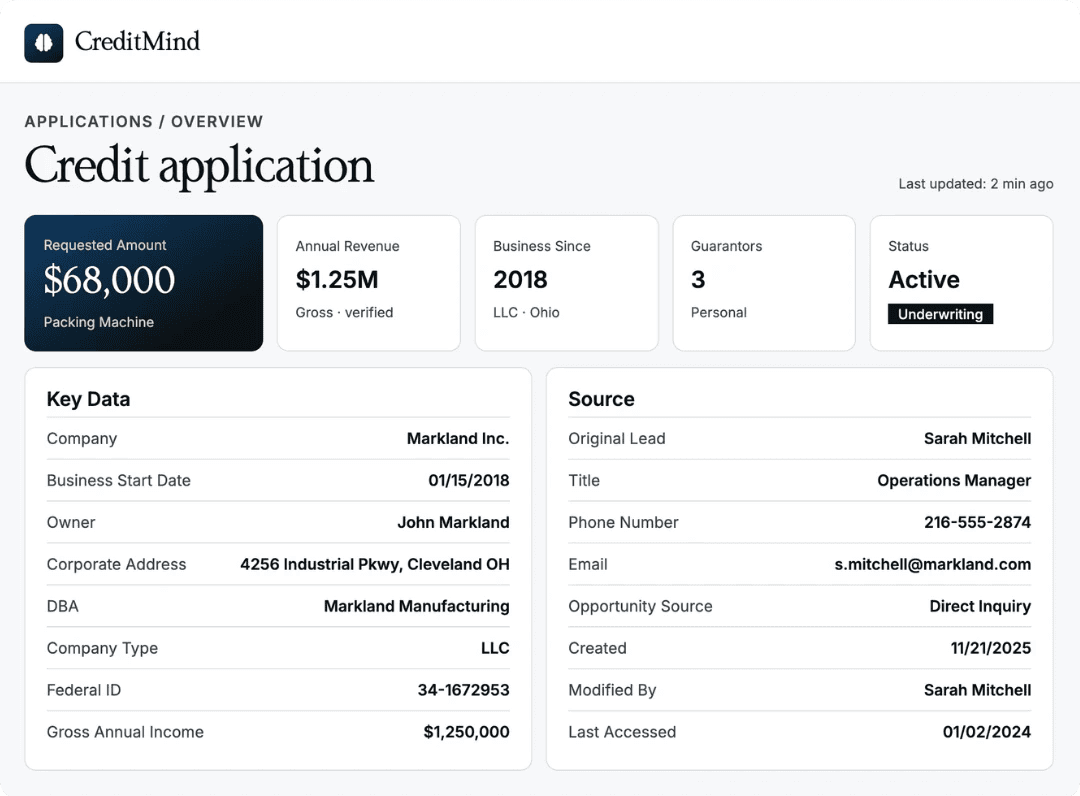
Acquisitions have widened this offering. Liventus bought Sparkflow Data Analytics in September 2024. In April 2026, it announced the acquisition of Tamarack, adding equipment-finance capabilities including portfolio intelligence, syndication, and customer self-service. Products supply a starting point; engineering supplies the adaptations a particular organization needs.
That combination creates a useful distinction for buyers comparing proposals. A general development firm offers people who can build a system. A software vendor offers a product with established features. Liventus is trying to join those propositions around particular industries. The test is whether that familiarity reduces the work of explaining your operation, and whether the reusable parts actually fit. An awkward exception can still require a spreadsheet.
Its relationship with Solifi illustrates where Liventus fits in the market. Solifi supplies finance technology. Liventus and Consult Disrupt help clients implement it, configure workflows, connect other systems, migrate, and maintain the result. A packaged platform and a custom developer can be complementary purchases.
The price of knowing the business
This is a services business as well as a product business. Clients pay for assessment, development, implementation, and continuing support. Clutch lists a $5,000 minimum project and a $100-$149 hourly range. Actual engagements can run much larger.
In a September 2020 Clutch interview, Beacon president Toby McDonough reported spending $500,000-$1 million annually and approximately $9 million cumulatively. Those are historical relationship costs. He also described dependence on Liventus’s accumulated knowledge and wished some work moved faster. Deep familiarity brings value and makes changing partners harder.
“They’re basically our technology team.”
Toby McDonough, Beacon Funding
Clutch interview, September 2020
The buyer also supplies something the invoice cannot capture: time. Someone inside the business has to explain the exceptions, settle conflicting requirements, and decide what good output looks like. That responsibility grows when the software touches financial decisions. A custom engagement is easier to evaluate when the client can name the process owner before naming the desired technology.
Continuity therefore matters. Liventus’s careers material emphasizes learning and collaboration. Its Great Place To Work profile, updated July 2026, reports that 98% of surveyed employees consider it a great workplace. That is employee sentiment, rather than a delivery guarantee, but retention matters when the service depends on remembering how a client operates.
Try it on your own paperwork
Liventus has applied the method internally, too. Its account of building an intelligence layer around Dynamics 365 begins with recorded sales calls. Summaries lacked account context; useful details never reached the CRM. The response connected notes, qualification rules, permissions, and handoffs. Sensitive changes waited for people. Its reported activity gains are observational, with acquisition-related changes complicating the comparison.
There is a modest lesson in that internal project: the organization had to describe its own sales rules before a machine could follow them. What, exactly, does a qualified deal mean here?
The useful buying question is specific: which handoff costs time, who owns it, and what would count as improvement? Custom engineering needs accessible data, clear rules, internal attention, and a maintenance budget. A straightforward requirement already handled by an existing tool may not warrant the commitment. Start with one awkward piece of work. Make it move. Then decide what deserves to follow.