A driverless forklift can have a surprisingly human problem. The machine knows where to go; the person supervising it cannot make sense of the controls. For Bleichert, a German automation manufacturer trying to reach smaller warehouses, that gap mattered. Robotics software built for engineers was asking too much of ordinary operators.
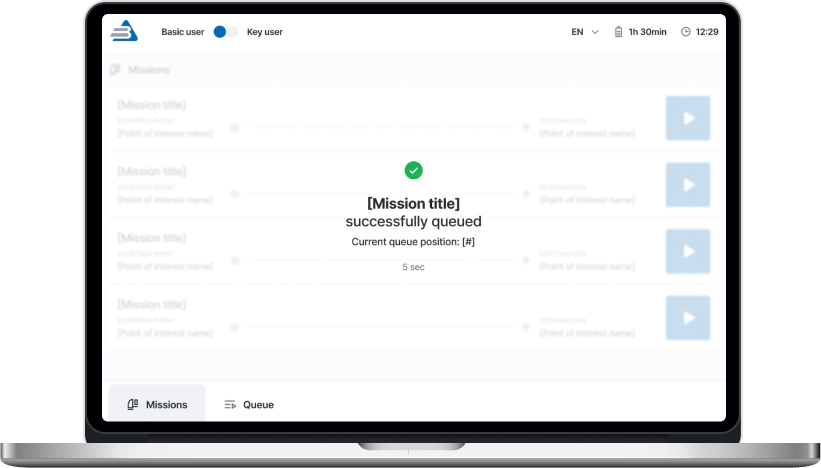
Instinctools’ assignment was to build a browser interface people could understand. The deadline was seven weeks, in time for a LogiMat demonstration. Then came the complication: the forklift itself was unavailable for routine testing while its sensors were being refined. The developers built an emulator. Before they could finish the controls, they had to simulate the thing being controlled.
- Builds custom software, enterprise systems, and AI applications.
- Its revealing projects fix specific operational bottlenecks.
- Buyers pay for engineering capacity and delivery, with scope that can evolve.
The forklift was ready. The interface wasn’t.
The Bleichert brief was unusually concrete. Reach a goal within three navigation levels. Respond to input in less than 0.4 seconds. Show a robot’s mission in real time. These were requirements, rather than a retrospective claim that everything had become “intuitive.” They gave the team something to design against.
Instinctools chose Python and FastAPI for the backend to fit the existing robotics software, with React for the interface. Basic operators could launch existing missions; authorized users could create routes and manage the queue. The MVP addressed one robot, while the architecture anticipated more. The emulator helped keep software development moving without transporting a forklift between Germany and Poland.
There is a useful buying lesson here. A deadline becomes more believable when someone names its dependencies. In this case, access to the hardware was one. Creating a substitute test environment was part of delivery, even though the customer had come looking for an app.
A product pulled apart by its customers
The company learned about awkward dependencies early. Founded in 2000 by Alexey Spas and Diethard Sohn, Instinctools initially pursued its own content-management software. In a later retrospective, managing director Gunthilde Sohn described the trap: insufficient capital made the business dependent on its first customers, whose particular requests pulled development away from a broadly reusable product.
“We learn as we go.”
Gunthilde Sohn, managing director · 2021
The product became too specific to roll out efficiently. Looking back, Sohn favored testing demand, building an MVP, and finding investors and customers prepared to support product development. The immediate customers kept the business alive; their requirements also constrained what it could become.
Spas dates the prehistory to students coding in his garage in 1998. His later interview describes an expanding remit, from websites and Java to business intelligence and AI. The company’s services business makes sense against that history: repeated adaptation became something customers could buy.

Five minutes at the counter
Consider its unnamed French eyewear customer. The original request was a small internal app. Store consultants were marking frames and manually calculating measurements. Instinctools built a mobile tool that used camera-based reference points to calculate optical positioning. Its case study reports five minutes saved per order, equivalent to a 33% improvement in processing time.
33% less processing time
Company-reported customer result
The pandemic changed the brief. Physical-store plans gave way to a customer shopping app, including virtual frame fitting. Across more than six years, the engagement grew into four staff applications, a consumer app, and a Shopify website. Shared backend services connected the work. Separate interfaces let each role get on with its own job.
An earlier Mercedes-Benz project addressed a different queue: people trying to understand the GLOBUS procurement system. Instinctools built a web support platform with a shared content repository, multilingual publishing, and searchable training materials. The reported implementation took five months. Here, the engineering problem included the work of authors and translators as well as the needs of end users.
The invoice tells you what you are buying
Instinctools sits in the engineering-services market, alongside specialist agencies and larger consultancies. Its customers range from startups to established enterprises. Its work includes cloud infrastructure, legacy modernization, analytics, and application development. The practical distinction is how much responsibility a buyer wants to hand over.
Staff augmentation adds people to an existing team. A dedicated team adds a broader delivery unit. In May 2026, Instinctools introduced Managed Capacity: three to eight specialists under a monthly fee, with agreed performance commitments. The customer retains priorities and the roadmap; Instinctools manages staffing and delivery.
Clutch lists an indicative $25-$49 hourly rate and a $10,000 minimum project size. Those figures are useful starting points, not project budgets. Instinctools’ standard arrangement bills actual hours monthly. Its FAQ says it does not offer fixed-price contracts. A buyer who needs an immutable price and specification should take that seriously.
The next interface is an agent
Two proprietary offerings show where the company is placing its experience. DITAworks Webtop organizes reusable technical documentation. GENiE, announced in May 2026, is an accelerator for custom AI agents: context management, orchestration, integration, and governance packaged around engineering services.
The connection is information. A support system must deliver the right instructions; an agent needs the right context before taking action. Neither improves simply because another interface has been added. In its October 2026 AI discussion, US managing director Chad West’s agenda included data readiness, organizational resistance, and the difficulty of moving beyond pilots.
Other projects put different limits on the same engineering habits. In its September 2026 account of work for Fileverse, a privacy-focused collaboration platform, Instinctools described designing without conventional analytics such as Google Analytics or Hotjar. The team used direct user feedback to identify interface friction. That is a useful qualification to the promise of data-driven design: privacy requirements can change which evidence is available. The method has to fit the product, including the information it deliberately refuses to collect.
For a prospective customer, the sensible first move is small: identify one stalled task, its owner, its inputs, and a measure of success. Then examine the dependencies. Bleichert needed access to a robot it could not supply. The eyewear business needed connected operations behind its new storefront. Those details give an engineering partner something concrete to solve.