The 98-year-old company that keeps your electronics from catching fire
Founded in 1927 to keep radios from frying, Littelfuse now makes the fuses, semiconductors and sensors that quietly protect everything from EV chargers to data centers - a $2.4 billion business built on parts most people never see.
There is a category of company that only becomes visible the moment something goes wrong. You do not think about the fuse in your car until the day it saves the wiring harness. You do not think about the surge suppressor in your laptop charger until a voltage spike would have cooked your motherboard. Littelfuse has spent nearly a century inhabiting that gap - the split second between "everything is fine" and "everything is on fire" - and turned it into a roughly $2.4 billion business.
The company was founded in Chicago in 1927 by Edward V. Sundt, an engineer with an improbable resume: before he ever touched a circuit, he had been a lumberman, a farmer, and a member of the Royal Canadian Mounted Police. He built a small, reliable fuse to protect the delicate meters and vacuum-tube radios of the era, called it a "little fuse," and the compressed spelling became the company name. The starting capital was $5,000. The first order, placed through an ad in Radio News magazine in 1928, was worth $1.10.
The productA part designed to fail first
Most companies sell you something built to work. Littelfuse sells you something built to break - on purpose, and before anything else does. A fuse is a deliberate weak point: a sacrificial link engineered to melt when current climbs past a safe threshold, cutting the circuit so the expensive equipment downstream survives. It is the cheapest component in the system and, in the wrong moment, the most important.
That single idea has expanded into a broad catalog. Beyond the classic cartridge and blade fuses, Littelfuse makes gas discharge tubes, TVS diodes, varistors and ESD suppressors that clamp or divert voltage spikes; power semiconductors like thyristors and IGBTs that switch and convert electricity in inverters and drivetrains; protection relays and switches; and sensors that read position, temperature, current and speed. The through-line has never changed: control electrical energy, and protect whatever depends on it.
The inventionThe blade fuse in every glovebox
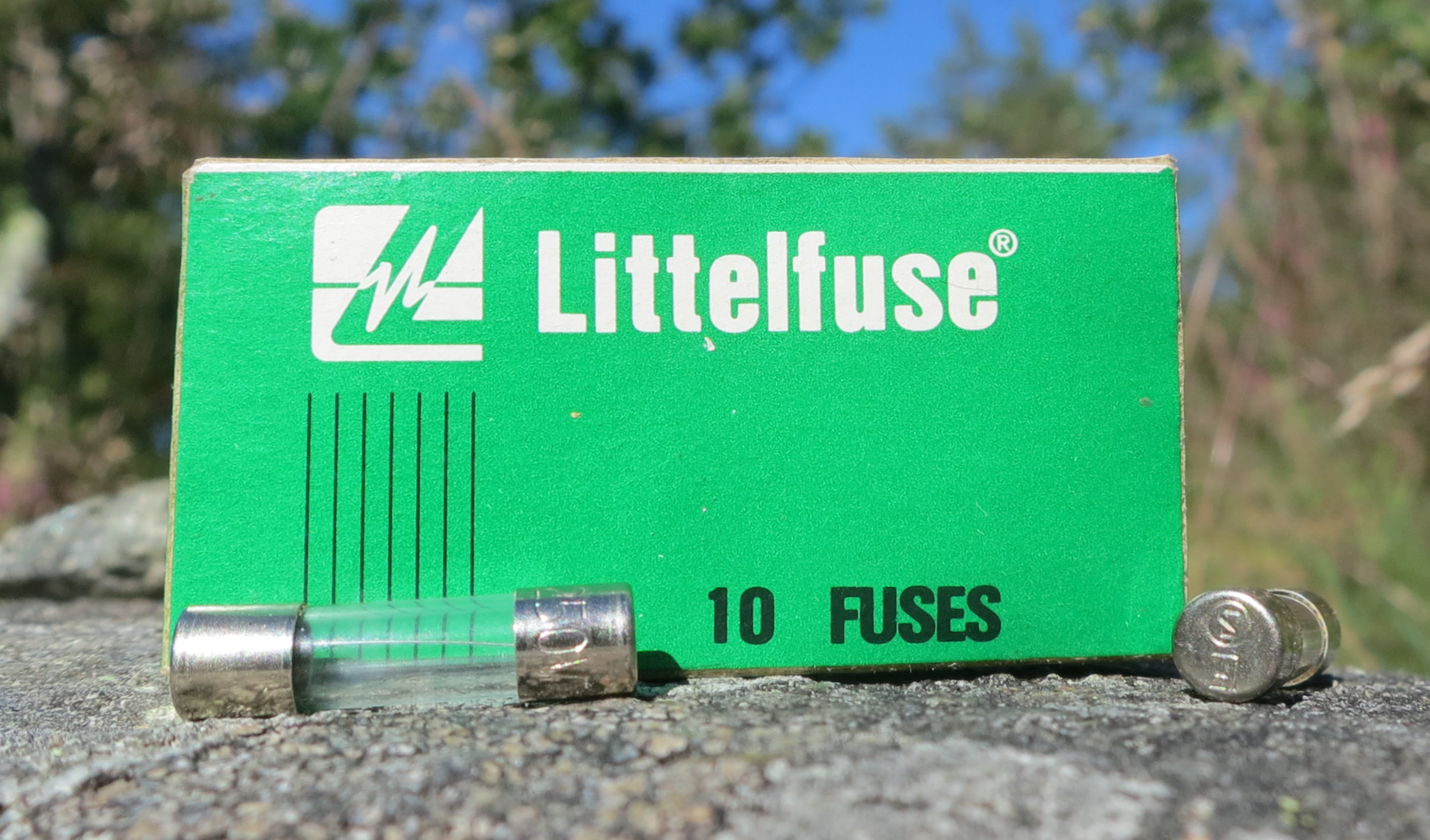
If you have ever opened the fuse box under a dashboard and seen a row of small colored plastic wedges, you have handled Littelfuse's most quietly ubiquitous invention. In 1976 the company developed AutoFuse, the first blade-type automotive fuse. It became a global standard. Nearly every car built since is fitted with fuses in that basic form factor - a rare case of a single component design outliving the decade it was born in and spreading to essentially the entire industry.
The customersEverywhere current flows
Littelfuse does not sell to consumers directly; it sells to the people who build the things consumers buy. Its parts are designed into products by manufacturers in automotive and commercial vehicles, industrial equipment, data centers, telecom, medical devices, consumer electronics, appliances, solar and renewables, and EV charging infrastructure. Engineers reach the catalog through distributors like Digi-Key, Mouser and Arrow, and once a part is specified into a design, it tends to stay there for the life of the product. Nobody rips out a proven fuse to save a nickel.
The business is organized into three segments, and their 2025 trajectories tell the story of where electrification is heading. Electronics is the largest, spanning circuit protection and power semiconductors. Industrial - grid infrastructure, data centers, renewables - is the fastest growing. Transportation, covering passenger and commercial vehicles, is the steady base.

The strategyGrowth by buying the boring parts
Littelfuse's expansion playbook is almost aggressively unglamorous: identify companies that make small, critical components in adjacent niches, buy them, and feed their products through a global sales-and-distribution machine. Hamlin brought sensing in 2013. IXYS - and with it the Zilog microprocessor line - pushed the company deep into power semiconductors in 2017. Carling Technologies added switches and controls in 2021. In 2025 it agreed to acquire Basler Electric for roughly $350 million, deepening its footprint in industrial power and grid systems.
The acquisitions are not without turbulence. In the fourth quarter of 2025 Littelfuse booked a $301 million non-cash goodwill impairment tied to its semiconductor product business, reflecting softer sales and profitability than it had once expected amid a weak chip market. Circuit protection is steady; power semiconductors ride the semiconductor cycle like everyone else.
The marketRiding electrification without the hype
Every trend investors love right now - electric vehicles, solar and wind, AI data centers, factory electrification - shares a requirement nobody puts on a keynote slide: when the power surges, something has to protect the hardware. That is Littelfuse's home turf, and it has occupied it for 98 years. Competitors like Eaton's Bussmann, Mersen, Bourns, TE Connectivity, Sensata, Vishay and Infineon overlap in pieces of the catalog, but few match the breadth across protection, power control and sensing under one roof.
Under Greg Henderson, who became CEO in February 2025 after leading a group at Analog Devices, the company guided toward strong double-digit revenue growth into 2026, helped by a strengthening backlog and the Basler acquisition. The stock trades on the NASDAQ as LFUS and sits in the S&P MidCap 400.
The takeawayWhat you can steal from it
The most instructive thing about Littelfuse is not the fuse - it is the moat. Its product is cheap, mandatory, specified into customer designs for years, and invisible until the moment it earns its keep. That combination compounds quietly: from a $5,000 startup and a $1.10 first order to $2.4 billion a year. The lesson for anyone building is that owning a small, essential problem completely can beat chasing a big, crowded one.
The recordFrom radios to server racks
Edward V. Sundt founds Littelfuse in Chicago with $5,000 to protect radios and instruments.
Littelfuse becomes a publicly traded company.
AutoFuse becomes the automotive fuse standard used across the industry.
Acquires IXYS (and Zilog), moving well beyond fuses.
Buys Carling Technologies for commercial-vehicle and industrial markets.
Greg Henderson takes over; Littelfuse agrees to acquire Basler Electric (~$350M).
Reports FY2025 revenue near $2.39B with a $301M semiconductor impairment, and guides to strong 2026 growth.