Consider a curved hospital wall. On a drawing, it is a tidy act of geometry. On a concrete floor, it becomes a succession of decisions: find the reference, measure the distance, transfer the curve, check the mark. Somewhere between the beautiful file and the person holding the pencil, precision acquires a labour bill. LightYX has built a company around shortening that journey.
- The tool: BeamerOne projects construction drawings at full scale onto floors, walls and ceilings.
- The buyer: contractors and framing, drywall and MEP crews.
- The wager: spend less time translating drawings, and catch discrepancies before installation makes them expensive.
Its current product page offers an arresting example: a DPR Construction healthcare layout, involving complex curves across 34,000 square feet, took three days against a stated 15-day comparison. Zero rework was reported. Those are LightYX’s published figures, rather than an independent trial. Still, they suggest a useful question. How much construction work is actually the work of explaining construction?
The floor becomes the instruction
BeamerOne is a robotic laser system controlled through a mobile app. The operator loads a digital plan, positions the device against reference points or existing reference elements, and chooses an area to project. Lines appear on the working surface at actual size. A worker can see a wall’s route, an opening or a hanger location where it belongs, rather than repeatedly looking away to consult a drawing.
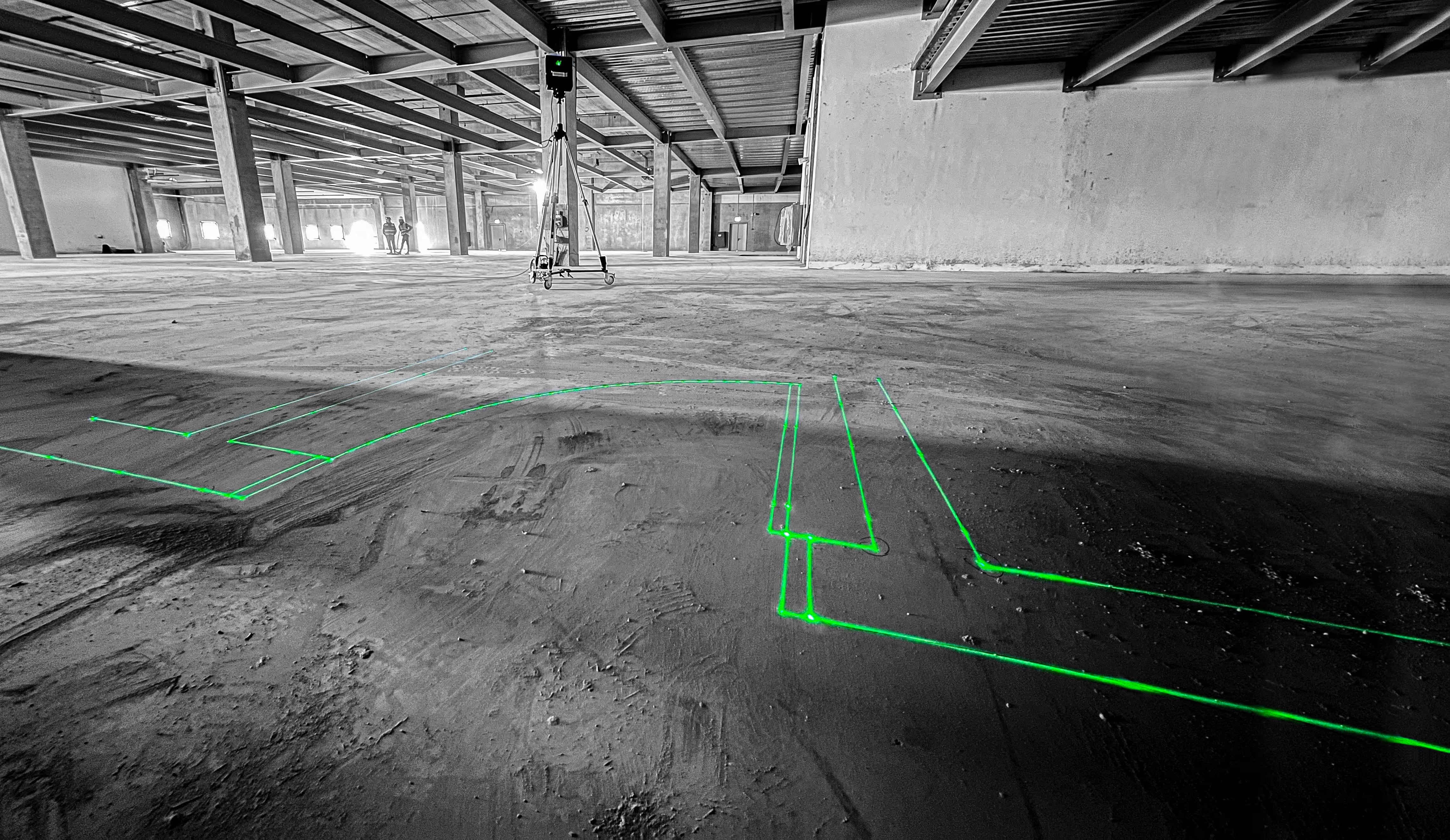
The important word is “surface.” A floor is only one candidate. LightYX also projects onto walls and ceilings, making its audience broader than the crew setting out partitions. Mechanical, electrical and plumbing installers can use the same approach for overhead work. The company’s project catalogue describes Kiewit laying out 2,101 MEP anchor points across 9,500 square feet in four days on a Canadian rail project.
The laser does not put up the wall or drill the hole. It makes the instruction easier to act upon. This is an appealingly restrained role for a robot: give the skilled person a clearer answer to the question immediately in front of them.
Fifteen days, three days, and a careful asterisk
80% less time in this published example. Project result, not a promise for every job.
LightYX’s present sales page advertises up to four times faster layout and one-person operation. Its media page describes layouts up to 80 percent faster. These are different expressions of performance, attached to marketing and demonstrations. A contractor needs a narrower answer: what happens on this particular job, with this crew, after setup and checking are included?
Accuracy deserves the same discipline. Current product marketing states one-eighth of an inch. BuildingPoint Southeast specifies typical projection accuracy of one-eighth of an inch up to 35 feet. The September 2025 funding announcement used a tighter figure, under two millimetres. Treat the tolerance as a specification to confirm for the offered equipment and working distance. A neat number becomes useful only when its conditions travel with it.
The drawing has to make the return trip
There is a less photogenic part of the product. BeamerOne supports scanning, field edits and as-built records. If the site differs from the drawing, the app can help document the discrepancy and share updated information with stakeholders. The digital model gives instructions to the site; the site supplies evidence back. That return journey matters when a perfectly drawn plan meets an imperfectly familiar building.
“It’s an extremely accurate and efficient machine...”Marco Tiberii, union carpenter at Tightline Construction, in a LightYX product testimonial
An engineering internship description exposes some of the machinery behind that simplicity. Plans arrive in formats including PDF, DWG, RVT and IFC, with geometry and metadata that need extraction and conversion for projection. LightYX’s expertise sits at the meeting of optics, software and field use. The polished interface conceals the unglamorous business of making one system’s information useful to another.
A laser still needs an approved plan
The obvious danger is also the least cinematic. An outdated drawing can be projected beautifully. In June 2026, LightYX published guidance stressing a shared data environment, version control and defined model-update procedures. The sensible inference is that a projection tool needs an information workflow around it. Someone must decide which drawing is approved, how changes reach the crew and who checks the field adjustment.
- 01 Approved drawing
- 02 Site alignment
- 03 Project + mark
- 04 Capture + review
A conceptual workflow: human approval belongs on both sides of the laser.
The copyable lesson extends beyond construction: place the instruction close to the action, then measure the whole handoff. For a crew evaluating LightYX, that means checking setup time, drawing preparation, marking time and corrections. Counting only the seconds when the laser is visible would be a flattering experiment and a poor purchasing decision.
The price of keeping it busy
LightYX offers annual rental, equipment purchase with a subscription, and partner-delivered layout services. Its rental package lists a tablet, tripod and wheels, training for up to four operators, support, maintenance and updates. BuildingPoint Midwest and Gulf Coast supplies a concrete public benchmark for its Beamer One Core kit: $450 daily, $1,800 weekly or $5,400 monthly.
At those listed rates, four daily rentals equal one weekly rental. Three weekly rentals equal one monthly rental. That is pricing arithmetic, not a savings forecast. The relevant variable is utilization. A device spending much of the month in its case has a different economic story from one moving through repeated layout tasks.
Light, ink, and the next wall
LightYX occupies the field-execution end of construction technology. Mechasys’s XR Projector is a direct projection alternative. HP SitePrint takes another route, moving across a floor and printing the layout in ink. The distinction has practical consequences: printed marks persist; a projected guide can change with the selected plan. Crews needing lasting markings must account for the work of marking projected lines.
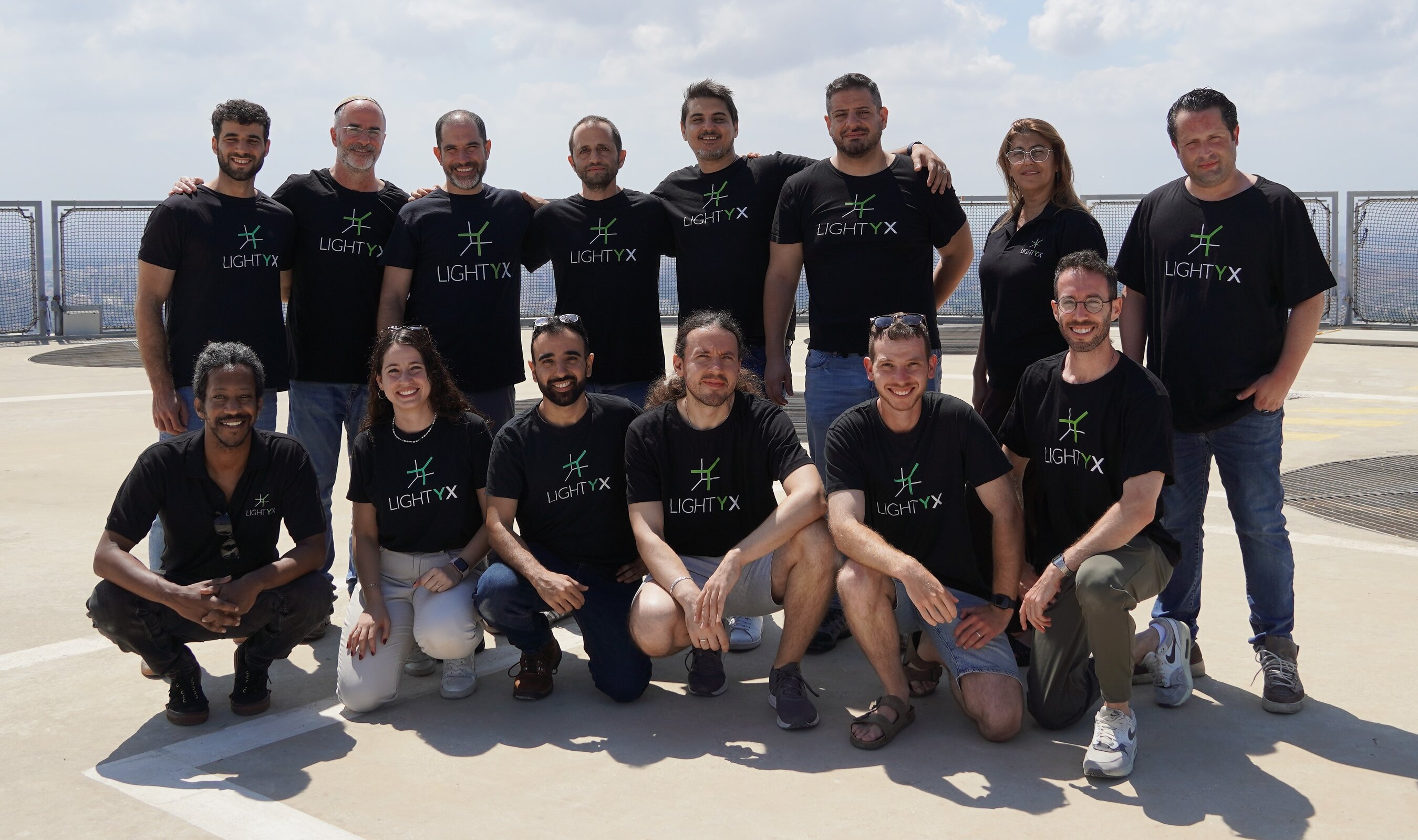
Founded in 2018 by Guy Ben-Romano, Tomer Elran and Uri Yehuday, LightYX raised an $11 million Series A led by NOVA by Saint-Gobain in September 2025. Its proposition is easy to admire and sensible to test: take a drawing that already exists, and make it easier to build from. The next curved wall is a good place to discover whether the explanation has become shorter.