At City College of San Francisco, an argument over ductwork came with a price tag approaching half a million dollars. Kitchell, the construction manager, had something more useful than a confident recollection: a visual timeline. In its published Cupix case study, program manager Ken Smith says that record helped bring the change order down to $125,000. The interesting object in this story is not the duct. It is the evidence of what happened around it.
- Cupix converts 360° footage into a shared, navigable site record.
- Teams compare installed work with building models and earlier captures.
- Its value depends on regular capture and people using the evidence.
Construction has a peculiar relationship with memory. Each successful stage conceals part of the previous one. Concrete covers reinforcement. Walls cover services. People change projects. By the time someone asks a precise question, the answer may be behind a finished surface. An ordinary photograph helps, provided somebody took the right picture and somebody else can locate it. Cupix is built around making that chain of coincidences less necessary.
The nearly half-million-dollar argument
The Kitchell example explains the appeal better than the phrase “digital twin” ever could. A timestamped, spatial record lets a team inspect the sequence rather than debate it from memory. But the distinction between the original claim and the eventual bill matters: this was a reduction to $125,000, not the disappearance of a $500,000 expense. The outcome is reported in a vendor-published customer account, not an independent controlled study.
There was also a buying decision behind the result. Kitchell had tried another platform and found the add-ons, training and support wanting. It evaluated more than half a dozen options, then chose Cupix for usability, BIM comparison and cost. The transition included importing four months of historical records. Software purchases rarely come with a more sensible question than this: can the new system remember what the old one knew?
“Cupix provided an equal to or better solution at a better cost.”
Rafael Martin, Kitchell · customer case study
A walk becomes a place you can revisit
The capture ritual is deliberately ordinary. Mount a supported 360° camera on a hard hat or pole, walk the site and record. Upload the footage. Cupix’s cloud processing reconstructs spatial context and generates views people can explore in a browser. With CupixWorks, teams can navigate captures, take measurements, attach notes and compare conditions with building information models, usually shortened to BIM. Repeat the walk and the record gains its fourth dimension: time.
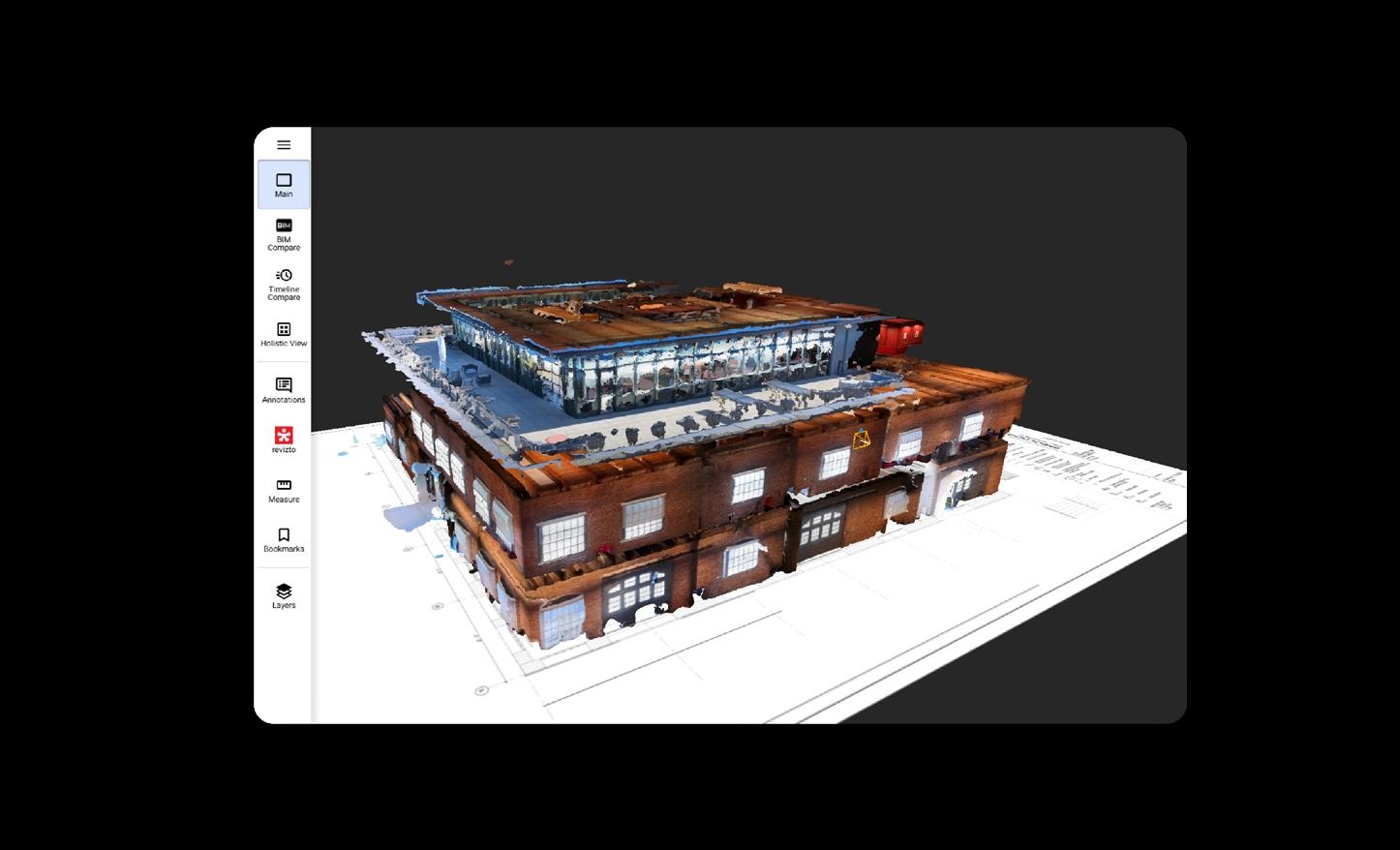
A design model describes an intention. A site capture describes an observation. Put them together and the team can examine where an installation differs from the plan. Cupix also brings laser point clouds and drone imagery into the spatial record. That is a consequential detail: a cheap camera walk need not carry every measurement burden. Different capture methods can contribute to the same project instead of living in separate software islands.
The company’s name combines “cubic” and “pictures,” a small piece of branding that describes the proposition rather neatly. Founder Simon Bae came from 3D software, having previously built Rapidform and VisPower. Cupix was founded in 2015; CupixWorks arrived in 2020. The expertise is in turning visual material into usable spatial information. The customer should not need to become an expert in that transformation to benefit from it.
The adoption problem wears a hard hat
At BNBuilders, innovation executive Brian Arnold wanted software people would enjoy using. His team evaluated alternatives over six months. Routine documentation was already expected; the extra attraction was compatibility with BIM and field simplicity. In Cupix’s account, a life sciences site with roughly 750,000 square feet of capturable area took about two and a half hours to document. That is one project’s result, not a stopwatch promise for every building.
The useful lesson is how the decision was made. A tool must satisfy the people walking the floor and the specialists checking the model. If capture is cumbersome, the record develops holes. If the result is merely an attractive tour, the coordination team still needs another place to work. Cupix’s position sits between those demands, with consumer camera hardware at one end and construction review workflows at the other.

From photographs to progress
CupixWorks serves contractors, specialty trades, construction managers and owners. Its SiteInsights add-on uses capture data and BIM to track installed work. Version 4.0, introduced in June 2026, connects that information with schedule views and dashboards for different project roles. The aim is to let an executive see a delayed trade, then let the project team examine the physical evidence behind the status.
Tutor Perini provides the larger-project example. Cupix’s May 2026 customer story describes progress tracking on the $2.95 billion Brooklyn correctional facility project, with reported savings of three to four hours daily on steel tracking. A September 2026 partnership with Global eTraining adds another route to construction software users. Connections to Autodesk, Procore, Revizto and Ricoh also show where Cupix fits: inside an existing project technology stack.
Buy the record, then keep it alive
This is a business software subscription, with CupixWorks quotes based on project size and scope. Buyers must budget for camera equipment, capture time and the people reviewing the output. CupixVista addresses a different job: individual scans and surveys. Its documentation says scan outputs do not automatically become an authored BIM model. OpenSpace and DroneDeploy offer alternatives in construction reality capture; Matterport is another familiar option for spatial documentation.
The habit readers can copy is simple: capture on a schedule, preserve location and time, and review the record before decisions become expensive. Cupix recommends at least weekly captures for progress tracking. Missed walks, hidden installations and outdated models limit what the software can establish. For tight measurement tolerances, assess the capture method against the actual task. A building’s memory is only as useful as what somebody bothered to record.