Li Yu received a watch for Preferred Bank’s thirtieth anniversary. His directors and fellow executives gathered to present it, a small ceremony for someone whose working life had become inseparable from the institution’s. A watch is a tactful gift for a banker. It acknowledges time served without suggesting that time is up.
The occasion was in 2021. Yu had helped found the Los Angeles bank in 1991 and taken the chief executive’s job two years later. He is still chairman and CEO. For a founder, thirty years can become a handsome retrospective. Yu has continued supplying the next quarter.
His story has a useful complication: he did not begin as a career banker. Before the loan committees and investor calls came accounting, an oil company and a succession of business ventures. The continuity arrived later. Once he had helped build Preferred, he stayed to manage what he and his investors had created.
A banker by way of an oil company
Born in Shanghai and raised in Taiwan, Yu arrived in the United States for graduate study in 1963. He earned his UCLA MBA in 1968, worked at Touche Ross and became chief financial officer of USA Petroleum in 1973. Banking entered through acquaintances who were organizing California Pacific National Bank in 1979.
He joined its board and became chairman in 1982. Preferred’s later corporate biography dates that chairmanship through 1987. Between that role and the launch of Preferred, he owned several private companies. His route to the corner office involved more than moving through the offices beneath it.
That sequence matters when considering the kind of work he eventually chose. An accountant, a corporate finance officer, a business owner and a bank chairman encounter money from different directions. Yu had occupied each position before becoming Preferred’s CEO. The résumé puts a considerable amount of operating experience ahead of the title most people now associate with him.
The deposit comes before the loan
In 1989, Yu and friends looked for a bank to buy. When they failed to find a suitable one, they decided to start their own. Preferred opened in 1991 with $20 million in initial capital. Some of its backing came from investors and companies in Asia.
Its Chinese American connections supplied an early network. Yu explained the practical order: a new bank needed deposits before it could build its lending business. He later described Preferred as a Los Angeles business bank. That distinction allowed room for its customer base to widen without erasing the relationships that helped establish it.
The bank’s present corporate description bears out that evolution. It serves businesses, entrepreneurs, property developers, professionals and individuals, and says most customers now come from the broader mainstream market. Real estate lending, commercial loans and trade finance sit alongside deposit services. Its geographic reach includes California, New York and Texas.
A founder’s initial circle can get an enterprise started. Continuing to earn business beyond that circle is another assignment entirely. In Yu’s case, the bank’s identity expanded along with its customers. The original community remained part of the history, while the day’s work required attention to a wider set of borrowers and depositors.
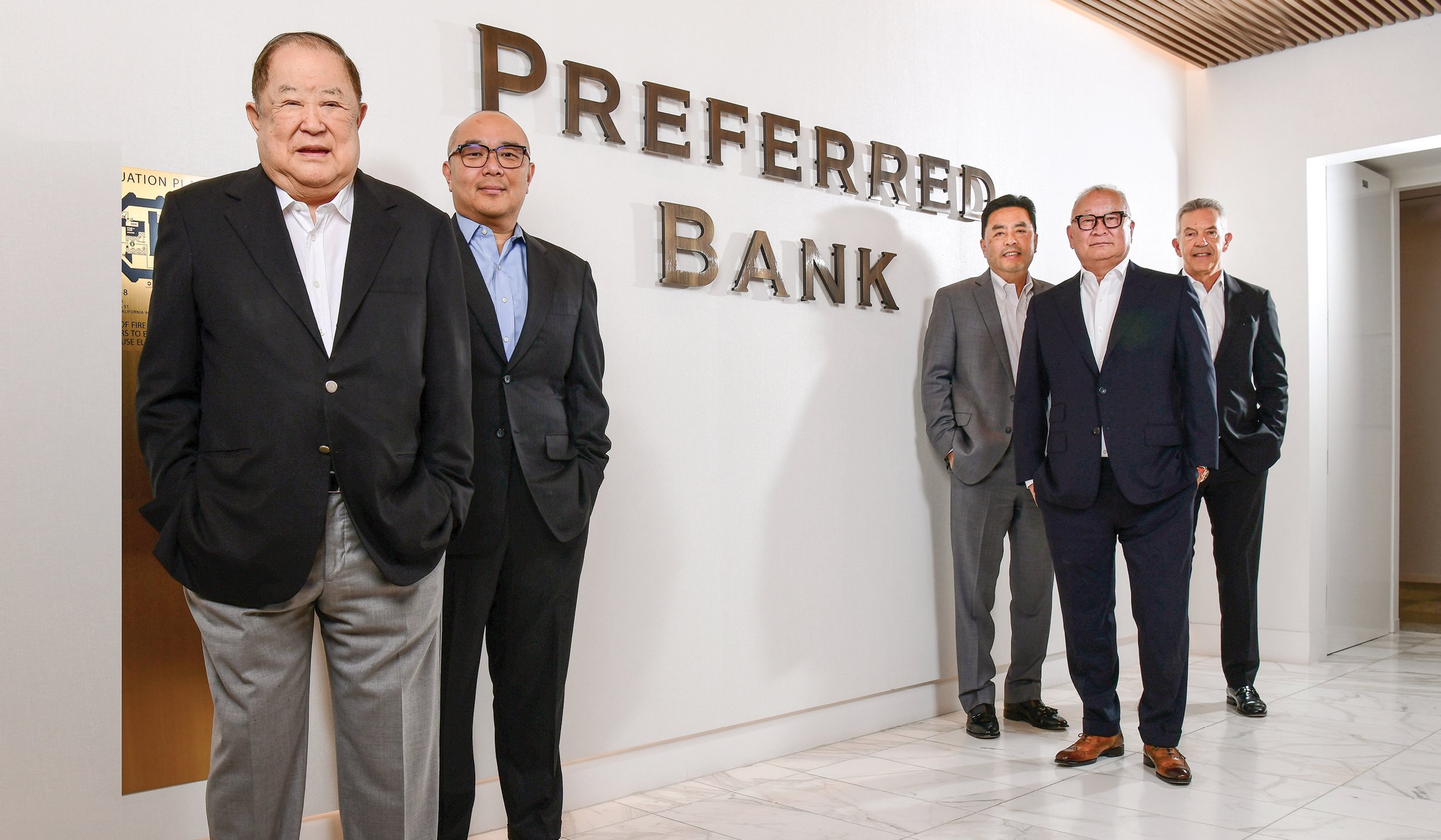
The operator keeps his wallet in view
By 2019, Yu had a compact description of his professional temperament: “I’m more of a manager, a day-to-day operator, not a dealmaker.” The distinction was particularly apt in an industry where an acquisition can create a much more photogenic announcement than a year of careful management.
Preferred had grown from $1.9 billion in assets in June 2014 to $4.3 billion by the time of that interview. Its approach emphasized a small branch footprint and growth mostly outside acquisitions. There had been an exception: buying United International Bank in New York brought problem condominium loans that Preferred later sold at a loss.
The episode gives the preference for organic growth a cost attached to it. Acquiring a bank brings existing loans as well as a new location. A purchase agreement can move both onto the buyer’s books in one afternoon; understanding and resolving the difficult credits takes longer. Yu’s preference for operating had a practical setting.
Preferred’s 2025 investor presentation describes how the business is meant to work: experienced lenders, close customer relationships, local decisions and access to senior management. It also emphasizes an efficient back office and the absence of a holding company. There is a deliberate economy to that description, with relatively little distance between a customer’s problem and someone authorized to decide.
None of this removes the ordinary hazards of lending. A familiar borrower can still miss a payment. An efficient bank can still make a poor loan. The value of Yu’s operating approach has to be tested in those less agreeable circumstances, when a relationship produces a file that needs attention rather than a referral.
“It’s the total shareholder return.”
Li Yu, on what matters more than bank size, 2016
There have been public ceremonies along the way. In March 2014, Nasdaq announced that Yu would ring its Closing Bell at the MarketSite in Times Square. A founder who spends much of his time considering deposits and loans occasionally gets an audience counting down to the end of the trading day. The ceremony makes a visible occasion of a public listing; the operating work resumes when the bell has finished ringing.
Good relationships, difficult loans
The January 2026 earnings discussion supplied such a test. Analysts asked about a downgraded borrowing relationship of roughly $123 million. Yu described customers seeking alternative financing and said the bank would allow that process to proceed. He also made clear that foreclosure remained an option if repayment could not be arranged.
That is an uncomfortable passage in any relationship banker’s story. Knowing a customer gives a lender context; it does not settle the account. Yu’s answer held together the possibility of a resolution and the possibility of enforcement. Patience had conditions. The customers’ efforts mattered, and so did the bank’s obligation to act.
The second-quarter results, released July 22, supplied a wider update on credit. Nonperforming loans declined by $70.2 million from the previous quarter. Several loans sold at book value plus accrued interest; one sale incurred a $950,000 loss. The bank reported $33.5 million in net income.
Credit improved, with costs attached: one loan sale recorded a $950,000 loss.
Those figures describe the work beneath the anniversary celebrations. The problem loans need selling, collecting or restructuring. A recovery improves one line; a loss reaches another. Yu’s tenure is unusually long, but each quarter still arrives with accounts that must stand on their own.
A founder’s job includes preparing the next chair
Yu’s colleagues describe a manager who asks for their views and accepts responsibility when decisions go wrong. Deputy chief operating officer Johnny Hsu has credited that behavior in discussing the stability of Preferred’s executive group. For a founder who retains the final say on major issues, inviting disagreement is consequential work.
In June 2025, Yu said succession planning extended beyond his own role to the other senior executives and a further management level. He offered no immediate retirement date. His enthusiasm for staying occupied was plainer: “I’d rather be doing something than nothing.” One suspects the beach would have difficulty presenting a sufficiently detailed agenda.
The succession question belongs inside the operating story. Relationships accumulated over decades have institutional value, but people eventually need to hand responsibilities to colleagues. Preparing those colleagues takes its own form of patience. A founder can keep making decisions today while ensuring that tomorrow’s decisions will have somewhere competent to go.
A million dollars, with music attached
There is another place in Los Angeles where Grace and Li Yu’s names appear together: the GRAMMY Museum’s lobby. In 2022, the couple gave $1 million to support music education, with particular attention to access for students in under-resourced communities across Los Angeles County.
Yu’s explanation was pleasantly direct: “Grace and I love music.” He spoke of the pleasure it had brought their lives and their wish to help music education. The gift supported a public institution’s programs, extending a private enthusiasm to students who might otherwise have fewer opportunities to participate.
The lobby naming puts the couple at the entrance to an institution devoted to performers. For a banker accustomed to working behind businesses, that seems a suitable position. Visitors can pass their names on the way to discovering someone else’s work. The purpose of the donation lies in what those visitors and students get to experience.
Another quarter on the calendar
In his April 2026 shareholder letter, Yu reported 2025 net income of $133.6 million, compared with $130.6 million in 2024. He outlined a strategy of organic growth and increasing tangible book value, while acknowledging interest-rate uncertainty and geopolitical risks. The agenda remained familiar: control overhead, manage capital and keep the business earning.
As of October 21, the next scheduled results are due October 23. That date is an appointment, with the outcome still ahead. A long record gives Yu experience to draw on; it gives him no exemption from the next set of questions.
The anniversary watch was a thoughtful acknowledgment of what he had already done. His continuing role makes its other function rather apt. There is still a calendar to consult, a bank to operate and another meeting approaching. Time, in Yu’s working life, keeps turning into something to do.