Tony Ressler missed the call. In June 2015, the NBA was trying to tell him that his ownership group had cleared the final hurdle to buying the Atlanta Hawks. The news reached him by text instead. For someone about to enter a business conducted beneath floodlights, it was an admirably inconspicuous entrance.
The next day, he was introduced to Atlanta. He described the purchase as taking responsibility for a “community asset and a business.” Six words, two constituencies, years of potential disagreement. Investors can agree on a return. A basketball crowd contains several thousand competing investment committees, most of them certain the owner should have signed somebody else.
Ressler had already helped establish two investment firms, Apollo and Ares. He understood debt, ownership and the patience required to build a company. The Hawks would test another skill: explaining himself to people who had emotional equity in an enterprise he legally owned. That distinction would follow him from the arena into the streets around it.
A bond trader’s education
Born in Washington, D.C., in 1960, Antony P. Ressler earned a degree at Georgetown’s School of Foreign Service before taking an MBA at Columbia. The education joined international affairs to business. His professional apprenticeship came at Drexel Burnham Lambert, where he rose to senior vice president in the high-yield bond department and took responsibility for the new-issue and syndicate desk.
High-yield finance requires an appetite for distinctions. A company can be unfashionable without being worthless; a promise to repay can look generous because the borrower is taking a considerable risk. Ressler’s work placed him where businesses’ ambitions met investors’ demands. That is useful training for anyone who will later spend decades deciding which ambitions deserve money.
Drexel went bankrupt in 1990. That year, Ressler became a co-founder of Apollo, alongside a group that included Leon Black, his brother-in-law. In 1997 came Ares. John Kissick and Bennett Rosenthal were among the colleagues involved in its founding. The career crossed institutions, but the underlying subject remained familiar: companies, capital and the terms on which one could help the other.
He would later credit his Drexel years with teaching him how to assess businesses. There is a practical cast to that account of education. A prestigious degree gets a line in the biography. Learning to distinguish a good company from a bad one becomes a recurring responsibility.
Making room at the top
Ares went public in 2014. By the time of its tenth anniversary as a listed business, Ressler was discussing its development alongside Michael Arougheti, another co-founder and the firm’s chief executive. In a 2024 interview, he emphasized credit, originating investments and finding capable people. His explanation left room for favorable markets, too. Even a founder’s retrospective can admit the weather.
The division of responsibilities had been made explicit years earlier. Ares announced in December 2017 that Arougheti would become CEO effective January 1, 2018. Ressler continued as executive chairman, concentrating on corporate strategy, major client relationships and building the firm’s name. The founder stayed involved while another executive took the chief executive’s chair.
His present responsibilities still include investment committee work across parts of Ares’s credit and private equity businesses, as well as sports, media and entertainment. That last category supplies a particularly neat overlap with his life in Atlanta. The person who buys a basketball team also helps oversee investment decisions in a sector where teams, media rights and venues meet.
In his public discussions of private credit, Ressler has argued that longer-term investors can provide a suitable home for longer-term assets. He expects growth across regions and types of lending. Those are his investment convictions, rather than a guarantee about what markets will do. They explain why the former bond executive continues to spend time talking about the plumbing of finance.
The arena requires attendance
The NBA’s governors approved the Hawks sale unanimously in June 2015. Ressler led the buying group, with former player Grant Hill among his fellow investors. Moving into basketball placed him in a public partnership with people who knew the game from very different positions. The owner had capital. Hill had spent years on the floor.
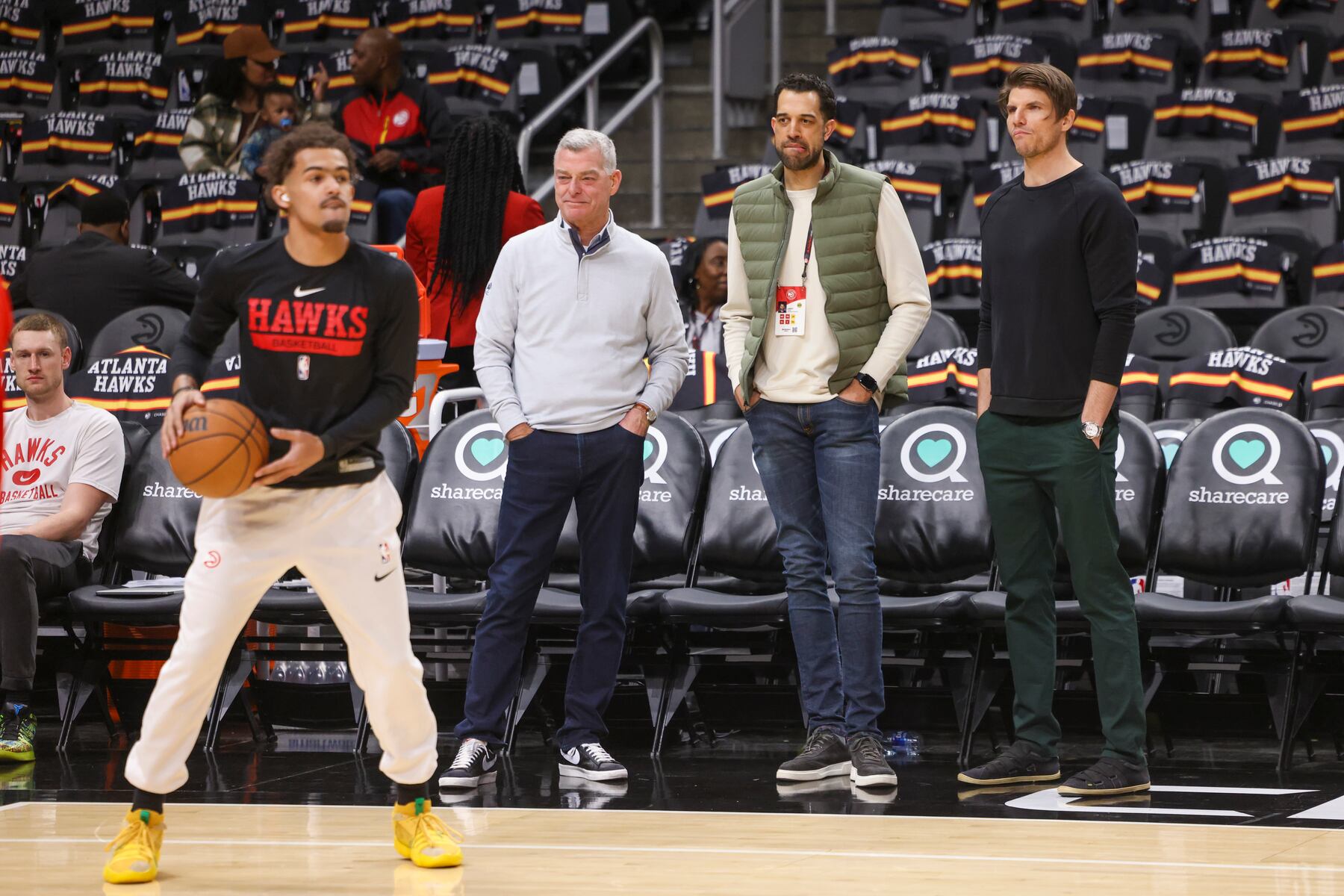
Four years into ownership, Ressler acknowledged how much the job demanded. He had expected less time and less personal presence. His son Oliver, appearing with him at an industry event, joked about making his publicity-shy father take part in panel discussions. It was a small family reversal: the son encouraging the father to come out and meet people.
“A lot more time and presence than I anticipated.”Tony Ressler on basketball ownership, 2019
The physical work was substantial. By 2019, the Hawks had completed a roughly $200 million transformation of State Farm Arena and added a G League team. Ressler described improvements to the arena and practice facilities as requirements he had initially mistaken for luxuries. Owning the team had supplied a continuing education in what the business actually needed.
Jami gets the lottery assignment
His wife, actor Jami Gertz, brought a different kind of experience to public life. In May 2018 she represented the Hawks at the draft lottery, where even an experienced performer could feel the pressure. The franchise’s future depended partly on bouncing balls, and someone had to sit there looking composed while they bounced.
Gertz described the assignment through the familiar demands of live theater: turn up, face the audience, deliver. Her husband’s choice of representative gave the family’s basketball involvement a recognizable face. For an investor accustomed to evaluating probabilities, the lottery also offered a fairly severe lesson in their limits. Preparation could choose the representative; it could not choose the envelope.
Patience, with a scoreboard attached
Ressler has repeatedly described a championship as the Hawks’ objective. The difficulty is in the route. An organization can change its executives and improve its buildings while still facing a fresh test every game. Basketball provides little discretion about when the market should value your work. It posts the result before everybody goes home.
In a March 2023 interview about front-office changes, he said he wanted an operation that was “far more collaborative, far more communicative.” He supported putting Landry Fields in charge of a different working environment. The vocabulary would have sounded familiar inside an investment firm: better communication, better decisions, clearer responsibility.
The decisions kept coming. In May 2026, the Hawks promoted Onsi Saleh to president of basketball operations. It was another change in the people entrusted with the basketball side of the enterprise. Championship aspirations survive executive appointments; appointments are easier to announce than championships are to arrange.
The investment across the street
Centennial Yards takes Ressler’s Atlanta involvement beyond the arena. The project occupies 50 acres in the downtown area known as the Gulch, near State Farm Arena and Mercedes-Benz Stadium. Its developer is a partnership between a CIM Group affiliate and a group led by Ressler. His brother Richard co-founded CIM, adding another family connection to a career already full of them.
The planned $5 billion development combines housing, hotels, entertainment and commercial space. The full plan calls for eight million square feet of new commercial and residential space. Those are project ambitions, with different buildings and venues arriving on different schedules. A neighborhood cannot be opened as conveniently as an investment account.
Planned space, not completed construction. Commercial uses include retail, entertainment, offices and hotels.
The scale also makes public obligations part of the story. The project’s financing includes public development incentives. Earlier plans emphasized minority contractor participation and affordable housing. Those commitments give Atlantans concrete things to measure alongside the new restaurants and buildings. A development beside a team’s arena still has to answer questions from people who will never buy a ticket.
By March 2026, construction was advancing in its Fan Zone, with a Live Nation music venue scheduled for 2027. The timetable brings his investment world into contact with the city’s daily life: streets, neighbors, jobs and the awkward period when a promising place is chiefly a building site.
Other ways to leave a name on a building
Ressler’s institutional work extends to Los Angeles. He helped found Alliance College-Ready Public Schools, whose first school opened in 2004 and became Alliance Gertz-Ressler High School. The network grew across the city. Its founding group included educators and civic leaders as well as people from business, making it another undertaking that required different kinds of expertise.
The education work has attracted disagreement as well as support. In 2015, parents and teachers raised concerns about access to leadership, working conditions and school decisions. Alliance defended its methods and pointed to student outcomes. Ressler acknowledged room for improvement while supporting the schools’ record. The debate exposed a recurring question in his public roles: who gets heard when an institution decides how it should run?
At the Los Angeles County Museum of Art, he serves as a board co-chair. In February 2026, LACMA announced the Ressler Family Wing in recognition of his and Gertz’s support for its building campaign. Willow Bay became his fellow co-chair. The family name now connects a school and a museum wing, alongside its association with an Atlanta basketball franchise.
These institutions ask different things of him. A school has students and teachers. A museum has visitors and trustees. A team has supporters who can be both devoted and furious in the same evening. Ressler’s career has carried him into places where providing money is only the beginning of being involved.
He entered NBA ownership after missing a phone call. Since then, showing up has become part of the job description. The balance sheet still matters. So does the person in the seat beside the court, visible to everybody, waiting for the next possession.