By the time Lei Jun decided to make a phone, he already had an excellent excuse to stop. He had run Kingsoft, helped take it public and founded an online retailer that Amazon bought. He was approaching 40. In the conventional arithmetic of a career, this was a respectable moment to collect board seats and develop firm opinions about other people’s mistakes.
Instead, he spent months worrying about whether to start again. The fear was specific: failure might undo his reputation. He later described keeping the new venture quiet until there was a product. The beginning of Xiaomi, in 2010, contained considerably more hesitation than its subsequent product launches would suggest.
Eleven years later, he volunteered for another expensive education. Xiaomi would build electric cars, and he would lead the business himself. The programmer who became a phone executive was now responsible for something with wheels. His career keeps returning to a question that success is supposed to settle: what should he attempt next?
A library book with consequences
Lei was born in Xiantao, in China’s Hubei province, on December 16, 1969. He entered Wuhan University in 1987 to study computer science. There, a copy of Fire in the Valley, about the personal computer industry and its entrepreneurs, supplied a more absorbing prospect than simply getting a qualification.
In a later commencement address, he recalled circling the playground to calm down after reading it. The attraction was the possibility of building a technology company of his own. His first practical response was wonderfully student-like: reorganize the coursework. He set out to complete the required courses in two years. His degree was awarded in July 1991.
The distinction between finishing coursework and receiving a degree is worth keeping. It makes the episode more interesting. Lei’s instinct was to find room within the university system for the things he wanted to do. At a 2017 campus appearance, he remembered saving library time by attending only the second film of a Friday double bill. Even recreation had acquired a timetable.
For all the influence of Silicon Valley’s famous founders, he later advised students against treating dropping out as a career plan. He had admired their companies, then made substantial use of his own education. The romance came with homework.
The years before the orange logo
Kingsoft hired Lei in 1992. He became chief executive in 1998, working in a software business that expanded into utilities, internet security and online games. These dates put some useful distance between the student with a book and the founder holding a smartphone onstage. There were years of running an organization in between.
In 2000, he founded Joyo.com, an online retailer. Amazon acquired it in 2004 for $75 million. Kingsoft listed in Hong Kong in 2007; Lei stepped down from its chief executive role that December. He later returned as chairman in July 2011, a position he continues to hold. His professional past has stayed in the room.
Investing widened that room. He backed businesses including UCWeb and the company now known as JOYY, and became a founding partner of Shunwei Capital. Lin Bin, a former Google executive, joined him in co-founding Xiaomi. The next venture therefore drew on relationships and operating experience accumulated well before its first handset.
This matters because the familiar founder photograph can flatten a career. A person in jeans holding a device looks like an individual with an idea. Behind Lei’s photograph stood software teams, a retail exit, investors and colleagues with experience at other technology companies. Starting again required him to risk an established position, while giving him resources a first-time founder would struggle to assemble.
The first hundred people
Xiaomi’s early audience was small enough to count without a spreadsheet. When the first version of MIUI, its Android-based software, appeared on August 16, 2010, there were 100 initial users. The software preceded Xiaomi’s first phone, which launched in August 2011. Before asking people to buy its hardware, the company had asked enthusiasts to try its software.
Those early users exchanged views with engineers. Xiaomi later commemorated their usernames in a sculpture at its technology park. A hundred people had become part of the company’s origin story, with something rather more permanent than a thank-you email.
There was a practical commercial idea inside this affection. People who help improve a product have reasons to keep watching it. Their suggestions give engineers material to work with; their enthusiasm gives a new company an audience. Xiaomi’s weekly software updates made that exchange recurrent. A product could be discussed, revised and discussed again.
For Lei, the arrangement also offered a particular kind of visibility. He could be the executive presenting the product and a participant in the conversation around it. That proximity would become a feature of his public identity. It also gave customers a recognizable person to address when expectations were disappointed. Friendship is a pleasant word to put in a company vision. Customers are entitled to remember it.
Five percent, in writing
Lei’s approach to pricing acquired a numerical expression in 2018. Xiaomi pledged that its overall annual net profit margin on its hardware business, including smartphones, connected devices and lifestyle products, would not exceed 5 percent. Any excess would be returned to users. The promise appeared in the company’s listing documents.
This was an aggregate net margin pledge for the stated hardware business. Reading it as a 5 percent markup on every individual product would give the wrong impression. The distinction matters when a neat number travels further than its explanation.
Ceiling on the overall annual net profit margin of the specified hardware business.
Smartphones, IoT and lifestyle products. A company pledge, not a per-product markup.As a statement of character, the promise fitted Lei’s interest in making well-designed technology accessible. As a business choice, it placed pressure on efficiency and scale, while leaving internet services as another source of revenue. Affordability had become something shareholders could read in a prospectus.
Xiaomi listed in Hong Kong in July 2018. Lei now had a public company whose shareholders expected returns and a public promise about how much its established hardware operation should keep. Balancing those expectations is a more revealing management problem than the usual question of which famous American founder he resembles.
“Are you OK?”
His public image had already escaped the prospectus. At the Mi 4i launch in New Delhi in April 2015, Lei spoke to fans in English and repeatedly asked, “Are you OK?” An internet creator turned fragments of the presentation into a remix. The question acquired a musical afterlife.
It was a fan edit, assembled from a product presentation. Lei had accidentally provided the vocals. He subsequently retweeted the remix, making room for the joke in his own public presence. An executive responsible for devices and distribution had discovered a distribution channel with very little interest in his preferred script.
The episode is funny partly because of the setting. Product launches are elaborate attempts to control what an audience remembers. Here, the audience picked a greeting. For a company that valued participation, it was participation in a particularly unruly form.
There is a recognizable continuity between this and the first hundred MIUI users. People were doing something with Xiaomi beyond buying it. Sometimes they improved the software. Sometimes they edited the chairman into a song. The company’s relationship with its fans had room for both, although only one would normally appear on an engineering schedule.
The phone company takes driving lessons
On March 30, 2021, Xiaomi announced its entry into electric vehicles. The plan called for an initial investment of RMB10 billion and an estimated US$10 billion over ten years. Lei would also serve as chief executive of the new business. He was 51, with an existing company to run and another industry to learn.
The SU7 sedan reached its commercial launch on March 28, 2024. Its starting price was RMB215,900. The idea behind Xiaomi’s expansion was that a car could belong in the same connected world as a customer’s phone and home devices. The company calls that strategy “Human × Car × Home.” For the customer, the proposition begins with familiar electronics and ends with a considerably larger purchase.
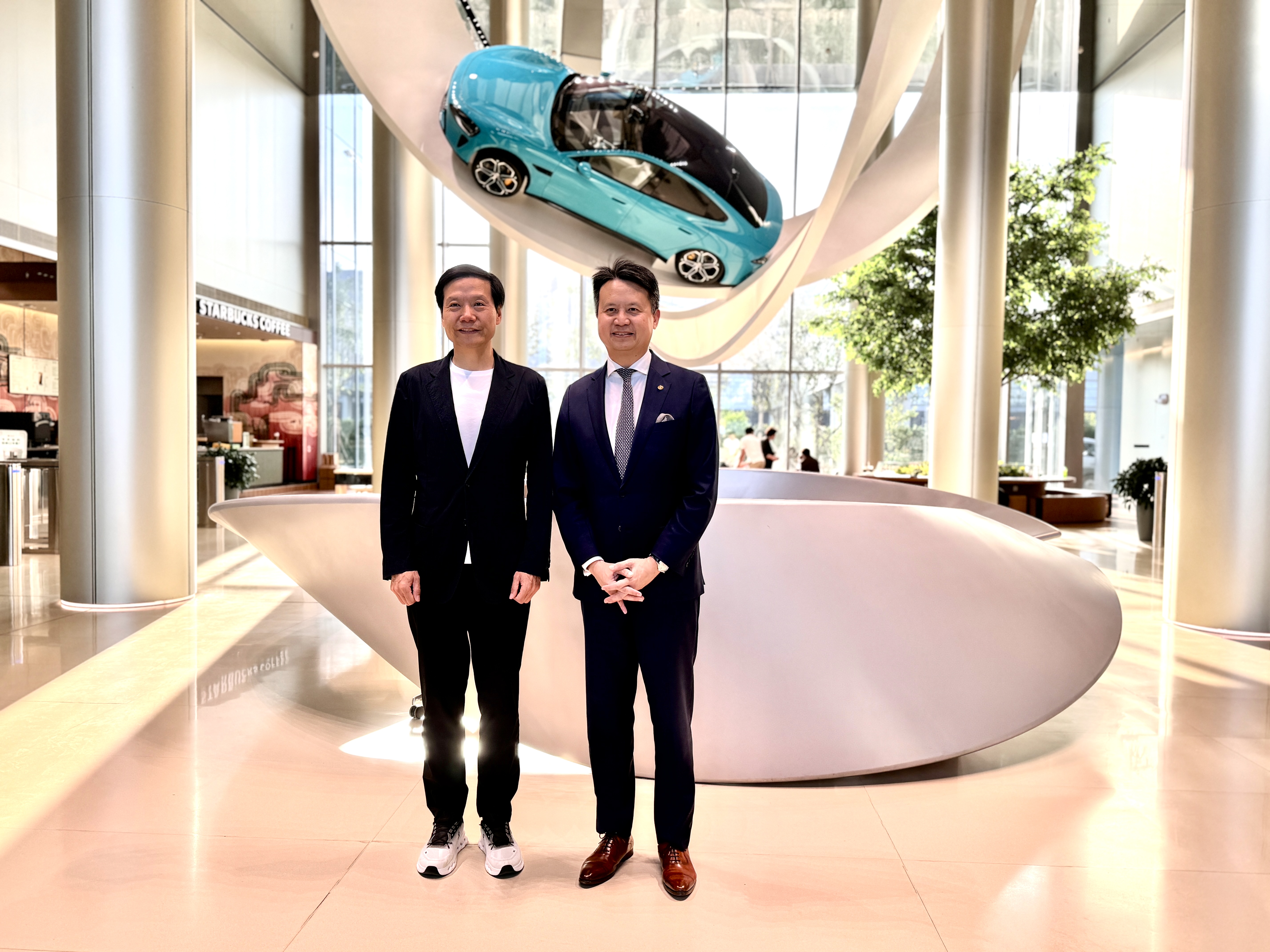
By 2025, Xiaomi delivered 411,082 vehicles. That figure describes actual deliveries across the year, rather than reservations or launch-night expressions of interest. It gives the venture a manufacturing scale that the original announcement could only propose.
The newer figures complicate any easy victory speech. In the second quarter of 2026, Xiaomi delivered 104,199 vehicles, up 28.2 percent from a year earlier. Across the first half of the year, however, group revenue fell 8.4 percent and adjusted net profit fell 42.8 percent. Component costs and competition remained pressures. Growth in one part of the business did not make the whole company immune to difficulty.
Q2 2026 · year on year+28.2%
H1 2026 · year on year-8.4%
H1 2026 · year on year-42.8%
The return to Wuhan
Another large number leads back to the library. In November 2023, Lei donated RMB1.3 billion to Wuhan University, his alma mater. The intended uses included basic research, computer science innovation and undergraduate education. He had begun donating to the university in 1997, years before Xiaomi existed.
The gift connects the experienced executive to the student who once budgeted his Friday evenings around library time. Scholarships had mattered to him. Later, he funded them. He has also returned to speak to students about the difficulty of entrepreneurship, including his own reluctance to put a successful reputation at risk.
“What if I fail and ruin my reputation?”
Lei Jun, recalling his hesitation before Xiaomi in his 2015 Wuhan University commencement address
That question makes his successive beginnings easier to understand. He could recognize what there was to lose and proceed anyway. The companies, colleagues and capital changed the terms of each attempt. They never supplied a guarantee.
Lei’s story now includes an online shop, software, phones, a car factory and a university gift. The teenager’s borrowed glimpse of the computer industry has turned into a career spent trying different ways to enter it. There is something appealing about a successful executive who still has to learn the next product. At least the homework keeps changing.
Keep following the experiment
- Xiaomi’s founders ↗
- Xiaomi Technology profile ↗
- Lei Jun on X ↗
- Lei Jun on Weibo ↗
- Lei Jun on Instagram ↗
- Lei Jun on TikTok ↗
- Watch: his 2024 annual speech ↗
- Watch: the original “Are you OK?” remix ↗
- His address to Wuhan’s graduates ↗
- Read: the SU7 launch ↗
- Xiaomi’s second-quarter 2026 results ↗
- Lei Jun: biography and further reading ↗