Samuel Ohev-Zion had a question for an industry that was rather fond of expensive answers. What if a customer simply wanted a phone that did the job, looked good and left some money in the bank? A surprising amount of his career has consisted of asking that question again, in another country, at another price, with another set of people between the factory and the buyer.
He is the founder, co-owner, president and CEO of BLU Products, based in the Miami area. His route into that job ran through mobile-phone distribution. By the time BLU appeared at CTIA Wireless in 2011, Ohev-Zion and fellow founder Luis Sosa could point to 16 years in that trade. They understood the part of technology that happens after the product announcement: having the right stock in the right place when somebody is ready to buy.
That background gives his story its particular shape. A distributor spends time dealing with products bearing other people’s names. Eventually, Ohev-Zion saw an opening to put BLU on the box. The company dates its founding to 2009. At its 2011 wireless-show debut, it described a business already selling across 25 countries, with a Miami distribution center and a range extending from basic handsets to Android smartphones.
His argument was practical. Components and manufacturing capabilities that had once been difficult for a smaller business to obtain were becoming accessible. A company could work with those capabilities and concentrate on design, purchasing and getting the resulting device into shops. For somebody with a distribution background, this was an invitation to move further up the business. He already knew something about the last mile. Now he wanted his own product to travel it.
- 1999Telecel
Latin America - 2006CT Miami
- 2009BLU
Products
A little dignity in the bargain bin
Affordability can be a peculiarly patronizing corner of consumer technology. The expensive customer gets taste; the inexpensive customer gets a specification sheet and an instruction to be grateful. Ohev-Zion’s public comments suggest he understood the weakness in that arrangement. He wanted people to take pleasure in owning a less expensive phone.
In June 2014, he put his position plainly: “We don’t get into spec wars.” He argued that buyers would increasingly ask what performance was sufficient for them. His pitch included varied styles and colors, and a product an owner would feel comfortable showing to somebody else. Price mattered, but the object still had to feel like a choice.
“We don’t get into spec wars.”
Samuel Ohev-Zion · 2014
He also described the commercial logic of BLU’s relationship with Gionee: the two businesses brought strength in different territories, allowing them to combine production volumes. It was an explanation rooted in purchasing power and geography. Making an attractive handset cheaply involved more than deciding to charge less. Someone had to arrange the components, quantities and route to market.
In Brazil that same year, his priorities were product development and placement in stores. BLU reported eight million devices delivered in 2013. Ohev-Zion described an internal design operation and a US warehouse holding roughly a million pieces of inventory. The warehouse detail is revealing. In his version of the phone business, availability deserved a place beside the camera and the screen.
An unlocked phone added another element to the proposition: a buyer could choose among compatible service providers. The commercial appeal was easy to understand. The purchase belonged to the customer, and the next decision about service could remain a separate decision. Ohev-Zion had built a business around giving that arrangement an attainable price.
The fifty-dollar experiment
In June 2016, Amazon gave that idea a particularly conspicuous price tag. Its Prime Exclusive Phones program introduced the BLU R1 HD at $49.99, compared with a full retail price of $99.99. The reduced price was supported by personalized offers and advertisements on the lock screen. Customers could also buy the version without those offers at full price.
The offer came with conditions: Prime membership, advertising, and compatibility with particular networks. Those details matter as much as the number. Ohev-Zion was working within a partnership that changed how a handset could be paid for. Part of the commercial value came from what the owner would see after buying it.
He celebrated what Amazon’s participation made possible. The R1 HD had a five-inch display, LTE connectivity and expandable storage. At the launch, Amazon put BLU beside Motorola in the same program. For an executive who had spent years distributing established brands, that pairing was a concrete marker of how far his own brand had traveled.
There is a small lesson in the arithmetic. A $50 reduction on a $99.99 device removes about half the initial handset price. It can change who considers the purchase. It also gives the buyer a new calculation to make about the offer attached to it. The bargain was visible on the receipt and on the screen.
A name large enough for a football shirt
Then came a different kind of distribution: football. In May 2017, BLU announced a partnership with Valencia CF that put its logo on the front of the team’s shirts for the 2017/18 season. The unveiling took place at the Oceanographic Auditorium in Valencia’s City of Arts and Sciences, before more than 400 guests and members of the media.
Ohev-Zion said the partnership would “accelerate our global brand strategy.” He spoke of emerging markets and the shared appeal of football, and welcomed joining the Valencianistas community. A company whose name expanded to Bold Like Us had found a setting in which bold lettering was, quite literally, part of the uniform.
The sponsorship offers a useful glimpse of his ambition. Getting a phone into a store establishes availability. Getting a name onto a football shirt establishes familiarity. Both involve meeting people somewhere they already go. By December 2017, the partnership had been extended through the club’s centenary season in 2019. The modest handset business had acquired a rather public wardrobe.
From the shop counter
to the front of the shirt.
The obligation inside the box
The career also includes a serious failure of oversight. In 2018, BLU and Ohev-Zion reached a settlement with the Federal Trade Commission over allegations about privacy and data security. The complaint concerned software supplied by ADUPS for wireless firmware updates and the collection of personal information beyond what those services required.
The allegations were specific. The FTC said a third-party provider collected information including the contents of text messages, and that BLU and its co-owner had made deceptive claims about limits on collection and safeguards. The agency alleged inadequate security procedures and oversight of service providers. These were allegations resolved through a settlement; the account should retain that distinction.
The final settlement required a comprehensive security program addressing new and existing devices. It barred misrepresentations about privacy and security, and subjected BLU to independent assessments every two years for 20 years. Ohev-Zion was personally named alongside the company. The obligations reached well beyond removing a piece of software from the next shipment.
For a business built through suppliers and partners, the episode exposed the other side of that model. Customers deal with the name on the box. Behind it may sit manufacturers, software providers and update systems, each requiring supervision. A brand can distribute the work across several companies while still carrying obligations to the person who buys the finished phone.
Independent security-program assessments every two years under the 2018 FTC settlement.
Back to Brazil, with the accessories included
By October 2022, Ohev-Zion was explaining another push into Brazil. The plan included assembly in the Manaus free-trade zone through Luxpay and distribution through Allied. The three initial models were priced at R$999, R$1,399 and R$1,699. He positioned BLU as an alternative in the space occupied by Samsung and Motorola.
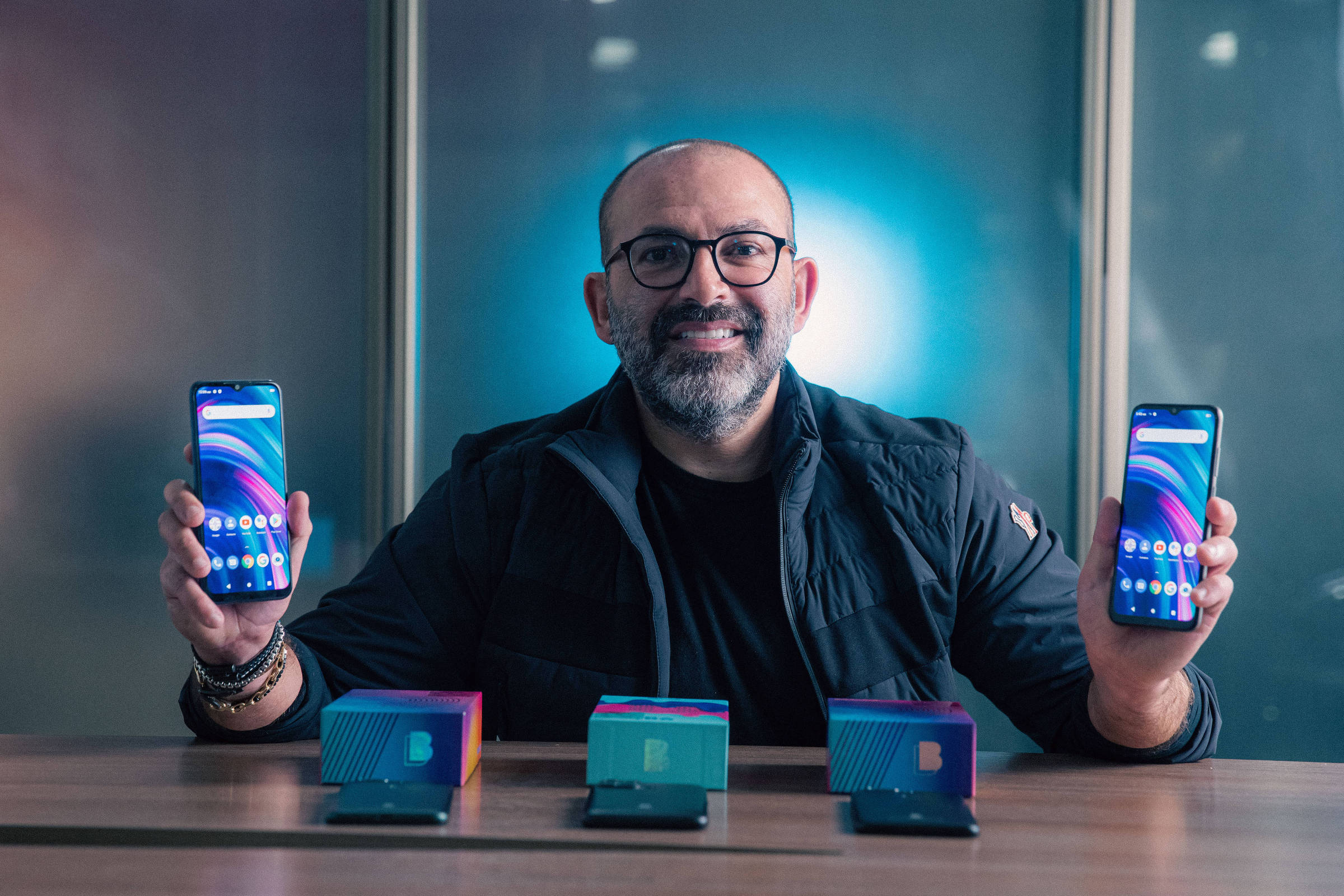
His attention returned to the contents of the package. Alongside the phone, he emphasized a charger, protective case and wireless earphones. There is something pleasingly literal about competing by putting more useful things in the box. The customer can count them without needing a presentation.
He set a target of four to five percent of Brazil’s smartphone market by 2025. That was an ambition announced in 2022, rather than an established result. He also previewed more models, including a 5G handset he said would cost less than R$2,000. His pitch retained the old concern with what a customer could afford, expressed in a new set of local prices.
The pattern continued in BLU’s October 2025 BOLD N4 announcement. The company listed a regular price of $299.99 and a limited launch deal of $249.99. It promoted a secondary rear display and included a case, earphones and a charger. Specifications had changed considerably since the early BLU handsets. The habit of making the package itself part of the price argument remained recognizable.
Ohev-Zion’s career is easiest to understand by following those concrete decisions: the shop counter, the purchasing partnership, the lock-screen offer, the football shirt, the accessories. Each is a way of reaching somebody and giving them a reason to consider an unfamiliar name. Each also adds a promise the company has to keep.
That is what makes his question about price worth returning to. The answer cannot end at the cash register. It includes what the phone does, what comes with it, how it is supported and what happens to the information inside it. Ohev-Zion built his place in the industry by asking how much a buyer needed to pay. The rest of his story concerns everything that payment ought to buy.