The teachers needed somewhere to live. This was one of the less glamorous discoveries Andrés Moreno made while running his first English-teaching business in Venezuela. Recruiting native English speakers was only the beginning. Someone had to accommodate them, organize their classes and get them to the executives who were paying to learn. A language school could acquire customers and still find itself becoming a small relocation agency.
Optimal, as the business was called, worked. That was the interesting difficulty. Moreno had evidence that people wanted the service, along with mounting evidence that delivering more of it would require more of everything. More teachers on the ground. More coordination. More expense. Expansion abroad promised to reproduce the entire administrative headache in a fresh location.
He eventually left that model behind. With Wilmer Sarmiento, a friend from engineering school in Caracas, he began working on an online alternative. The teacher could stay where the teacher lived. The student could stay at home. The room, that expensive and inconvenient unit of expansion, could disappear.
Today Moreno is the founder, chairman and CEO of Open English. He is also a familiar face from its television advertising. The distance between those two jobs is smaller than it first appears: building the school meant persuading people that a teacher on a screen could belong in their lives.
A childhood conducted across borders
Born in Caracas, Moreno spent his childhood moving between countries, including Slovenia, Peru, Chile and the United States. His family's international work made adaptation a recurring assignment. A new country meant another set of people to understand, another culture to navigate and, sometimes, another language to learn.
English acquired a practical meaning during those moves. It could carry a conversation across national boundaries. For a child repeatedly arriving somewhere unfamiliar, that was a useful discovery. The connection between language and access would later become the organizing idea of his business.
Back in Venezuela, he studied engineering at Universidad Simón Bolívar. He left before completing the degree. In a 2022 interview, he placed the decision in his final semester, a moment when abandoning a course of study would have felt especially pointed. Graduation was close enough to have a place at the family table.
His commercial interests already ran toward teaching. Optimal served executives at multinational companies; its clients included Procter & Gamble, Sun Microsystems and Cargill. This gave him a demanding early audience. English had to fit around working lives, and its usefulness would be judged well beyond an exercise book.
Physical classroom
Local coordination
Online classroom
Study from anywhere
A change in delivery, with live teaching at the center.
The sofa came before the television
The early Open English effort took shape in a student apartment in Caracas. Moreno and Sarmiento were trying to build a service that would let people study with native-speaking teachers over the internet. Sarmiento became the principal architect of the first learning platform. The proposed flexibility was substantial: lessons available around the clock, from home or work.
Financing the idea was a separate education. Moreno went to Silicon Valley and slept on a friend's sofa while looking for investors. He has described getting up, putting on a suit and seeking small commitments, sometimes in increments of $20,000. The suit was doing rather more commuting than its owner could afford.
The details resist the tidy version of startup history in which a founder has an idea, meets an investor and immediately orders office furniture. Moreno needed time to assemble backing and build the product. In his telling, television advertising eventually helped the company find its audience.
There was little room for error. He has recalled an approximately $8,000 bank loan in Venezuela that helped keep the young company alive. A small sum beside later institutional funding, it bought something more immediate: another chance to continue. Early capital had a calendar attached to it.
“You think of money in terms of months to live.”
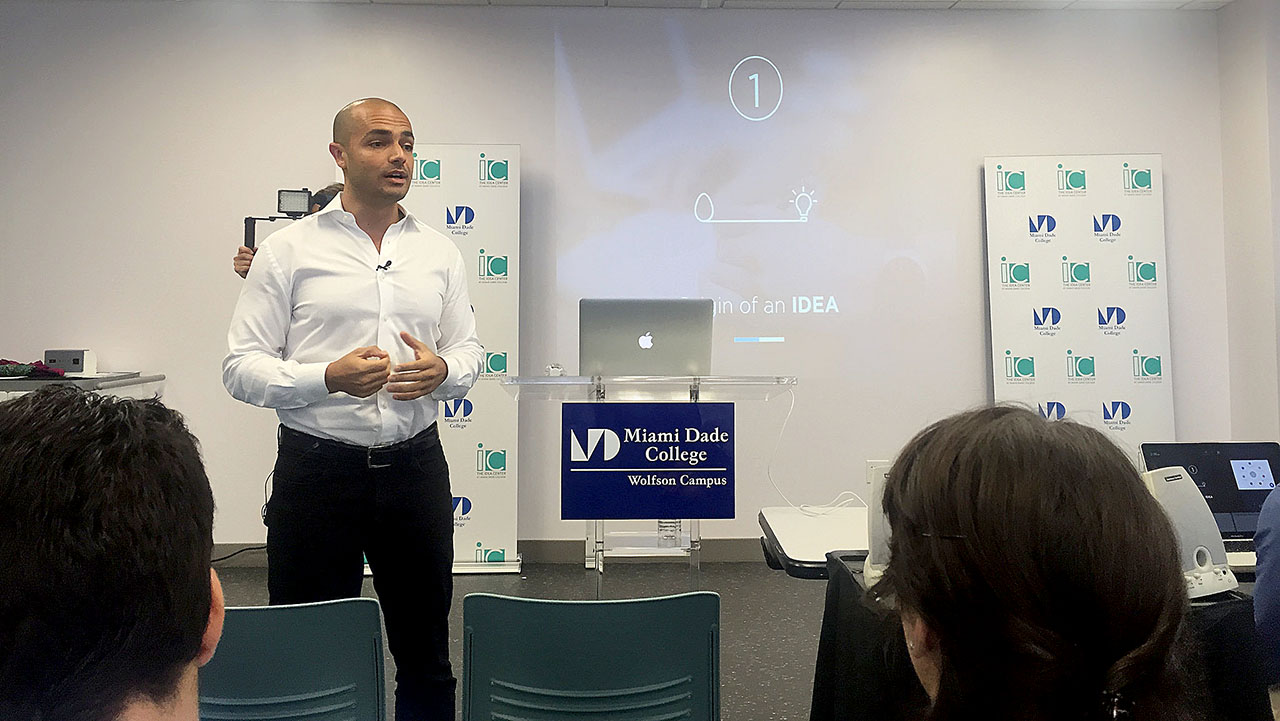
Andrés Moreno, speaking at Miami Dade College
The school that emerged retained a human instructor at the center of an online service. That distinction helps explain the original gamble. Students were being asked to change where and when they learned, while keeping the live interaction that gave a language lesson its point. Technology removed a journey without removing the person at the other end.
A founder becomes part of the furniture
Open English began running television commercials featuring Moreno in 2009. The founder became a recurring character in the thing he was selling. Advertising turned a fairly abstract proposition, learning online, into a recognizable encounter. A potential student could become acquainted with the face before deciding to try the class.
The company now has unusually explicit instructions for that face. Its public brand guide assigns Moreno the role of a credible, rational voice. He should project confidence, communicate naturally and represent competent English. Even the wardrobe is documented: black shirt, white shirt, black polo. Entrepreneurship occasionally ends in a costume department.
Those rules reveal the work behind an apparently casual television presence. Moreno's commercial role is carefully maintained. His delivery needs to make the offer understandable and the company trustworthy. Familiarity has become part of the business, alongside the platform and the lessons.
For a founder, appearing in the advertising also creates a lasting personal association with the product. Moreno's public career cannot be separated neatly from Open English's visibility. He is the executive explaining the business and the character many viewers already recognize. Each appearance carries a little of both.
What the bigger classroom contains
By 2026, Open English reported more than three million cumulative student enrollments and a presence in over 30 markets. Its footprint extends across Latin America and the US Hispanic market to places including Turkey and Spain. Miami is home base; offices span cities from Bogotá and São Paulo to Istanbul and Bangalore.
The product family also expanded. There are offerings for individuals, children and businesses. Open Mundo adds French, Italian and Portuguese. More than $150 million in venture backing, including investment from Insight Partners and TCV, supported the company's development. These are company figures, a measure of the operation Moreno now leads.
His other ventures follow related practical interests. Next University moved into online digital skills and was acquired by Open English in 2016. Escala addresses marketing and sales for Hispanic small and medium-sized businesses, bringing customer management, landing pages, email and automation into one platform. The student who once left engineering now spends time helping other people organize their businesses.
There is a recognizable connection between these projects. Learning a language can make work accessible. Learning a digital skill can change the work someone does. Giving a small business better sales tools can help it reach customers. Moreno keeps returning to the machinery between a person's ambition and the next useful step.
The next student may arrive through a country
One version of that ambition is visible in Rionegro, Colombia. Sueños Bilingües, a partnership involving Open English, Fundación Fraternidad Medellín and Fundación Los 8 Valores, began in 2024. It brought digital learning and live classes into a public educational institution, with an in-person teacher supporting the classroom experience.
The first phase served 444 students and their teachers. An April 2025 company account reported 963 beneficiaries after expansion to a wider school community. The arrangement placed the screen inside an existing institution. Local teachers and outside instruction shared the work, rather than asking every learner to arrange everything alone.
In April 2026, the scale changed again. Costa Rica launched access to Open English through Hello Brete, working through the Instituto Nacional de Aprendizaje and government ministries. The announced contract could enable up to 500,000 licenses a year and as many as two million over four years. Those numbers describe available capacity under the arrangement, rather than completed courses.
For Moreno, this puts a longstanding ambition into a different setting. A service originally sold to individuals can also be purchased through an institution trying to improve access to work. The buyer changes. The old problem remains recognizable: how to give people useful instruction within the constraints of their actual lives.
Artificial intelligence is now part of the offer. Jenny, a virtual tutor, supports pronunciation practice and personalized feedback; AI+Teacher Class combines AI with live instruction. Moreno continues to emphasize the teacher's role. His argument is grounded in the social demands of speaking: confidence and interaction matter alongside grammar and vocabulary.
A second audience, with questions of its own
Moreno has also made entrepreneurship itself a subject to teach. His work with Endeavor Miami dates to its founding period in 2013, and his Éxito project has included talks and now a podcast. The audience has broadened from people trying to speak English to people trying to build something.
Éxito's conversations include founders and business leaders such as Elias Torres and Martín Varsavsky, as well as figures from other parts of public life. Interviewing gives Moreno a different seat from the one he occupies in a commercial. He can ask how someone else solved the problem.
His own advice keeps returning to execution. The first business provided customers, yet required a different way to deliver the service. The online school required software, then financing, then a reason for people to show up. Each apparent finish produced another task. In a July 2026 conversation, he put his personal claim plainly: “My superpower is that I finish what I start.”
That is a useful place to leave the familiar television face: working through an unfinished list. The founder who once had to find accommodation for teachers now has platforms, partners and public programs to manage. Somewhere within all that organization is the same small event that made the enterprise worth attempting: a learner opens a conversation and discovers they can keep it going.
Keep the conversation going
Moreno's projects, public profiles and longer conversations.