League has spent 12 years chasing a deceptively mundane moment: a person opens a health app and tries to figure out what to do next. Is this therapist covered? Where is the claim? Which clinic is in network? Should I book the screening now? The answers usually live in separate portals, PDF booklets, call-center scripts and databases that regard one another with the warmth of feuding cousins.
The Toronto company does not provide the doctor or underwrite the insurance. It builds the consumer layer that sits above those systems. A health plan can use League to launch a branded member portal. A provider can assemble a digital front door. A retailer can mix care navigation, rewards and personalized programs into its own app. Underneath are data connections, configurable interfaces, recommendation engines, APIs and, increasingly, AI agents.
That sounds less exciting than “reinventing healthcare,” which is precisely why it may be commercially useful. League sells the part everyone notices - the experience - without demanding that a giant insurer replace every machine in the basement.
01 / The original betThe massage button was not the business
Michael Serbinis founded League in 2014 with Dan Leibu and Dan Galperin, colleagues tied together by Kobo, the Canadian e-reader challenger that Rakuten bought in 2011. Their first idea was an Uber-like marketplace for wellness: assemble trusted professionals, let consumers book massages, eye exams and other services, and make preventative health feel as convenient as ordering a car.
What failed first was not necessarily the software. It was the size of the job. A marketplace could help someone find a massage, but it did not answer the expensive questions controlling access: What does my employer cover? Who pays? How do I claim it? Customers urged League toward insurance, and in 2016 the company pivoted into health benefits, partnering with RBC Insurance for underwriting.
The second version was tangible. Employers paid a monthly fee on top of their health plan. Workers got a wallet, benefit enrollment, claims, provider discovery and wellness programs in one mobile experience. By the Series A announcement in 2016, League said nearly 500 companies had joined. Publicly named clients later included Shopify, Uber and Unilever.
The clever move was not abandoning the consumer. It was finding the institutional buyer with a budget for the consumer's frustration.The League playbook, in one sentence
02 / The upmarket moveFollow the mess, not the feature
The benefits app exposed a larger problem. Employers were only one doorway into a health system built from disconnected claims engines, provider directories, electronic records, call centers, pharmacies and wellness vendors. Large plans and providers did not need another isolated app. They needed a layer that could connect the pieces, present them coherently and keep changing without a five-year rebuild.
League moved upmarket. Its pitch became composability: launch an all-in-one portal, embed selected modules in an existing property, or use APIs and developer tools to build something custom. The interface can wear the customer's colors and name. League is often invisible, a quiet arrangement that suits risk-conscious healthcare brands better than asking them to hand the member relationship to a startup.
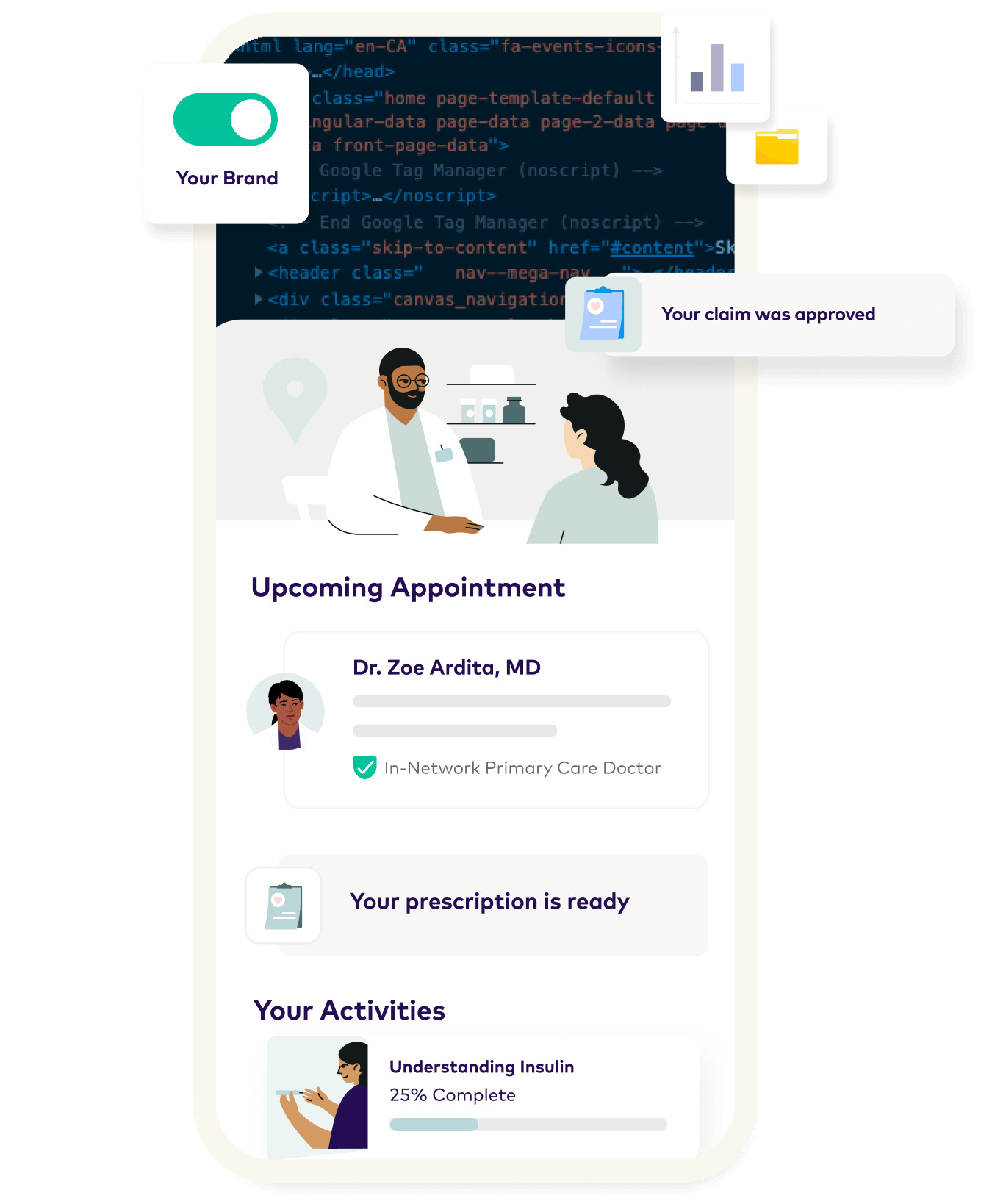
The product line now covers three broad jobs. Member Portal handles claims, benefits, care finding and self-service. Health Engagement adds programs, content, rewards and nudges for conditions and preventive care. Experience Composer gives customers configurable building blocks. A FHIR-native data layer and partner integrations connect the front end to systems already in place.
The marquee proof came from large organizations. Highmark Health worked with League and Google Cloud on My Highmark, a digital front door across its insurance and care businesses. Manulife reported more than a 40 percent lift in users of its mobile experience. Medibank took League beyond North America. More recently, CareSource, SCAN, Santa Clara Family Health Plan and Point32Health have appeared in customer announcements. Point32Health plans to unify the portals and apps for Harvard Pilgrim and Tufts Health Plan, with member rollout expected in early 2027.
The invisible audience got very large
03 / What it costPlatforms eat capital before they eat markets
This was not a weekend pivot. League raised US$4 million in seed funding in 2014, US$25 million in a 2016 Series A, roughly US$47.1 million in a 2018 Series B and US$95 million in a 2022 Series C. By 2025 it reported more than US$285 million in venture capital. RBCx also supplied a US$100 million credit facility for platform development, sales capacity and possible acquisitions. Morningside later made an investment on undisclosed terms.
The spending bought more than screens. Enterprise healthcare demands integrations, implementation teams, procurement patience, localization, security controls and proof that software touching health information behaves like an adult. League has obtained HITRUST certification and says its platform is built to SOC 2 Type II, HIPAA, PIPEDA and GDPR standards. Those acronyms rarely make a product demo sparkle. They do keep the product in production.

04 / The AI chapterThe demo is easy. The audit trail is the product.
League added AI in layers. The Benefits AI Guide answers plan-specific coverage questions. AI Health Actions recommends the next useful step. In 2025, Agent Teams grouped specialized agents around benefits navigation, care navigation, health coaching and care-gap closure. A Concierge Agent coordinates them using Health Story, League's plain-language narrative assembled from clinical, claims, engagement and preference data.
Then came Forge, announced in July 2026. It is a no-code environment where a health plan or provider can describe an agent, limit the data it may use, establish escalation rules, test it on synthetic patient populations, deploy it and monitor accuracy and completion. Early access is planned for September.
The useful skepticism
League publishes striking engagement numbers, including three-times higher health-action participation with AI and high recommendation-completion rates. Those figures are company-reported and may vary by customer, population and definition. A login is not a blood-pressure reduction. A completed action is more promising, but buyers still need controlled measurement against clinical, cost and satisfaction outcomes.
Forge's argument is that healthcare AI fails in the distance between a clever answer and a safe action. A general chatbot may explain a benefit beautifully and still invent the coverage. League emphasizes approved sources, expert-authored answer keys, evaluations, permission-aware access and human escalation. “Anyone can wrap a foundation model in a chatbot,” Galperin has said. “The hard part isn't the demo. The hard part is production.”
That is League's clearest difference from point solutions. Navigation vendors may own a particular journey. Data platforms may unify records. Portal vendors may handle transactions. League tries to combine the experience layer, data context, behavioral design, developer surface and regulated AI controls. The reward is a larger contract and deeper position. The penalty is a broader promise that customers can judge on many fronts.
05 / What to stealCopy the sequence, not the spending
Founders should not copy League by raising hundreds of millions or adding “operating system” to a pitch deck. The reusable lesson is narrower: begin with the visible frustration, discover who controls the workflow and budget, and keep turning one-off fixes into configurable infrastructure.
There are conditions where this playbook does not work. A small employer with straightforward benefits may prefer a cheap packaged app. A provider with clean modern systems may not need another orchestration layer. An organization without reliable data cannot personalize its way out of bad inputs. A buyer unwilling to redesign internal workflows will simply place a handsome portal over the same confusion. And if an AI cannot be connected to scheduling, claims or outreach, it remains a conversational brochure.
League also faces the classic platform squeeze. Customers can build. Big consultancies can assemble. Adjacent vendors can expand. Point solutions can be better at one narrow task. The defense is speed across the full journey and evidence that integration creates more completed care, fewer calls and lower costs. That case must be proved deployment by deployment.
The company began by making wellness purchasable. It changed its mind when customers revealed that payment, coverage and navigation were the real obstruction. Today it sells a way for giant organizations to behave, at least on the screen, like one coherent service. Healthcare is still fragmented. League's bet is that the layer translating that fragmentation into a next step will be valuable - even when the person tapping the button never knows who built it.