The factory called at five in the morning. Somewhere in Revolution Foods' Oakland production operation, a problem had escaped the floor and reached a customer. Lauren Dunford, who led West Coast partnerships, was the person who got the call. The operation produced millions of school meals, yet important knowledge still traveled by whiteboard, clipboard and paper. In the heart of Silicon Valley, a modern food company could make lunch at industrial scale while remaining oddly nearsighted about the machines doing the work.
The contradiction stayed with her. Factories make the ordinary inventory of civilization - coolers, sutures, greeting cards, vitamin bottles, road paint - but much of their equipment predates the cloud and has no clean way to report what it is doing. A plant might contain a hundred machines bought across several decades. No sane operator replaces productive equipment merely to make a software diagram tidier. The digital future, in other words, must learn to live with the mechanical past.
Dunford eventually gave that condition a wonderfully unvarnished name: a “patchwork of patchworks.” It is also the terrain on which she built Guidewheel, the San Francisco company she co-founded with Weston McBride. Its wager is that every machine, whatever its vintage, has one legible vital sign. It draws electricity. Read that pattern closely enough and the old machine begins to speak.
A fondness for the useful win-win
Long before factory software, Dunford was practicing a kind of field education. As a teenager she joined AMIGOS programs in Mexico and Nicaragua. Participation involved raising money, which meant selling grapefruit, pecans and poinsettias - an early sales apprenticeship with unusually festive inventory. Her first summer, in Guanajuato, was difficult and homesick. She returned for a second program partly because the first had been hard. The instinct was already there: discomfort was a reason to go back better prepared.
At Stanford, where she earned a BA in Human Biology with a concentration connecting sustainability, environment and health, operations and climate began to fuse. She helped establish the university's Green Fund, backing campus improvements designed to pay for themselves. She also met McBride while the two led rival environmental student groups. The future co-founders began as competitors, which is one way to guarantee that neither arrived at the partnership underestimating the other.
A Fulbright took Dunford to India for nine months of supply-chain research. Work at Revolution Foods later made the abstractions physical: schedules, equipment, output, waste and the customer waiting at the end. She returned to Stanford for an MBA in 2016 with a problem worth spending every available hour on. Better factory visibility could improve production and reduce waste. The commercial and environmental outcomes did not need separate machinery.
The customer commits a useful act of disobedience
The company that became Guidewheel began with energy monitoring in emerging markets. Early pilots ran in Kenya, her husband's home country, with support from Stanford's TomKat Center. The premise was appealing: give factories a simple view of power use, help them find savings and let cleaner growth follow. The first users helped strip away complexity and co-design a system suitable for the realities around them.
Then came the uncomfortable evidence. Many eager customers did not use the early product as intended. Founders can respond to that moment with a louder pitch, a larger feature list or a private theory that users require education. Dunford's team went to the factories. A small set of customers were using the data enthusiastically, but for a different job: they were watching production.
The electrical trace could show when a machine started, stopped and cycled. It could reveal idle periods and micro-stops, count output and warn when behavior drifted from normal. Energy data was also machine data. A sustainability tool had discovered a more urgent front door: keeping production moving.
This was not a retreat from the original mission. It was a change in sequence. “The purpose of a factory is to produce things, not to save energy,” Dunford has said. Sell the operating result first. When a factory makes more from the same assets, its energy and emissions intensity can fall with the waste. Guidewheel could pursue the climate benefit through the daily scoreboard plant teams already cared about.
The cardboard-box test
Industrial software is haunted by integration projects: long timelines, specialist teams and partial connections to machines from favored vendors. Guidewheel designed for a rougher world. Its sensors clip around electrical conductors without touching machine controls. A hub sends the data to cloud software. The kit can travel in a cardboard box and be installed without replacing the asset it observes.
The elegance is not the sensor alone. It is the low cost of beginning. Dunford often returns to “crawl, walk, run” as an implementation principle. One useful metric can earn the right to add another. A fast, visible result can turn adoption from a management instruction into a habit owned by the floor. The people closest to a jam, a long changeover or an unplanned stop finally get evidence while they can still do something about it.
That emphasis on the frontline is more than friendly product language. Factory improvement is social. A perfect calculation that arrives in a monthly review cannot recover Tuesday afternoon. A simple alert seen by the right operator might. Guidewheel's dashboards let teams compare shifts, identify bottlenecks and keep a history of what happened, but the point is not to admire the record. It is to create a shared account of reality that makes the next conversation shorter and the next action clearer.
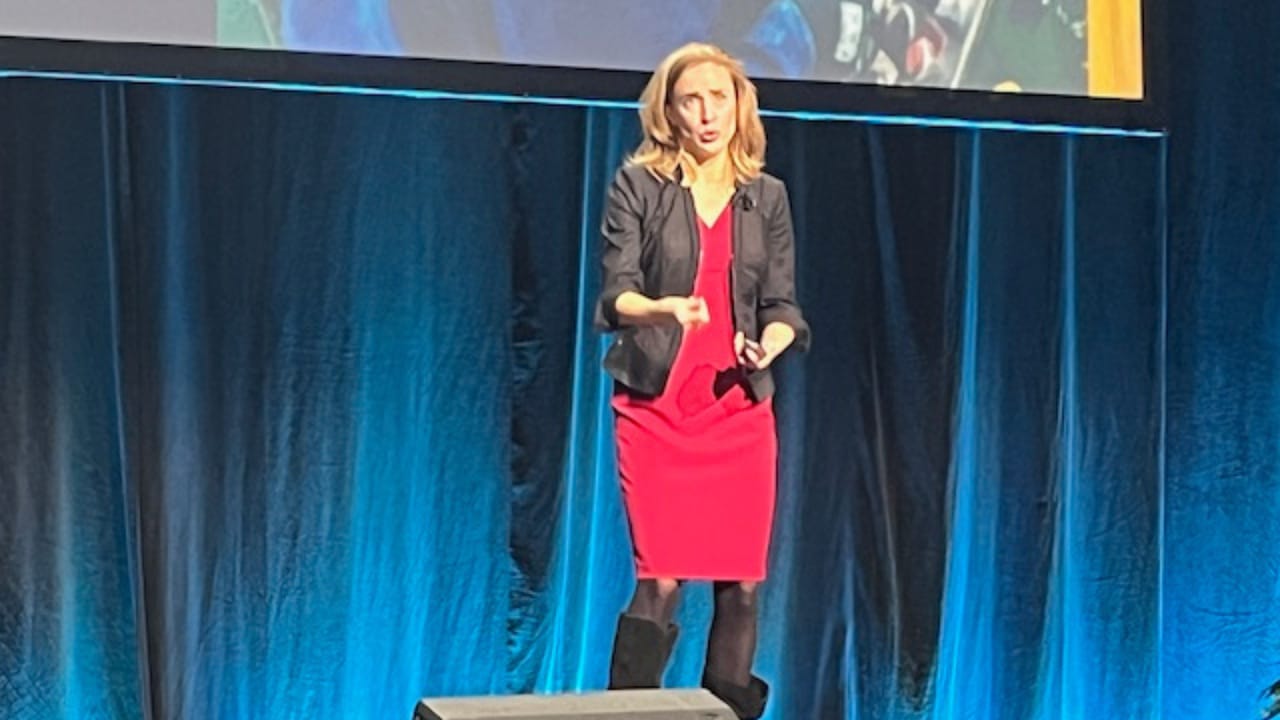
At MD&M West in February 2026, Dunford described the approach through a Johnson & Johnson suture operation. Decades-old equipment lacked modern cloud connections. Nearly one hundred assets were brought into view using the same “Fitbit for factory” logic, and the operation reported a 35 percent productivity improvement, later extended to additional sites. The result matters less as a universal promise than as proof that legacy equipment does not have to remain mute.
Guidewheel's own numbers have grown with the scope of the claim. The company announced a $31 million Series B in August 2024, led by Decarbonization Partners, the BlackRock and Temasek partnership. By March 2026, Wichita State University described Guidewheel as supporting more than 400 manufacturers across five continents, with about $52 million raised in total. Dunford was named Entrepreneur-in-Residence at the university's Barton School of Business, bringing factory AI into classrooms as both a technology subject and an operating discipline.
The capital has widened the product rather than changed its basic grammar. Guidewheel added Scout, an AI-powered predictive-maintenance capability meant to catch unusual equipment behavior before failure becomes downtime. The progression is logical: first establish a reliable stream of physical data, then ask software to recognize patterns across it. AI arrives after the signal, not before. In factories, where an inaccurate suggestion can waste material or interrupt a line, that order is less theatrical and more useful.
Optimism with a clipboard
Dunford's public philosophy is notably free of futurist fog. She likes the factory visit, the actual machine and the person working the shift. Her professional posts celebrate the surprise of watching cookies, airplane wings and other products come off lines. She urges young people to consider manufacturing because it combines tangible work, team competition and the inexhaustible pleasure of discovering how ordinary things are made.
The approach also leaves room for comedy. On an early customer trip, her team followed a mislabeled destination through the dark and arrived at the gate of a prison instead of their overnight cottages. During Guidewheel's first U.S. push, her husband Jason packaged and shipped sensors so often that a hardware store, seeing him buy soil and seeds after FedEx runs, assumed he was a professional gardener. Industrial transformation still involves wrong turns and packing tape.
Those stories fit the more serious habit underneath them: reality gets the final edit. The first AMIGOS summer could be revisited. The first product could be rebuilt. A factory's written plan could be checked against the shift that actually happened. Dunford's aspiration - sustainable peak performance for the world's factories - is vast. Her method is deliberately smaller: listen to one machine, help one team see one loss, then earn the next step.
In an industry attracted to digital twins, Guidewheel begins with a more modest proposition: machine truth. The phrase carries a useful moral. Plans matter, dashboards matter, AI models matter, but the material world is under no obligation to match them. A mold is still at the back of the plant. A line is still waiting. An old motor is drawing current in a pattern that tells a story. Look closely enough and it will tell you where the day went.