The engineers at HELLA thought they knew which station was slowing their sensor assembly line. They had a candidate bottleneck and the usual factory tool kit for investigating it. Then they watched the video. The slow work was happening elsewhere: a worker had to reach across the station with one arm, twisting on every cycle. The setup was tiring, and a small piece of furniture was quietly taxing an industrial process.
That is an unusually modest ending for a story involving artificial intelligence. HELLA's team reconfigured the station, improved line balance, and said the Drishti deployment paid for itself in less than six months. The software did not rearrange the bench. It gave people enough evidence to do it.
- Drishti used computer vision to measure manual assembly work and make production video searchable.
- Its customers included DENSO, HELLA, Flex, Ford, and Nissan.
- Factory teams used footage to find bottlenecks, trace defects, and train operators soon after a problem occurred.
- Its most revealing question was simple: what happened between the machines?
A machine has a dashboard. A person had a stopwatch.
Manufacturers have spent decades attaching sensors to machines. A press can report its output; a robot can log an error. Yet a large share of assembly still happens in human hands, especially when the work involves dexterity, judgment, or a product that changes too often to justify full automation. Drishti and consulting firm A.T. Kearney surveyed more than 100 manufacturing leaders and reported that people performed 72% of factory tasks. That figure came from their survey, not from a census of every factory. Even with that caveat, it identifies an odd accounting problem: the activity most familiar to the line worker can be the least legible to the planning system.
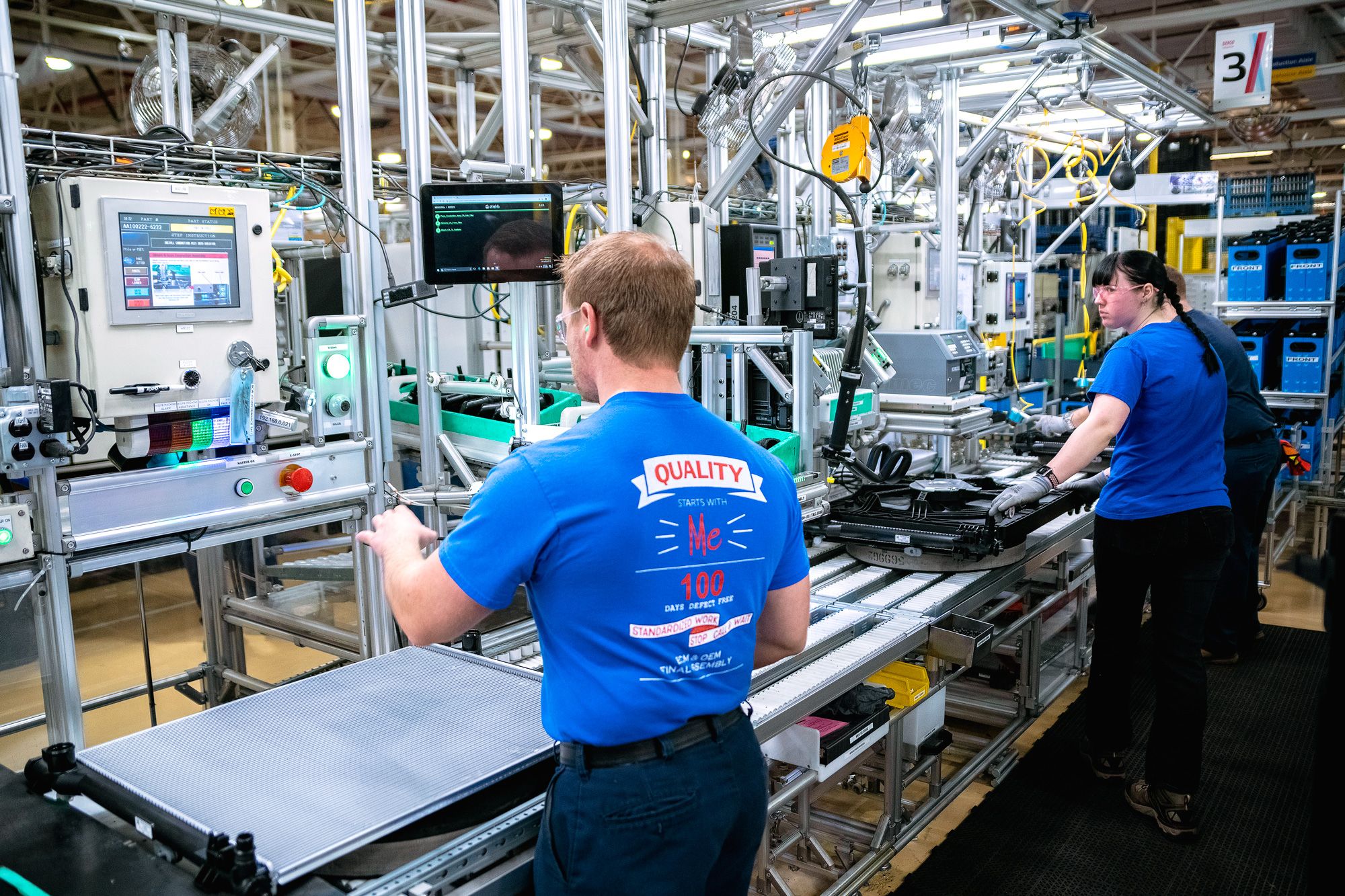
The old remedy is a time and motion study. Someone stands by a station, watches a sample of cycles, and records what they can. This remains useful work. It is also episodic. A delayed part, an awkward handoff, or an unusually smooth shift may escape the sample. Drishti's answer was to analyze continuous video of manual stations, recognize actions, and turn them into cycle time data. Engineers could compare the times; quality teams could retrieve a clip of the exact unit; supervisors could use a recent incident for training.
Prasad Akella, Drishti's founding chief executive, had been here before in a different form. In the 1990s he led a General Motors team that developed early collaborative robots - machines designed to work around people. Drishti reversed the emphasis. Instead of giving the machine more strength, it aimed to give the human operation better sight. He founded the company in 2016, joined by computer vision researcher Krishnendu Chaudhury and entrepreneur Ashish Gupta. It spun out of SRI International and raised a $10 million Series A in 2018.

The rewind button becomes a production tool
Drishti sold a fairly specific form of visibility. Its Trace product made station video searchable by line, station, time, and product, so a quality engineer could find the relevant moment without trawling through an entire shift. Flow measured each unit's cycle time at each station. Together, they connected a number on a chart to the behavior that produced it. The distinction matters. A slow cycle is a symptom; a worker twisting across a bench is an explanation.
Video records the manual step while the unit is being built.
Search by station, product, or time when a defect appears.
Use the clip for layout changes, root cause review, or focused training.
One automotive supplier used that sequence for training. It installed Trace and Flow on one of roughly ten similar lines. When a defect appeared, the supervisor could retrieve the cycle, mark the relevant clip, and talk with the operator while the episode was still fresh. Drishti reported 26 in-process defects on the pilot line in the six months before installation and 13 in the six months after. The other lines, according to the case study, did not show the same improvement. This is a useful comparison, though the published account does not prove that the software alone caused every prevented defect.
This is the practical thing another plant can copy without buying any grand theory: pick one line, identify a recurring defect, preserve the exact cycle, and shorten the interval between error and coaching. A team can then compare the pilot with similar lines. If the camera only produces a prettier report, it has missed the point.
A camera is also a management decision
The commercial case had several audiences. DENSO announced use of Drishti at multiple North American facilities in 2020. Its engineers wanted continuous data on manual tasks; line associates could see their own cycle results. Drishti also named Flex, Ford, and Nissan among manufacturers deploying its technology. HELLA became both a customer and, through HELLA Ventures, an investor. Its teams tested the system in Mexico and India, and HELLA and Drishti received a 2021 Manufacturing Leadership Award for their work.
The economics are easier to describe than to price. Drishti sold enterprise deployments and software licenses, but public materials do not give a standard fee per camera, line, or site. HELLA's under-six-month payback is the clearest public cost signal. It says the improvement outweighed that deployment's expense, without telling us the purchase price. The company itself raised $25 million in a 2020 Series B led by Sozo Ventures, bringing its two announced priced rounds to $35 million.
“People are Industry 4.0's biggest blind spot.”Prasad Akella, Drishti founder
A blind spot does not disappear merely because a camera points at it. When WIRED reported from a DENSO plant, workers were initially wary of being recorded throughout the day. Some later valued having video to review with managers when something went wrong. That change says as much about management as about machine learning. A clip can support a worker's account, expose a bad station layout, or become a tool for blame. The software cannot decide which culture receives it.
Nor will every line reward the same approach. A station needs a usable view of the work; a team needs enough repeated activity to make cycle comparisons meaningful; and somebody must be willing to change a process after seeing the evidence. A plant that collects footage but cannot redesign a fixture, revise training, or let workers challenge the diagnosis will acquire a video archive instead of an improvement system.
The small discovery that made the large claim credible
Drishti occupied an interesting position in the industrial software market. Manufacturing execution systems track orders and production states. Conventional machine vision often inspects parts. Drishti concentrated on the human actions between those records: the reach, the wait, the repeated step, the moment a defect entered the line. It was an attempt to make manual work measurable without pretending that the worker was a machine.
Business databases record that Apple acquired Drishti in September 2023; The Information later reported the purchase in a story about factory automation. The deal terms were not disclosed. That ending is less instructive than the bench at HELLA. A company spent years and substantial venture money developing action recognition, and one of its clearest published wins came from noticing that a person had to twist too far. The software was sophisticated. The useful question was almost embarrassingly human: why is that worker reaching over there?